







Definition and Meaning
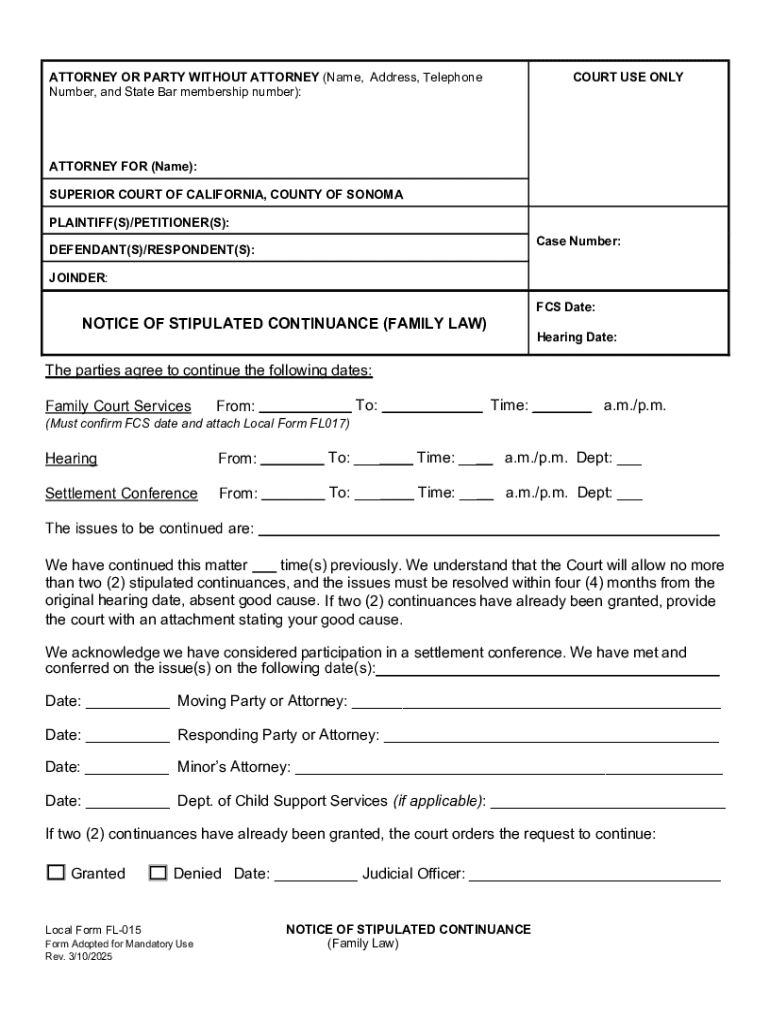
The "Notice of Stipulated Continuance" is a formal legal document used primarily in family law cases within the Superior Court of California, County of Sonoma. It serves as a written agreement between involved parties to postpone specific legal proceedings, such as court hearings or Family Court Services appointments. This notice allows for a delay in proceedings, providing parties additional time to prepare, negotiate, or resolve disputes before resuming formal court actions. The continuity of proceedings, however, is limited to ensure issues are resolved within four months of the initial filing. The document serves a critical function in maintaining procedural fairness and efficiency by allowing both parties and the court to adapt to unforeseen circumstances without compromising the legal process.
Key Elements
- Agreement to Postpone: Both parties acknowledge the necessity to delay proceedings.
- Specific Court Dates: Details of which sessions or hearings are affected by the postponement.
- Limitation on Duration: Guidelines ensuring that the continuance does not exceed a specified period, typically mandated to be within four months.
- Confirmation of Participation: Sections for both parties to confirm their agreement to the postponement and acknowledge the terms.
- Judicial Approval: Space for an official endorsement by the presiding judge, which validates the agreement and makes it enforceable.
How to Use the Notice of Stipulated Continuance
Utilizing a Notice of Stipulated Continuance involves a series of steps to ensure compliance with legal protocols:
- Drafting the Document: Begin by accurately completing all sections of the notice, ensuring the names, case numbers, and affected dates are correctly reflected.
- Consultation: Engage with legal counsel to understand implications and ensure mutual understanding and consent of all relevant parties.
- Filing the Notice: Submit the completed notice to the court, ensuring it is filed before the originally scheduled dates for affected hearings or appointments.
- Judicial Review: Await confirmation and approval from a judge, which legitimizes the stipulated agreement.
- Notification: After judicial approval, both parties should be informed and provided with copies of the final document.
Steps to Complete the Notice of Stipulated Continuance
Completion of the Notice of Stipulated Continuance requires attention to detail:
- Information Entry: Fill out the form, entering specific case identifiers, such as case number, names of involved parties, and dates of originally scheduled court appearances.
- Consent Acknowledgement: Include statements reflecting both parties' agreement to the terms of postponement.
- Signature Collection: Acquire signatures from both parties, legal representatives, and any pertinent witnesses.
- Judge's Authorization: Submit the document for judicial review to obtain the necessary judicial signature.
- Record Keeping: Retain multiple copies for personal records, legal counsel, and future court appointments.
Legal Use of the Notice of Stipulated Continuance
The legal authority of the Notice of Stipulated Continuance is significant in:
- Extending Deadlines: Legally defers the timeline for resolving family disputes, offering additional preparation time.
- Court Efficiency: Helps manage court schedules by avoiding unnecessary hearings if negotiations are in progress.
- Ensuring Fairness: Provides both parties equal opportunity to regroup and address legal challenges or document preparation.
- Compliance: Ensures adherence to procedural rules, minimizing potential legal challenges stemming from missed court dates.
Who Typically Uses the Notice of Stipulated Continuance
The primary users of this document include:
- Legal Practitioners: Attorneys representing clients in family law matters who require additional time for case preparation.
- Parties in Litigation: Individuals or parties engaged in legal proceedings needing more time for negotiation or evidence gathering.
- Judicial Officers: Judges and court officials responsible for overseeing case adjudications and ensuring legal processes are upheld.


Important Terms Related to Notice of Stipulated Continuance
Understanding the legal terminology associated with this document is crucial:
- Continuance: A postponement or adjournment of a court proceeding to a later date.
- Stipulation: A mutual agreement between parties in a legal case regarding certain facts or proceedings.
- Judicial Approval: Endorsement by a court judge, validating and enforcing the stipulated arrangements.
- Family Law: A legal domain dealing with issues such as divorce, child custody, and other familial matters.
State-Specific Rules for the Notice of Stipulated Continuance
The form's use is governed by distinct rules depending on the location:
- California Guidelines: In California, the Notice of Stipulated Continuance is filed with specific courts, such as the Superior Court of California, and must adhere to local timelines and formatting requirements.
- Sonoma County Specifics: Includes particulars set by the County of Sonoma, emphasizing timelines, filing procedures, and necessary authorizations.
- Uniformity Across Jurisdictions: While standardized in purpose, the form's application may vary, requiring users to consult local rules.
Examples of Using the Notice of Stipulated Continuance
- Case Scenario 1: In a child custody dispute, both parents agree to postpone a mediation session to facilitate further negotiations and possibly reach an amicable agreement before court involvement.
- Case Scenario 2: Parties involved in divorce proceedings require additional time to settle financial disclosures, mutually deciding to delay hearings until all necessary documentation is gathered.
- Edge Case: Suppose one party attempts to repeatedly file continuance notices to unfairly delay proceedings. In that case, judicial discretion may override such requests to ensure timely justice delivery.




