
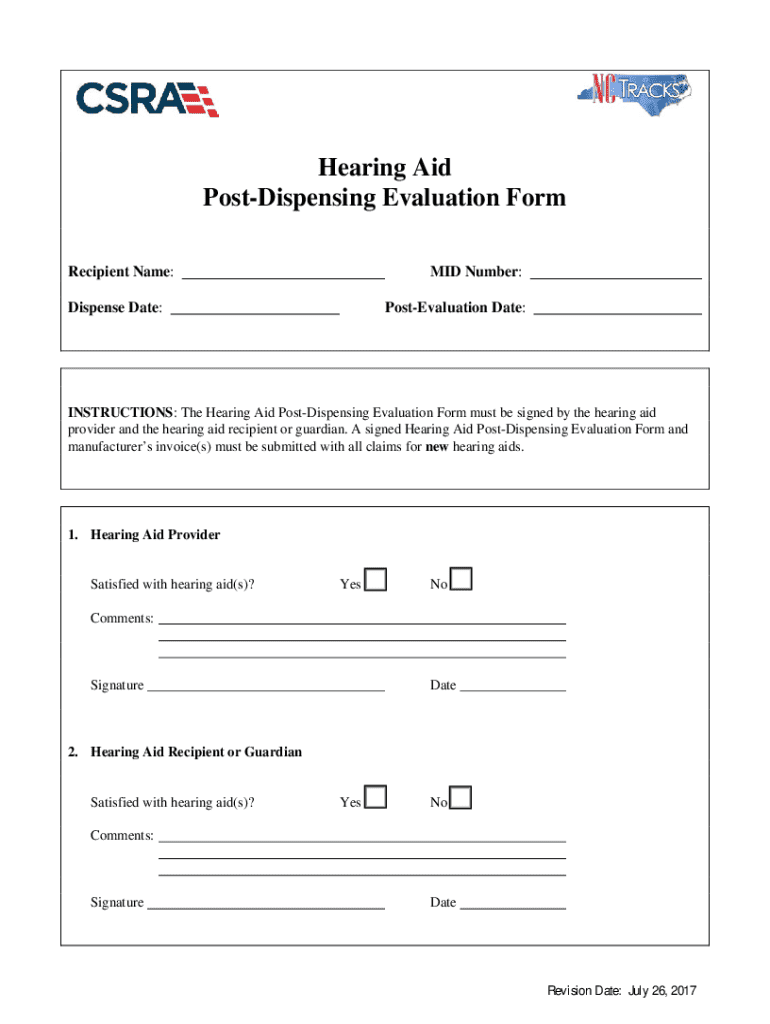







Definition and Purpose of the Hearing Aid Post-dispensing Evaluation Form
The Hearing Aid Post-dispensing Evaluation Form is an essential document used to assess the satisfaction levels of recipients after the distribution of hearing aids. Its primary purpose is to collect feedback from the hearing aid user or their guardian regarding the device's performance and their overall satisfaction. This form helps providers ensure that the hearing aids meet the user's needs and function as intended. By capturing this feedback, providers can make necessary adjustments to enhance user satisfaction and address any issues that may have arisen post-dispensation.
Who Typically Uses the Hearing Aid Post-dispensing Evaluation Form
The primary users of the Hearing Aid Post-dispensing Evaluation Form include audiologists, hearing aid providers, and the recipients of the hearing aids or their guardians. Audiologists and providers utilize this form to gather direct feedback on the device, ensuring that it meets the intended purpose and provides the necessary support to the user. Recipients, on the other hand, use this form as a platform to share their experiences and report any concerns, allowing the provider to tailor the device settings accordingly. This collaborative approach ensures optimal satisfaction and usability for the recipient.


Key Elements of the Hearing Aid Post-dispensing Evaluation Form
Sections of the Form
The form is divided into several key sections, each targeting specific feedback areas essential for a thorough evaluation. These typically include:
- Recipient Information: Details such as name, contact information, and relevant health or hearing history.
- Device Information: Specifications of the hearing aid model and serial number.
- Satisfaction and Performance Ratings: Questions or scales assessing the device’s sound quality, comfort, and functionality in daily use.
- Comments and Feedback: Open-ended sections for recipients to provide detailed feedback or suggestions for improvement.
- Signature Block: Areas for the recipient and provider to sign, confirming the accuracy of the feedback and validating the evaluation process.
Important Terms Related to the Form
There are several critical terms associated with the Hearing Aid Post-dispensing Evaluation Form. Familiarity with these terms ensures accurate completion and interpretation.
- Dispensing: The act of distributing the hearing aid devices to the recipient.
- Feedback: Responses and comments provided by the user regarding their experience with the device.
- Satisfaction Rating: A scale used to gauge the user’s overall satisfaction with the hearing aids.
- Adjustment: Modifications made to the hearing aid settings based on recipient feedback.
Steps to Complete the Hearing Aid Post-dispensing Evaluation Form
Detailed Completion Process
Completing the Hearing Aid Post-dispensing Evaluation Form requires a systematic approach to ensure all necessary information is captured accurately.
- Collect Initial Information: Begin by filling out the recipient's personal and contact details, including any relevant health information.
- Provide Device Details: Record the specific details of the hearing aid, such as make, model, and serial number.
- Rate Satisfaction and Performance: Utilize provided scales or questions to evaluate various aspects of the device, including sound quality, comfort, and usability.
- Offer Comments and Feedback: Use the comments section to elaborate on any issues or commendations regarding the hearing aid's performance.
- Sign and Validate: The final step involves signatures from both the hearing aid provider and the recipient, establishing the form as a formal evaluation record.
Practical Examples
- A user reports difficulties with the clarity of sound in noisy environments, prompting the provider to adjust frequency settings.
- A recipient notes discomfort with the fit, leading to a remolding of the ear inserts for better comfort.
Legal Use and Submission of the Hearing Aid Post-dispensing Evaluation Form
Compliance and Requirements
The Hearing Aid Post-dispensing Evaluation Form has legal implications as it serves as a record of the recipient’s satisfaction and feedback. It is critical for compliance with healthcare standards and may be required during audits or claims processing.
Methods of Submission
- Online: Many providers offer digital submission options, allowing recipients to complete the form electronically through a secure portal.
- Mail: Traditional postal services are used for physical forms, ensuring delivery to the provider’s office.
- In-Person: Some recipients may prefer or are required to submit the form directly during a follow-up visit with their provider.
State-specific Rules and Variations
Regulations and Differences
State-specific regulations may govern the use and requirements of the Hearing Aid Post-dispensing Evaluation Form. These variations can include different standards for feedback collection, storage, or the legal processes related to claims and satisfaction records.
- Example: In some states, additional fields may be required to comply with state health documentation laws or insurance claim processes.
- Consideration: Providers must be aware of and adhere to these regional differences to maintain compliance and ensure smooth operations.
Practical Scenarios and Examples of Using the Form
Real-world Cases
- Case Study 1: A user who frequently attends concerts finds that their hearing aids do not effectively filter high-decibel sounds. The feedback provided leads to a redesign of the sound processing features for better performance.
- Case Study 2: A child’s guardian reports that the hearing aid frequently falls out during school activities. The evaluation form feedback prompts the provider to assess and fit a more secure retention mechanism.
By integrating these comprehensive elements, this content provides a deep dive into the practical application, structure, and significance of the Hearing Aid Post-dispensing Evaluation Form, offering detailed guidance for users and providers alike.




