GV-110 Temporary Gun Violence Restraining Order 2026

Get Form
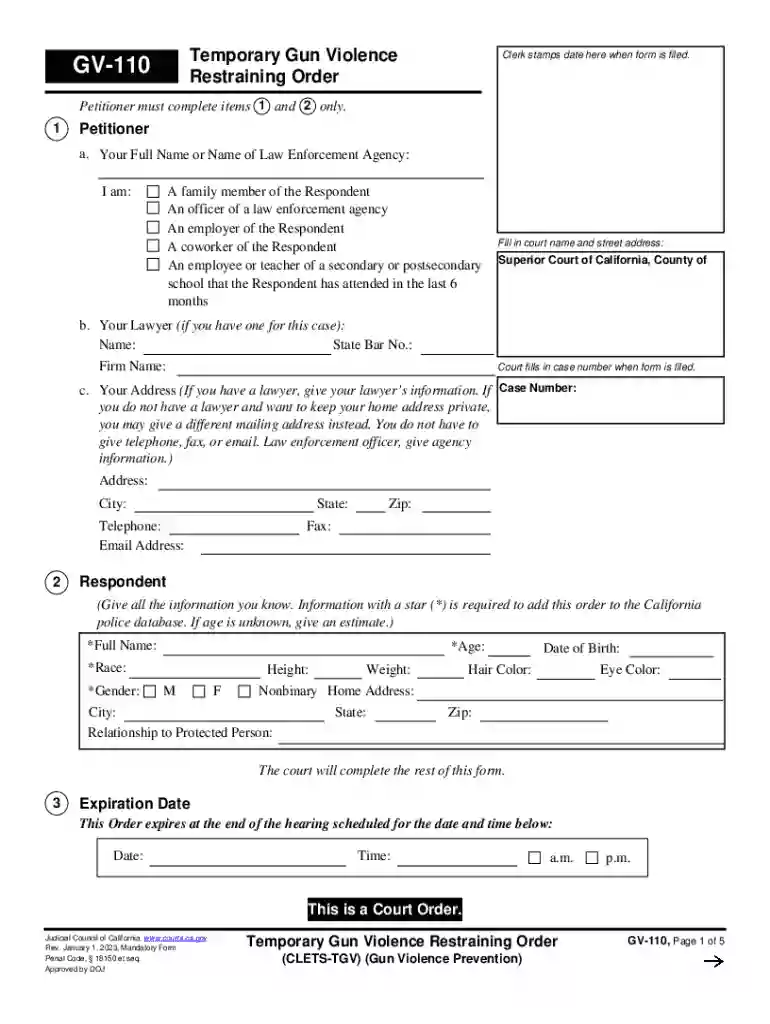
GV-110 Temporary Gun Violence Restraining Order Preview on Page 1

Here's how it works

01. Edit your form online
Type text, add images, blackout confidential details, add comments, highlights and more.

02. Sign it in a few clicks
Draw your signature, type it, upload its image, or use your mobile device as a signature pad.

03. Share your form with others
Send it via email, link, or fax. You can also download it, export it or print it out.

Definition and Meaning

The GV-110 Temporary Gun Violence Restraining Order is a legal instrument issued by the Superior Court of California. It serves as a preventive measure designed to restrict individuals deemed to pose a significant danger by possessing firearms, ammunition, or related items. The order mandates respondents to surrender such items within 24 hours, ensuring they cannot cause personal injury.

Legal Implications

  • Purpose: The temporary order aims to enhance public safety by reducing the risk of gun violence.
  • Scope: It prohibits firearm possession and may extend to related items, including ammunition.
  • Duration: The GV-110 offers protection until a court hearing can determine if a more permanent order is warranted.

How to Use the GV-110 Temporary Gun Violence Restraining Order

Employing the GV-110 involves several steps to ensure its effective application.

  1. Identify Threats: Assess if an individual poses a significant risk of harm through firearm possession.
  2. Petition the Court: File a petition with supporting evidence, such as witness statements or documented threats.
  3. Implement the Order: Upon court approval, the order must be served to the respondent, mandating compliance.

Important Considerations

  • Evidence Gathering: Collect comprehensive evidence to support the need for a restraining order.
  • Communication: Clear instructions must be communicated to the respondent regarding surrendering firearms.
  • Follow-up: Attend subsequent court hearings to discuss the necessity of extending the order.

How to Obtain the GV-110 Temporary Gun Violence Restraining Order

Starters in securing a GV-110 order involve legal procedures and proper documentation.

  1. Filing for the GV-110: Submit a formal petition to the Superior Court of California.
  2. Provide Evidence: Submit any documentation that supports the claim, such as police reports or affidavits from witnesses.
  3. Await Decision: The court will evaluate the submission and assess the risk before issuing the order.

Documentation Requirements

  • Petition Forms: Complete and submit the required forms accurately.
  • Supporting Evidence: Include records of past threats, acts of violence, or unstable behavior.
  • Law Enforcement Report: Attach any police reports that corroborate potential danger.

Steps to Complete the GV-110 Temporary Gun Violence Restraining Order

Completing the GV-110 involves careful attention to detail and adherence to legal standards.

  1. Prepare Documentation: Gather all necessary forms and evidence.
  2. Form Filling: Accurately complete each section of the GV-110 form.
  3. Submission: File the form with the court, ensuring all documentation is included.

Detailed Breakdown

  • Personal Information: Provide accurate details of both petitioner and respondent.
  • Incident Description: Offer a comprehensive account of incidents justifying the order.
  • Firearm Surrender Details: Explicitly state the conditions for surrendering firearms or related items.

Key Elements of the GV-110 Temporary Gun Violence Restraining Order

The GV-110 encompasses several critical components structured to mitigate risks effectively.

  • Petitioner Details: Information about the person requesting the order.
  • Respondent Information: Data regarding the individual being restrained.
  • Firearm Surrender Clauses: Precise instructions on relinquishing firearms.

Additional Provisions

  • Law Enforcement Involvement: Specific roles and responsibilities for officers to enforce the order.
  • Follow-Up Hearings: Scheduling additional court hearings to evaluate the necessity for a permanent order.

Legal Use of the GV-110 Temporary Gun Violence Restraining Order

Courts employ the GV-110 as a legal tool to address urgent situations involving potential gun violence.

  • Statutory Basis: The order is grounded in Californian legislation concerning restraining orders.
  • Enforcement Mechanisms: It includes provisions empowering law enforcement to ensure compliance.
  • Judicial Oversight: The order is monitored by the court to confirm the continued need for its stipulations.

Compliance Measures

  • Timely Surrender: Respondents must comply within 24 hours of receiving the order.
  • Law Enforcement Roles: Officers ensure proper implementation of the order, including confiscation where necessary.

Eligibility Criteria for the GV-110 Temporary Gun Violence Restraining Order

Determining eligibility involves specific legal requirements and situational assessments.

  • Who Can File: Generally, law enforcement officers or immediate family members.
  • Grounds for Issuance: Evidence of recent threats or violent behavior linked to firearm possession.
decoration image ratings of Dochub

Specific Requirements

  • Immediate Risk: There must be a credible, demonstrable risk of gun violence.
  • Documentary Support: Submissions must contain substantial evidence supporting the claims of risk.

Important Terms Related to GV-110 Temporary Gun Violence Restraining Order

Understanding the terminology is crucial for effective communication and compliance.

  • Petitioner: The entity requesting the order.
  • Respondent: The person being restrained.
  • Temporary Order: A short-term restriction pending further court review.

Terminology Breakdown

  • Firearm Surrender: The mandatory relinquishment of guns and ammunition.
  • Restraining Order: A legal directive to prevent specific actions or behavior.

State-Specific Rules for the GV-110 Temporary Gun Violence Restraining Order

While based in California, aspects may vary depending on jurisdictional interpretation.

  • Jurisdictional Nuances: Procedural differences may exist based on local court rules.
  • Local Enforcement Practices: Varying enforcement practices dependent on regional law enforcement policies.

State Compliance Protocols

  • Filing Procedures: Specific filing and approval processes must align with local court mandates.
  • Interstate Recognition: Consideration of how orders are recognized and enforced across state lines.

Examples of Using the GV-110 Temporary Gun Violence Restraining Order

Practical applications illustrate the form's utility in real-world scenarios.

  • Domestic Cases: Applied where family members report threats involving firearms.
  • Public Safety: Used by law enforcement in situations where an individual's behavior poses a broader community risk.

Case Study Insights

  • Impact on Crime Reduction: Studies show a decline in gun-related incidents following order issuances.
  • Precedent Cases: Review cases where the GV-110 led to significant legal outcomes or policy changes.
be ready to get more

Complete this form in 5 minutes or less

Get form

Got questions?

We have answers to the most popular questions from our customers. If you can't find an answer to your question, please contact us.
Contact us
There may also be a Temporary Firearms Restraining Order prohibiting you from having any firearms and ammunition, and requiring you to surrender, sell, or store any firearms and ammunition that you currently own or possess. You must obey the order until the hearing.
Permanent restraining orders are the most severe types of restraining orders in this state, and they have the most serious consequences.
A GVRO requires that all firearms and ammunition be relinquished by the subject of the order, and prohibits the subject of the order from purchasing any guns or ammunition while the order is in effect.
If the court decides to issue a permanent restraining order, it will also appear on your record and usually lasts for a longer timeoften up to five years or more, depending on the situation. Both types of orders can affect background checks.
A restraining order may appear on certain background investigations, especially those that provide detailed civil records. Temporary orders typically do not show up on standard background checks, but permanent orders often do.

Security and compliance

At DocHub, your data security is our priority. We follow HIPAA, SOC2, GDPR, and other standards, so you can work on your documents with confidence.
Learn more
ccpa2
pci-dss
gdpr-compliance
hipaa
soc-compliance
be ready to get more

Complete this form in 5 minutes or less

Get form

People also ask

Your potential new employer may discover your restraining order during a background check. There are certain reasons a restraining order may affect your current job. If you are required to use a firearm during your employment, you might have to change duties or seek another job.

Related links