
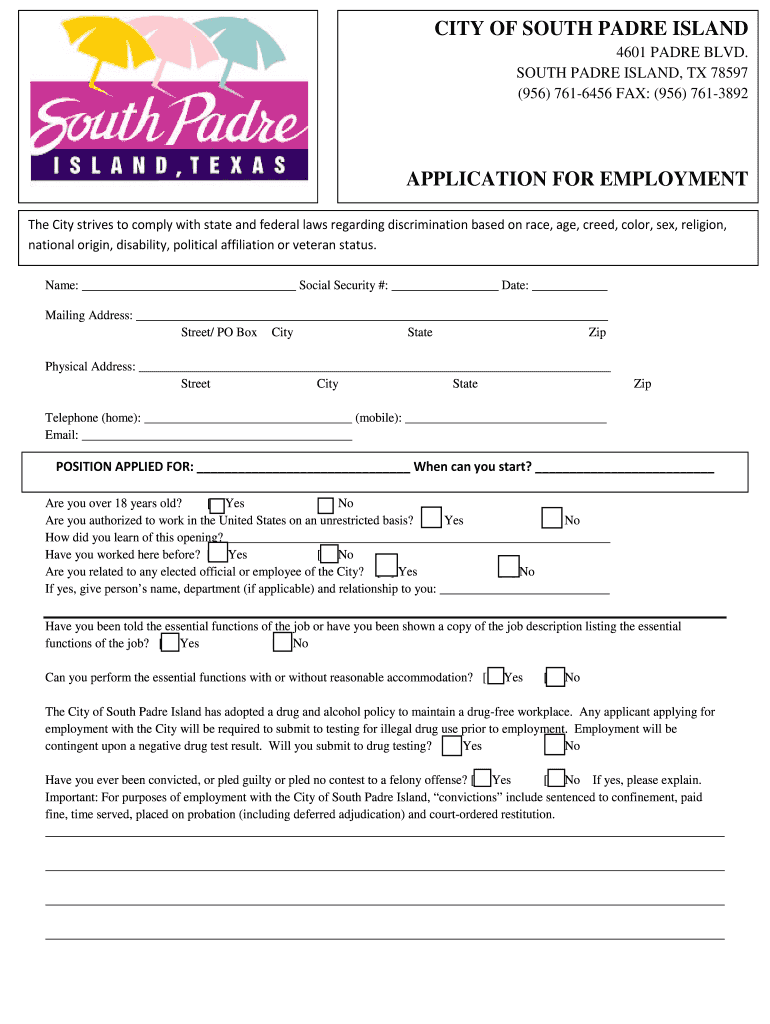







Definition and Meaning of an Employment Application
An employment application is a standardized form filled out by job applicants as part of the recruitment process. It serves as a tool for employers to collect consistent data from all candidates, facilitating fair comparison and selection. The form typically includes sections for personal information, educational background, work experience, and references. In the United States, employment applications may also incorporate compliance statements related to equal employment opportunity and drug-testing policies. Understanding its structure and purpose ensures applicants provide complete and accurate data, improving their chances of progressing to the interview stage.
How to Use an Employment Application
Filling out an employment application requires attention to detail and honesty. Candidates should review the entire form before beginning to ensure they understand the requested information. When providing personal details, such as name and contact information, accuracy is key to ensuring future communication with the employer. Work history sections should include relevant job titles, employers, dates of employment, and duties. Educational sections should reflect degrees or certifications and their institutions. For fields like references, candidates should choose professional contacts who can vouch for their skills and work ethic. Each section must be completed, as incomplete forms may be disregarded by employers.
Steps to Complete the Employment Application
- Gather Necessary Information: Before starting the application, collect your personal, educational, and employment history details.
- Fill Out Personal Information: Include your full name, address, and reliable contact information.
- Detail Educational Background: List your educational qualifications in reverse chronological order.
- Document Work Experience: Provide comprehensive details about your previous jobs, including achievements and responsibilities.
- Provide References: Choose professional references who can provide insights into your abilities and character.
- Review and Proofread: Double-check all sections for completeness and accuracy.
- Submit the Application: Depending on the format, ensure that you either save it in the required digital format or prepare it for mailing if submitting physically.
Who Typically Uses an Employment Application
Employment applications are utilized by a wide range of entities across various sectors. They are commonly used by corporate HR departments, government agencies, educational institutions, and nonprofit organizations when initiating the hiring process. Each of these entities relies on the uniformity of the application to gather initial data from a broad pool of applicants. Both full-time and part-time job seekers are required to complete these forms, making them integral to both entry-level and executive recruitment processes.
Key Elements of an Employment Application
- Personal Information: Basic details such as full name, address, contact number, and email address.
- Employment History: Previous work experiences, including job titles, dates, and responsibilities.
- Educational Background: Degrees, certifications, and the institutions where they were obtained.
- Skills and Qualifications: Any additional skills relevant to the job being applied for.
- References: Names and contact information of people who can verify the applicant's credentials and experiences.
Legal Use of Employment Applications
In the U.S., employment applications must adhere to legal standards, ensuring fair hiring practices. Employers are required to comply with the Equal Employment Opportunity Commission (EEOC) guidelines, which prohibit discrimination based on race, color, religion, sex, or national origin. Applications may include disclaimers regarding the employment-at-will doctrine and are often accompanied by privacy statements explaining how an applicant’s data will be handled.
State-Specific Rules for Employment Applications
Employment laws can vary significantly from one state to another. For example, some states have banned the inclusion of questions about salary history to prevent wage discrimination. Other states have specific regulations on background checks, dictating when and how employers can inquire about an applicant’s criminal history. Job seekers should be aware of the regulations applicable in their state to ensure compliance when filling out applications.
Software Compatibility with Employment Applications
Digital employment applications often integrate with HR software systems, facilitating seamless data collection and processing. Systems like Workday, Greenhouse, and Taleo streamline the application review process, allowing employers to efficiently sort through large volumes of candidates. Applicants should ensure their documents are compatible with such platforms, typically requiring formats like PDF or DOCX. Understanding the digital ecosystem of employment applications can aid both employers and applicants in navigating the recruitment process more effectively.
Examples of Using Employment Applications
Consider an applicant applying for a position at a municipal government office. The process starts with filling out the employment application, which requires details about past positions in public service. Another example is a college graduate applying for an educational role who must highlight relevant coursework and projects. Each specific scenario requires tailoring responses on the application to best align with the job description, demonstrating the applicant’s relevant experience and skills effectively.




