
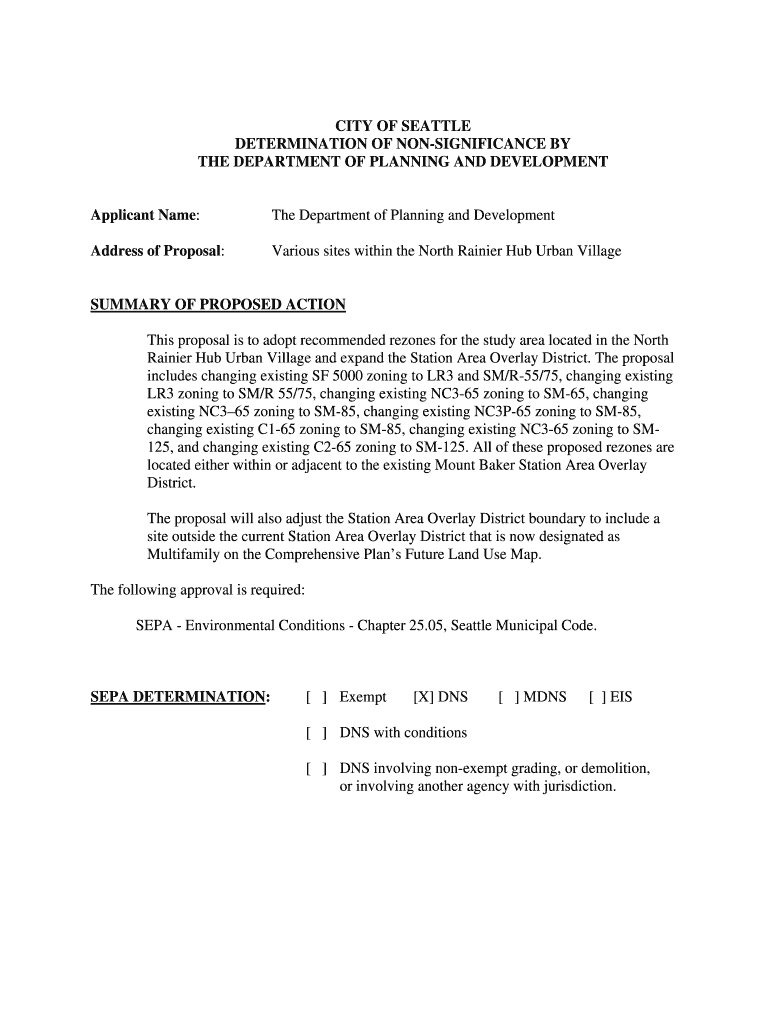







Definition and Meaning
The "Determination of Non-Significance" (DNS) is a term used in environmental regulations, primarily under the State Environmental Policy Act (SEPA) in the United States. It refers to a decision made by a lead agency that a proposed action, such as a construction project or zoning change, is not expected to have significant adverse environmental impacts. This decision indicates that the project can proceed without a more extensive environmental impact statement (EIS).
- SEPA Requirements: In compliance with SEPA, a DNS is issued when the environmental review process finds no adverse effects, allowing projects to move forward with minimal environmental scrutiny.
- Purpose: It streamlines project approvals by identifying projects that do not pose a threat to environmental health and can be executed without detailed environmental review.
- Significance Threshold: The assessment focuses on whether the proposals would significantly affect the environment, including water quality, wildlife habitats, and pollution levels.
How to Use the Determination of Non-Significance
Understanding how to apply a DNS effectively can facilitate smoother project execution regarding environmental compliance.
- Project Evaluation: Before applying for a DNS, evaluate the project's potential environmental impacts. Consider factors like location, scale, and nature of the project against SEPA criteria.
- Submit to the Lead Agency: The responsibility for issuing a DNS usually lies with a designated government body or lead agency. Submit all necessary documentation and support that demonstrates compliance with environmental standards.
- Public Notice and Comments: After submission, there is often a period for public notice where stakeholders can review the DNS. Respond promptly to any requests for further information or clarification from the agency or public.
- Review Outcomes: If a DNS is issued, the project can proceed as planned without additional environmental assessments. If rejected, consider preparing an Environmental Impact Statement (EIS) for further evaluation.
Steps to Complete the Determination of Non-Significance
Completing a DNS involves several careful steps to ensure compliance and approval.
- Initial Assessment: Conduct an initial environmental review using SEPA checklists to determine potential impacts.
- Gather Documentation: Collect all relevant documents such as site plans, detailed project descriptions, and any preliminary studies.
- Submit Application: Fill out required forms accurately and submit the application to the appropriate lead agency.
- Await Response: Allow time for the agency's assessment. They will issue a decision based on environmental thresholds.
- Address Queries: Be prepared to provide additional information if requested by the reviewing agency during the decision-making process.
Legal Use of the Determination of Non-Significance
A DNS serves specific legal functions within environmental regulation frameworks.
- Regulatory Compliance: Ensure projects comply with SEPA requirements, providing a legal framework that projects must adhere to.
- Permitting Process: A DNS can expedite the permitting process by affirming that no further environmental evaluation is necessary.
- Public Trust: By fulfilling legal obligations, a DNS fosters trust with the public and stakeholders that environmental concerns are being responsibly addressed.
Key Elements of the Determination of Non-Significance
Understanding the core components of a DNS aids in the preparation and application process.
- Project Description: Clear description of the project, its purpose, and scope.
- Environmental Checklist: Comprehensive checklist assessing all potential environmental impacts.
- Analysis of Impacts: Detailed analysis showing why impacts are considered insignificant.
- Lead Agency Details: Identification of the government agency responsible for issuing the DNS.
State-Specific Rules for the Determination of Non-Significance
State regulations can vary, affecting how DNS processes are conducted.
- Washington: In Washington, SEPA plays a significant role, requiring thorough initial evaluations before a DNS can be issued.
- California: While California has its own environmental policies (CEQA), projects still need to follow specific state guidelines when seeking a DNS.
- New York: Projects in New York should adhere to SEQRA, with a focus on state-specific natural resource management guidelines.
Examples of Using the Determination of Non-Significance
Practical applications of a DNS can be seen in several scenarios.
- Urban Development: In cities like Seattle, zoning changes requiring a DNS ensure that development does not adversely affect urban ecosystems.
- Infrastructure Projects: Road expansions or public utility projects may require a DNS to validate minimal environmental disturbance.
- Educational Institutions: Universities expanding their campuses often use DNS to comply with environmental standards while pursuing growth.
State-by-State Differences
Each state can have distinct requirements for issuing a DNS, reflecting different environmental priorities.
- Regulatory Bodies: Some states may have unique lead agencies responsible for issuing DNS decisions.
- Environmental Priorities: States may emphasize different aspects of environmental protection, such as water conservation or air quality, influencing DNS criteria.
- Community Involvement: Public involvement and the importance placed on community feedback can vary state by state, affecting how DNS decisions are approached and finalized.




