




01. Edit your form online
Type text, add images, blackout confidential details, add comments, highlights and more.

Type text, add images, blackout confidential details, add comments, highlights and more.

Draw your signature, type it, upload its image, or use your mobile device as a signature pad.

Send it via email, link, or fax. You can also download it, export it or print it out.
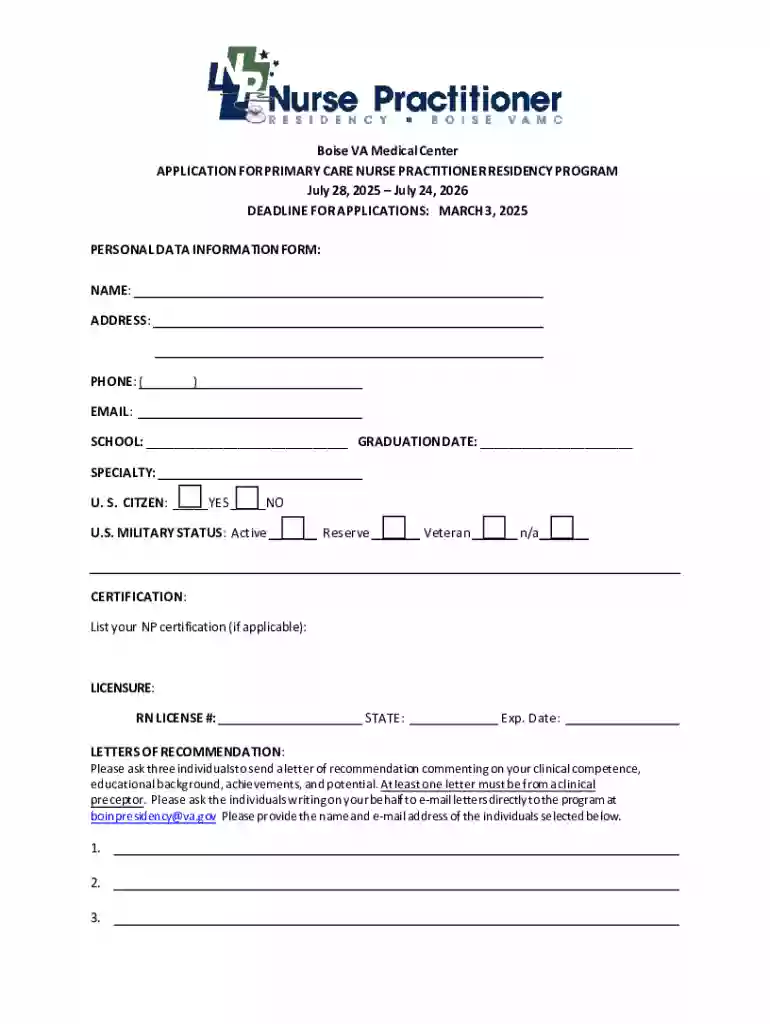
The application for the Primary Care Nurse Practitioner Residency Program is a comprehensive document designed to assess the qualifications and suitability of applicants aspiring to join a residency program that enhances their clinical and scholarly skills. It serves as a critical tool for evaluating a candidate's educational background, professional licenses, and prior experience in healthcare settings. This application is essential for both the applicant and the program administrators to ensure that selected candidates meet the required criteria and can successfully contribute to and benefit from the residency experience.
Eligibility for the Nurse Practitioner Residency Program requires candidates to have an active Registered Nurse (RN) license and recent graduation from an accredited Nurse Practitioner (NP) program within the past year. Applicants must be legally authorized to work in the United States, as this program is US-centric and focuses on training candidates for the American healthcare system. Additional qualifications might include specific certifications or residency experiences relevant to the program's focus areas.


Completing the application entails several key steps, beginning with gathering the necessary documents and evidence of qualifications. Applicants must complete all sections of the application, including personal, educational, and professional history. Each field should be filled with precise and accurate information to reflect the applicant's qualifications comprehensively.
Several critical terms are associated with the application process for the residency program. Understanding these terms ensures clarity and avoids potential confusion during the application process.
Applicants have multiple options for submitting the completed application, allowing them flexibility and convenience based on their circumstances.
The application form is composed of various elements that comprehensively assess the applicant's qualifications and readiness for the residency program.
Once submitted, applications undergo a review process to assess their completeness and the applicant's qualifications for the residency program.
Completing the residency program offers numerous benefits, including enhanced career opportunities, specialized training, and practical experience in primary care settings.
At DocHub, your data security is our priority. We follow HIPAA, SOC2, GDPR, and other standards, so you can work on your documents with confidence.


Application Requirements: Current resume/curriculum vitae; Personal statement (250 words or less) describing your aspirations for the residency program, your
Aug 26, 2025 Primary Care Nurse Practitioner Residency Program Program structure Program structure Application requirements Application requirements.
As the accrediting body for more than 7,900 residency programs, the Accreditation Council for Graduate Medical Education is the entity charged with setting and


