




01. Edit your form online
Type text, add images, blackout confidential details, add comments, highlights and more.

Type text, add images, blackout confidential details, add comments, highlights and more.

Draw your signature, type it, upload its image, or use your mobile device as a signature pad.

Send it via email, link, or fax. You can also download it, export it or print it out.
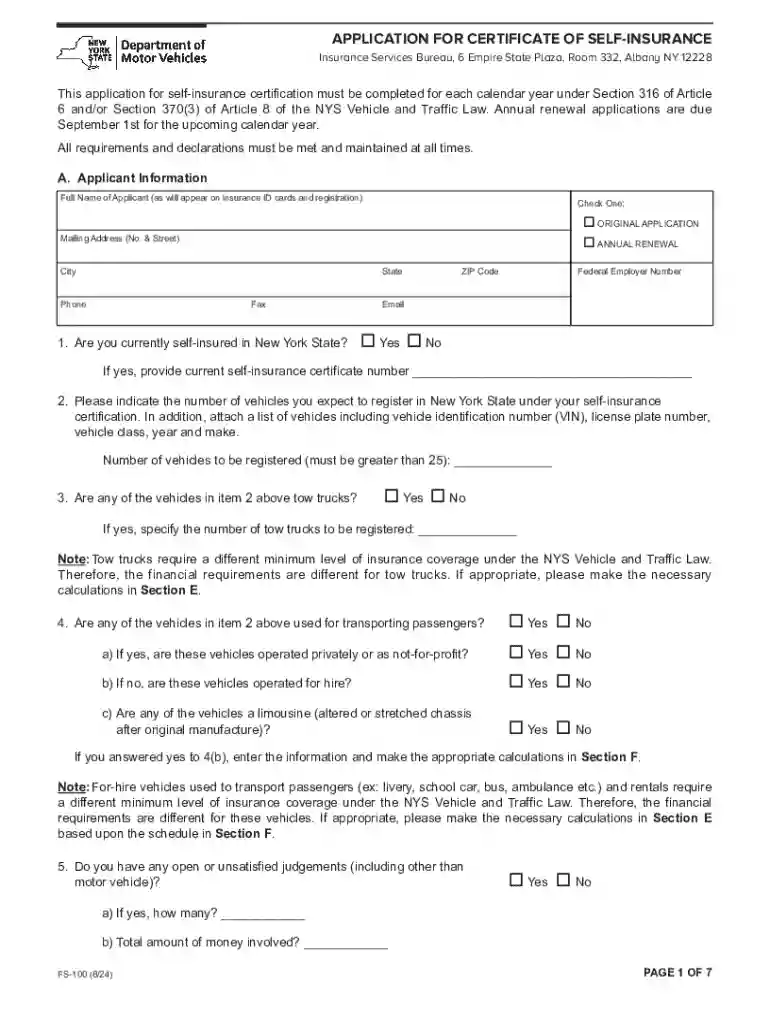
The FS-100 Application for Certificate of Self-Insurance is an essential document required in the context of the New York State Vehicle and Traffic Law. This form is utilized by individuals or entities seeking to self-insure their vehicles, which involves assuming the risk of vehicle insurance themselves rather than purchasing a policy from an insurance provider. The application outlines critical information to qualify for self-insurance, such as the applicant's details, vehicle registrations, and financial criteria. This process allows entities to leverage their financial strength to cover potential liabilities directly, serving as an alternative to traditional insurance policies.
Understanding the application process is crucial for effectively using the FS-100 form. Primarily, users must gather all relevant documentation, including financial statements prepared by a certified public accountant, which affirm the entity's ability to cover insurance liabilities. Completing the form involves accurately filling out details about the applicant, including all registered vehicles under consideration. It is vital that all information is correct and complete to avoid delays or denials. The final step involves submitting the application to the appropriate state department, ensuring that any additional requested documents are included.
The FS-100 application consists of several critical elements necessary for its processing:
Not every entity can apply for self-insurance using the FS-100 form. Eligibility hinges on specific requirements:


Submitting the FS-100 requires various documents to verify the applicant's eligibility:
The application process begins post-submission, where the state evaluates the supplied information and documents. Approval times can vary but generally range from several weeks to a few months, depending on the complexity of the application and the volume of submissions the department handles. Applicants should plan accordingly, especially if coverage needs are immediate.
Failure to adhere to the requirements and deadlines associated with the FS-100 form can result in severe penalties. These can include fines, legal action, or revocation of the self-insurance certificate. Non-compliance is particularly risky as it can leave a fleet uninsured, placing the entity's financial liability at risk. Entities are encouraged to maintain rigorous internal controls to ensure ongoing compliance.
The application process for the certificate of self-insurance involves understanding and adhering to New York State's specific rules and regulations. These may include distinct financial thresholds, detailed reporting obligations, and the need for periodic renewals or audits. This particularity ensures applicants meet state-defined standards before receiving approval, ensuring public safety and regulatory adherence.
At DocHub, your data security is our priority. We follow HIPAA, SOC2, GDPR, and other standards, so you can work on your documents with confidence.
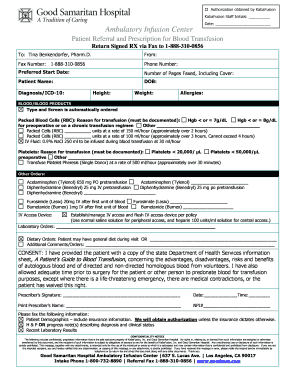



This application for self-insurance certification must be completed for each calendar year under Section 316 of Article. 6 and/or Section 370(3) of Article 8 of
(2) A certificate of self-insurance will be issued upon written request stating the name and address of the applicant along with a description of the
- Enter the valid policy number, self-insurance certificate number or the word binder in the space provided. - Enter UK in the space provided if unknown.


