




01. Edit your form online
Type text, add images, blackout confidential details, add comments, highlights and more.

Type text, add images, blackout confidential details, add comments, highlights and more.

Draw your signature, type it, upload its image, or use your mobile device as a signature pad.

Send it via email, link, or fax. You can also download it, export it or print it out.
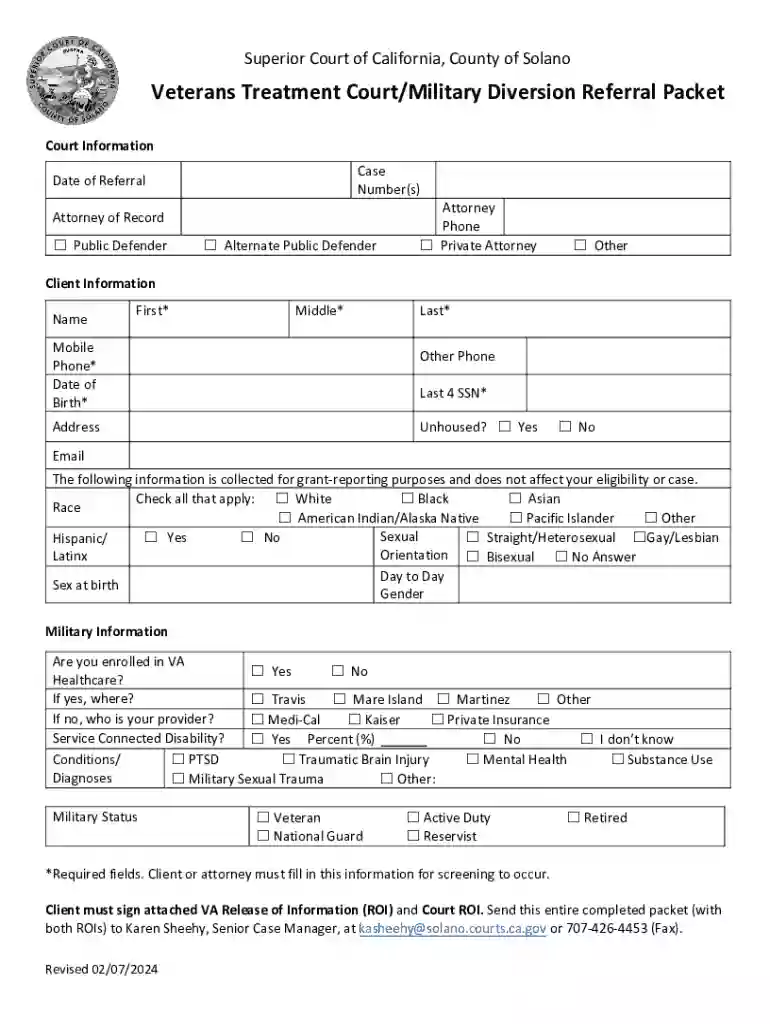
The Veterans Treatment Court Military Diversion Referral Packet is a comprehensive document used to facilitate the enrollment of military veterans into specialized court programs. These programs, such as Veterans Treatment Court and Military Diversion, are designed to provide veterans with alternatives to traditional criminal justice processes, focusing on rehabilitation and treatment. The referral packet includes essential information that assesses the veteran’s eligibility, ensuring they receive appropriate support. This document is specific to Solano County, California, where it serves as a crucial tool for collecting necessary data on a veteran's military background, legal issues, and health information.
To successfully utilize the Veterans Treatment Court Military Diversion Referral Packet, start by obtaining the form through the appropriate channels, which may include court websites or by direct request from legal representatives. Once the packet is in hand, carefully review each section of the form. Follow these steps:
Personal Information: Enter the veteran's personal details, ensuring accuracy as this will be used for identification purposes.
Military Background: Fill out all relevant fields regarding the veteran's military service, including branch, rank, and service dates.
Legal Information: Provide details on the current legal case, including court dates and charges.
Health and Background Check: Consent to necessary background checks and the release of health information, as these are critical for eligibility assessment.
After completion, submit the packet through the channels designated by the court or legal advisor, either online or through mail services.
Completing this referral packet involves several detailed steps to ensure all information is accurately captured:
Read Each Section Carefully: Begin by thoroughly reading through all sections in the packet to understand the required information.
Gather Necessary Documents: Collect any supporting documents beforehand, such as military discharge papers (DD-214), legal documents, and medical records.
Fill Out Personal and Military Information: Enter all required fields, ensuring accurate and complete data entry.
Consent for Information Release: Sign the consent sections which allow the court to access your health and military records for assessment purposes.
Review and Double-Check: Carefully review the entire packet for completeness and accuracy to avoid delays in processing.
Submission: Follow submission guidelines outlined by the court, ensuring the packet is submitted by any set deadlines.
The primary users of the Veterans Treatment Court Military Diversion Referral Packet are military veterans who find themselves involved with the criminal justice system. The packet is used by:
Social workers and mental health professionals involved in veteran rehabilitation programs may also engage with the form to facilitate the process.


The Veterans Treatment Court Military Diversion Referral Packet consists of several critical components that aid in evaluating a veteran's eligibility for diversion programs:
Court and Client Information: This includes personal identifiers and specific details about the court case.
Military Service Details: Information that verifies service, including branch, rank, service dates, and discharge status.
Health Information Authorization: Sections for consenting to the release of medical records needed for treatment and eligibility purposes.
Release of Information: Legal consent allowing the court to access other pertinent records required for assessing the case.
Eligibility criteria for the Veterans Treatment Court and Military Diversion programs are usually determined by the following factors:
Service Background: Verification of military service, typically requiring an honorable discharge.
Legal Criteria: The nature and severity of charges, focusing on non-violent offenses.
Health and Mental Conditions: Any mental health or substance use disorders that the treatment programs specifically address.
Eligibility is assessed on a case-by-case basis, and not all veterans may qualify for these diversion programs.

One notable example of using the referral packet is a veteran charged with a non-violent offense receiving an alternative sentencing that includes participation in a structured counseling program. In another case, a veteran suffering from PTSD and involved in a misdemeanor may be redirected away from jail time to a treatment path that addresses their specific needs. These examples highlight the importance of the referral packet in facilitating positive outcomes for veterans within the justice system.
The legal use of this referral packet is strictly regulated to protect the privacy and rights of veterans. The packet:
Ensures Consent: Sections for signing ensure that veterans have agreed to the release of sensitive information.
Supports Legal Processes: Used by courts to streamline the process of evaluating and assigning veterans to treatment programs.
Adheres to Confidentiality: All data collected and shared is handled with utmost confidentiality, ensuring compliance with legal standards.
All legal practitioners and court officials involved must follow these guidelines to protect veterans' rights throughout the diversion process.
At DocHub, your data security is our priority. We follow HIPAA, SOC2, GDPR, and other standards, so you can work on your documents with confidence.



Focusing almost exclu- sively on criminal defendants who served in the United States military, these courts are relatively new in the therapeutic courts arena.
Feb 7, 2024 Client or attorney must fill in this information for screening to occur. Client must sign attached VA Release of Information (ROI) and Court ROI
Oct 5, 2018 Updated veterans preference. Sec. 136. Use of State highway specifications. Sec. 137. Former military airports. Sec. 138. Eligibility of


