







Definition and Meaning
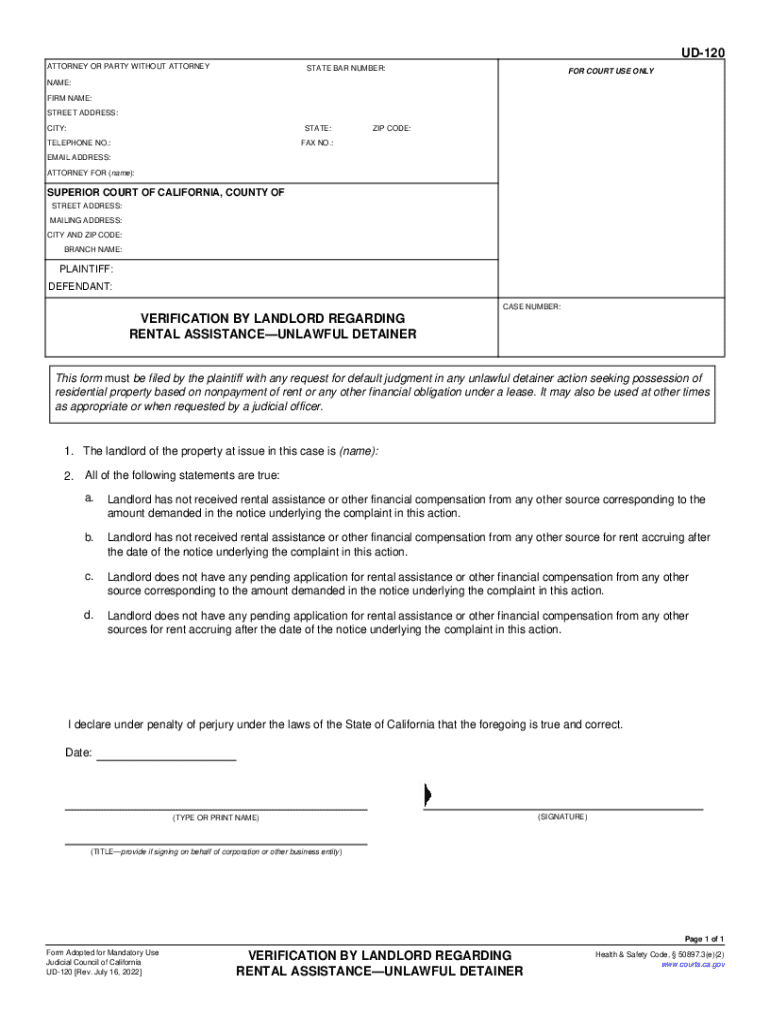
The UD-120 Verification by Landlord Regarding Rental Assistance Unlawful Detainer Judicial Council form is a legal document used in the State of California. It allows landlords to verify and affirm the absence of rental assistance or any financial compensation while dealing with unlawful detainer actions due to nonpayment of rent. This document plays a critical role in ensuring that landlords have not received, nor are they expecting any rental assistance equivalent to the amount claimed in a summons against the tenant. By filing this form, landlords make a sworn statement regarding these financial details in the context of a legal proceeding.
Key Elements of the UD-120 Verification
The UD-120 form contains several important elements that landlords need to complete accurately:
-
Landlord's Information: This includes the landlord's full name, address, and contact details.
-
Tenant's Details: Comprehensive information about the tenant, including their name and address of the rented property.
-
Verification of Financials: A declaration that no rental assistance was received, corresponding to the unpaid rent amount claimed.
-
Absence of Pending Applications: Confirmation that there are no pending applications for rental assistance related to the unpaid rent subject of the unlawful detainer.
Understanding these elements ensures the form is completed accurately and in compliance with legal standards.
Legal Use of the UD-120 Form
The UD-120 form is utilized in legal proceedings within California's court system, particularly concerning unlawful detainer actions. Landlords must file this form when seeking a default judgment in eviction cases for nonpayment of rent. The form establishes that landlords have disclosed all pertinent financial information and affirmed that no rental assistance is being received or expected, which could affect the judgment for unpaid rent. The accurate submission of this form upholds the integrity of the legal process by ensuring transparency in financial declarations.
Steps to Complete the UD-120 Form
Completing the UD-120 form requires a thorough understanding of its sections and a precise approach:
-
Gather Required Information: Collect all necessary personal and tenant details as well as any correspondence regarding rental assistance applications.
-
Fill Out Landlord Details: Accurately enter your name, address, and contact info.
-
Enter Tenant and Property Information: Provide the tenant's full name and the address of the rented property.
-
Declare Financial Status: Clearly state that no rental assistance has been received or applied for relevant to the rent in dispute.
-
Sign and Certify: The completed document must be signed and certified, indicating the truthfulness of the information provided.
Double-checking the form for completeness and accuracy before submission helps prevent delays in legal proceedings.
Why Use the UD-120 Form
Using the UD-120 form is essential for landlords pursuing a default judgment in unlawful detainer cases where the tenant has failed to pay rent. This form serves as a verification tool to assure the court of the landlord's financial declarations, particularly their non-receipt of any rental assistance that correlates with the claimed unpaid rent. Fulfilling this requirement supports a transparent and just legal process, enabling the court to make informed decisions regarding eviction proceedings.
State-Specific Rules
The UD-120 form is specifically used in California and follows state-specific legal guidelines governing eviction and unlawful detainer actions. Knowing these rules ensures that landlords comply with the requirements for filing the form and seeking judgment. Unlike other states, California mandates this form to verify the absence of rental assistance and to proceed with legal action against non-paying tenants appropriately.
Examples of UD-120 Form Usage
To better illustrate how the UD-120 form is used, consider the following scenarios:
-
Case Study 1: A landlord in Los Angeles is pursuing an eviction for a tenant who has not paid rent for several months. The landlord submits the UD-120 form to declare that they have applied for, nor received, financial assistance for the rent in question.
-
Case Study 2: A landlord in San Francisco uses the UD-120 form while seeking a default judgment when the tenant fails to appear in court, ensuring all financial aspects regarding rental aid are covered by the form submission.
These examples highlight the form's role in ensuring legal compliance and facilitating court proceedings related to eviction due to unpaid rent.
Required Documents
When submitting the UD-120 form, landlords may need to provide additional documentation to support their claims:
-
Lease Agreement: To verify the terms of the rental agreement and any financial aspects involved.
-
Payment Records: Demonstrating a history of rent payments or absence thereof.
-
Correspondence: Any communications with government agencies or organizations regarding rental assistance applications.
Providing comprehensive and accurate documentation strengthens the landlord's position in pursuing a legal judgment.
Form Submission Methods
The UD-120 form can be submitted using various methods, each suited to different preferences and situations:
-
Online Submission: Utilizing California's online court filing systems where available, providing convenience and efficiency.
-
Mail Submission: Certified mail services can ensure delivery confirmation and provide a paper trail.
-
In-Person Submission: Direct handover at the local court office to ensure prompt processing and address any immediate questions or issues.
Each method offers unique benefits, whether it's the efficiency of online filing or the security of in-person delivery.
Penalties for Non-Compliance
Failure to correctly complete or submit the UD-120 form can result in significant negative consequences:
-
Delay in Legal Proceedings: Improper or delayed submissions can postpone court actions, prolonging the eviction process.
-
Dismissal of Unlawful Detainer Case: Incomplete verification might lead to the dismissal of the landlord's case, necessitating re-filing and additional costs.
-
Legal Repercussions: Misrepresentation or inaccuracies on the form can lead to legal actions against the landlord, further complicating the situation.
Ensuring compliance with form requirements is crucial for avoiding these potential penalties.




