Mediation and ArbitrationSuperior Court of CACounty 2026

Get Form
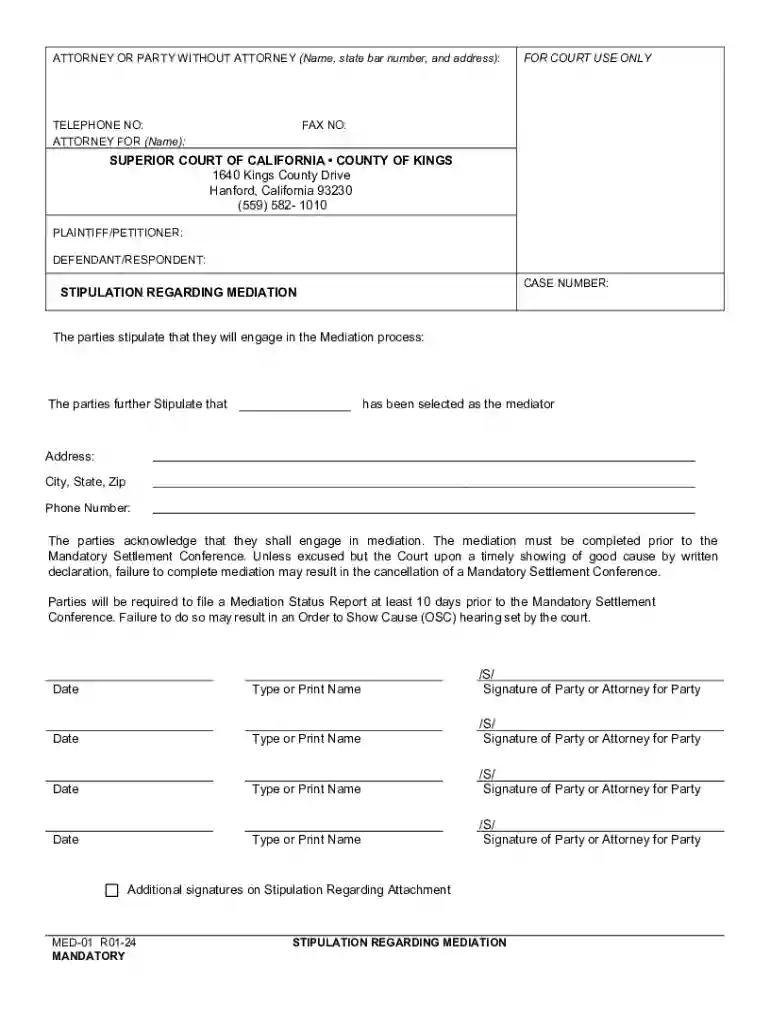
Mediation and ArbitrationSuperior Court of CACounty Preview on Page 1

Here's how it works

01. Edit your form online
Type text, add images, blackout confidential details, add comments, highlights and more.

02. Sign it in a few clicks
Draw your signature, type it, upload its image, or use your mobile device as a signature pad.

03. Share your form with others
Send it via email, link, or fax. You can also download it, export it or print it out.

Definition and Meaning

The "Mediation and ArbitrationSuperior Court of CA County" form is integral in the context of legal dispute resolution within California's judiciary system. It signifies official engagement in either mediation or arbitration processes administered by the Superior Court in various counties throughout California. Mediation is a non-binding, confidential process where a neutral third party assists the disputing parties in reaching a mutually satisfactory resolution. In contrast, arbitration involves a neutral arbitrator who hears evidence and arguments and then makes a binding decision. Both methods aim to provide an alternative to traditional court litigation, helping parties resolve their disputes efficiently and cost-effectively.

Steps to Complete the Mediation and ArbitrationSuperior Court of CA County

Successfully completing the "Mediation and ArbitrationSuperior Court of CA County" form involves several crucial steps. These steps ensure that all information is provided comprehensively and that the application is submitted correctly:

  1. Gather Necessary Information: Collect all pertinent details about the case, including the names and contact information of involved parties, a description of the dispute, and any supporting documentation.

  2. Complete Required Fields: Fill out the form sections that request specific information about the mediation or arbitration, ensuring all fields are accurately completed to avoid delays.

  3. Attach Supporting Documents: Include any necessary documentation that may support the mediation or arbitration case, such as contracts, previous legal documents, or correspondence.

  4. Review for Accuracy: Carefully review all entered information to ensure there are no errors or omissions that could affect the outcome.

  5. Submit the Form: Depending on the prescribed submission method, submit the form either online, via mail, or in person at the relevant Superior Court office.

  6. Confirmation and Follow-up: After submission, confirm receipt by the court and follow any further instructions provided by court officials.

Key Elements of the Mediation and ArbitrationSuperior Court of CA County

The form contains several key elements that participants must understand:

  • Applicant Information: Details about each party involved, ensuring clear identification.
  • Dispute Details: A comprehensive account of the issue at hand, clarifying what the mediation or arbitration aims to resolve.
  • Process Selection: Indicate whether you seek mediation or arbitration, which influences how the proceedings will be conducted.
  • Outcome Preferences: Any particular outcomes or resolutions desired by the parties, which can guide the neutral party.
  • Agreements or Stipulations: Existing agreements between the parties related to the case, which may affect the process.

Legal Use of the Mediation and ArbitrationSuperior Court of CA County

The form is legally significant as it serves multiple functions:

  • Initiate Mediation or Arbitration: Officially start these dispute resolution processes within the court system.
  • Record Agreement to Participate: Document consent from all parties to engage in mediation or arbitration, reflecting a mutual decision to resolve disputes outside of regular litigation.
  • Establish Legal Framework: The form acts as a binding agreement that acknowledges the rights and responsibilities of each party under California law during mediation or arbitration.

State-Specific Rules for the Mediation and ArbitrationSuperior Court of CA County

California has specific rules and regulations that govern the mediation and arbitration processes across its counties:

  • Uniform Court Rules: These establish the procedural framework for how mediation or arbitration is conducted to ensure consistency across the state.
  • County Variations: Each Superior Court may have local rules detailing additional procedures or requirements, such as fees or timelines.
  • Mandatory Mediation: Some counties might require mediation as a first step in specific types of cases, emphasizing alternative dispute resolution as a preferred method.

Eligibility Criteria

Participants must meet certain eligibility criteria to engage in mediation or arbitration through the Superior Court:


  • Parties Involved: Must include individuals or entities with standing under California law, directly tied to the dispute.
  • Dispute Type: The conflict must fall within categories permissible for mediation or arbitration, typically excluding criminal matters.
  • Readiness to Participate: All parties must demonstrate willingness to engage in mediation or arbitration in good faith, seeking resolution outside the courtroom.
decoration image ratings of Dochub

How to Obtain the Mediation and ArbitrationSuperior Court of CA County

The form can be obtained through various channels:

  • Online Access: Downloadable from the Superior Court's website, providing easy access for all involved parties.
  • Court Offices: Available at local Superior Court offices, where staff can offer assistance or guidance.
  • Legal Aid Services: Some legal aid organizations may provide access to the form for individuals requiring additional support.

Examples of Using the Mediation and ArbitrationSuperior Court of CA County

Real-world scenarios where the form is utilized include:

  • Business Disputes: Companies often use mediation or arbitration for commercial disagreements, preferring efficiency and confidentiality.
  • Family Law Conflicts: Mediation might be chosen for resolving child custody or divorce issues in a less adversarial environment.
  • Contractual Disputes: Parties to a contract may seek arbitration to enforce or interpret contract terms without full litigation.
be ready to get more

Complete this form in 5 minutes or less

Get form

Got questions?

We have answers to the most popular questions from our customers. If you can't find an answer to your question, please contact us.
Contact us
Saves Time Compared to Litigation It is not unusual for litigation to drag on for several years, leaving parties in limbo and disputes unresolved. ADR offers a much faster alternative. Mediation or arbitration can often be scheduled within weeks, and in many cases a single session is enough to resolve the matter.
The primary types of ADR in India are arbitration, mediation, conciliation, negotiation, and Lok Adalats. These all have different approaches, from formal processes to very informal processes.
Get good results at your mediation by keeping these basic tenets in mind. Rule 1: The decision makers must participate. Rule 2: Important documents must be physically present. Rule 3: Be right, but only to a point. Rule 4: Build a deal. Rule 5: Treat the other party with respect. Rule 6: Be persuasive.
Arbitration is like the court process as parties still provide testimony and give evidence similar to a trial but it is usually less formal. In mediation, the process is a negotiation with the assistance of a neutral third party. The parties do not docHub a resolution unless all sides agree.

Security and compliance

At DocHub, your data security is our priority. We follow HIPAA, SOC2, GDPR, and other standards, so you can work on your documents with confidence.
Learn more
ccpa2
pci-dss
gdpr-compliance
hipaa
soc-compliance