







Definition & Meaning
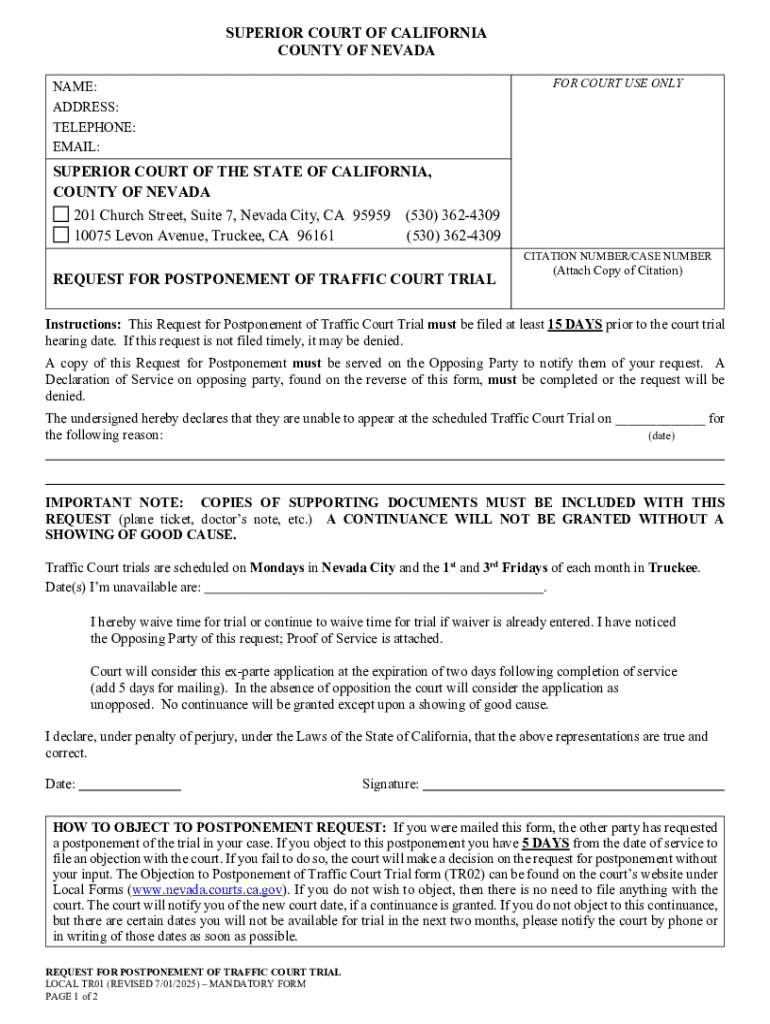
A "Request for Postponement of Traffic Court Trial" is a formal petition submitted to the court to delay a scheduled traffic court trial. This document serves as a request for additional time due to unforeseen circumstances that could prevent a party from attending the originally scheduled court date. Such requests are crucial for ensuring due process and allowing all involved parties the opportunity to present their case adequately.
Steps to Complete the Request for Postponement of Traffic Court Trial
-
Gather Necessary Information: Collect all details pertaining to your traffic court case, including your case number, court name, and scheduled trial date.
-
Complete the Form: Fill out the "Request for Postponement of Traffic Court Trial" form accurately. Include your personal details, case information, and the reason for requesting a postponement.
-
Attach Supporting Documents: Provide any relevant documentation that supports your request, such as medical notes, travel itinerary, or any substantiated evidence of unavoidable conflicts.
-
Notify the Opposing Party: Ensure that the opposing party is informed of your intention to request a postponement. In some jurisdictions, it is required to notify the other party, and they may have the right to object.
-
Submit the Form: File the completed form with the court. Check whether your jurisdiction requires an online submission, mail, or in-person filing.
-
Follow Up: After submission, contact the court to confirm receipt and inquire about the decision timeline.
Important Terms Related to Request for Postponement of Traffic Court Trial
- Continuance: Another term for postponement, referring to the act of delaying a scheduled court proceeding.
- Good Cause: The legally acceptable reason that must be provided to justify a postponement request.
- Objection: A formal disagreement submitted by the opposing party regarding the request for a trial delay.
Reasons to Request a Postponement
There are numerous valid reasons why someone might need to request a postponement of their traffic court trial:
- Medical Emergencies: Unplanned health issues that require immediate attention.
- Travel Obligations: Previously scheduled trips or unavoidable work commitments.
- Legal Counsel Conflicts: When your attorney is unavailable or has overlapping commitments.
- Administrative Errors: Issues like incorrect notice of the trial date requiring rescheduling.
Who Typically Uses the Form
Individuals involved in traffic violations who are unable to attend their scheduled court date due to unforeseen circumstances use the "Request for Postponement of Traffic Court Trial." This includes defendants in traffic cases and sometimes their legal representatives.


State-Specific Rules for the Request
State laws can vary significantly regarding the postponement of traffic court trials. For instance:
- California: Typically allows one-time postponements if requested at least ten days before the trial date.
- New York: May require more stringent documentation for the reason behind the request.
Understanding the specific requirements of your state ensures compliance and increases the likelihood of your request being granted.
Filing Deadlines / Important Dates
When submitting a request for postponement, timing is critical:
- Standard Deadlines: Most jurisdictions require the request to be submitted a set number of days before the trial date, often at least ten days.
- Expedited Situations: In cases of sudden emergencies, expeditious requests can be made to the court, which may have specific protocols to follow.
Required Documents
To successfully file a "Request for Postponement of Traffic Court Trial," you may need:
- Completed Form: The official form filled out with accurate information.
- Supportive Evidence: Documents such as medical records, travel tickets, or legal counsel confirmation.
- Notification Proof: Evidence showing that the opposing party has been informed of your postponement request.
Who Issues the Form
Traffic court forms, including the "Request for Postponement of Traffic Court Trial," are typically issued by the court where the ticket or violation was contested. In states like California, these can be obtained from the Superior Court in the specific county handling your case.




