







Definition and Purpose of FM-1192
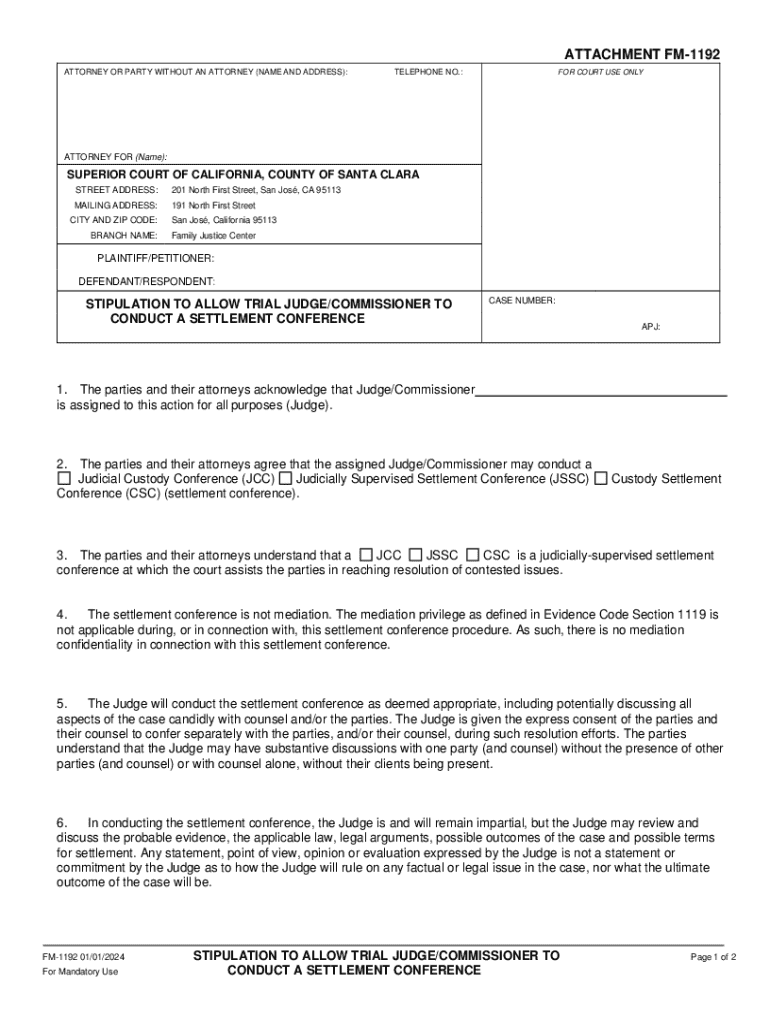
The FM-1192 is a stipulation form utilized within the Superior Court of California, County of Santa Clara. This document is primarily designed to facilitate the process of settlement conferences in family law cases. These conferences offer an opportunity for parties to negotiate and potentially resolve disputes with the assistance of a Judge or Commissioner. The use of this form is critical to formally agree on the terms and conditions under which such conferences are conducted, explicitly stating it is not a mediation and does not hold mediation confidentiality.
How to Use the FM-1192 Form
Using the FM-1192 form involves several important steps. First, both parties involved in the family law case must agree to participate in a settlement conference by signing the form. This signals consent for the assigned Judge or Commissioner to conduct the conference. The form should be completed with accurate details about the case and submitted to the court following completion. During the conference, the form grants permission for the Judge or Commissioner to meet with parties or their legal representatives individually, facilitating discussions that may lead to a settlement.
Steps to Complete the FM-1192
- Gather Required Information: Ensure all pertinent details such as case number, parties' names, and other relevant information are available.
- Read the Instructions: Review the instructions provided with the form to understand its uses and requirements fully.
- Fill Out the Form: Complete all sections of the FM-1192 accurately, specifying the roles of the parties involved and their agreement to the settlement process.
- Signatures: Obtain signatures from both parties or their legal representatives, indicating their agreement to the terms outlined.
- Submission: Submit the completed form to the appropriate court clerk or department for processing.
Who Typically Uses the FM-1192
The FM-1192 is typically employed by parties involved in family law disputes within the jurisdiction of the Superior Court of California in Santa Clara County. This generally includes spouses going through a divorce, guardians in custody disputes, or other family law litigants. Legal professionals such as family law attorneys and mediators might also be involved in facilitating the completion and submission of this form.

Legal Use of the FM-1192
The FM-1192 is used to legally formalize the willingness of parties to engage in a settlement conference. Its submission represents mutual consent for a Judge or Commissioner to conduct negotiations, with the understanding that private discussions outside the courtroom setting may occur. It is important to note that any agreements reached as a result of this conference can be binding and affect the outcome of the case.
Key Elements of the FM-1192
- Participant Information: Includes names and contact details of the parties involved.
- Case Details: Specifies the case number and relevant court information.
- Agreement Summary: Outlines what the parties agree to regarding the facilitating of the settlement conference.
- Judicial Consent: Allows a Judge or Commissioner to conduct and preside over the conference.
- Signatures: The form must be signed by both parties or their legal representatives to be valid.
State-Specific Rules for the FM-1192
In California, particularly in Santa Clara County, the FM-1192 must conform to state and court-specific rules surrounding family law proceedings. Parties should ensure the form complies with local stipulations and is appropriately filed within the court's timelines and guidelines. Ensuring compliance with these specific rules is crucial to the form's acceptance and the legitimacy of the subsequent settlement conference.
Digital vs. Paper Version of FM-1192
Both digital and paper formats of the FM-1192 can be used, depending on the court's capabilities and preferences. Digital submissions may provide efficiencies in terms of processing speed and convenience for parties who manage their cases electronically. However, paper versions remain a viable option, especially in scenarios where digital submissions might be hindered. Parties should verify with the court to determine the preferred submission method.




