
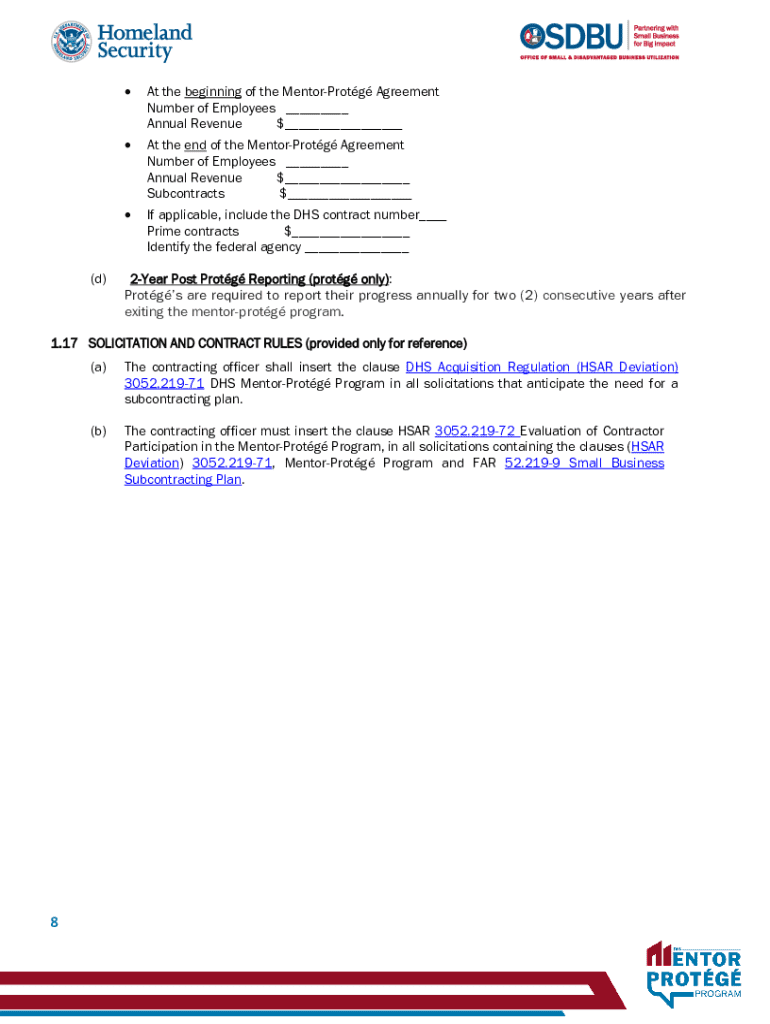







Definition and Purpose of the DHS Mentor-Protégé Program Guide
The DHS Mentor-Protégé Program Guide is a vital framework established by the U.S. Department of Homeland Security to promote business development for small businesses. This guide assists small businesses by pairing them with more established prime contractors, facilitating a mutually beneficial partnership. The mentor-protégé relationship aims to strengthen the capabilities of small businesses, enabling them to compete more effectively for federal contracts. The guide details various aspects of the program, including eligibility criteria, application processes, and the expected roles of both mentors and protégés. Among its key objectives is enhancing developmental assistance to small businesses, thus fostering growth and innovation.
How to Use the DHS Mentor-Protégé Program Guide
-
Understanding Eligibility: Begin by reviewing the eligibility criteria stipulated in the guide. Determine whether your business qualifies as a mentor or protégé by assessing factors such as business size, operational history, and federal contracting experience.
-
Application Process: Follow the step-by-step instructions outlined in the guide to prepare and submit your application. This process includes gathering necessary documentation, completing required forms, and ensuring all information aligns with the DHS requirements.
-
Roles and Responsibilities: Use the guide to clarify the specific roles and obligations of both mentors and protégés. Understanding these responsibilities is crucial for creating a strong partnership that meets program objectives.
-
Developmental Assistance Strategies: Explore the guide's recommendations for effective developmental assistance. This includes strategies for knowledge transfer, training programs, and resource sharing between mentor and protégé businesses.
Steps to Complete the DHS Mentor-Protégé Program Guide
-
Initial Review: Conduct a comprehensive review of the guide to familiarize yourself with its content and structure.
-
Information Gathering: Collect all relevant business data and documentation required for the application, such as financial records, business plans, and past performance reports.
-
Application Filling: Complete the application sections pertaining to organizational details, eligibility criteria, and proposed mentorship activities.
-
Submission: Submit the completed application according to the instructions provided in the guide. Pay attention to submission deadlines and the preferred submission method, which may include online, mail, or in-person options.
-
Follow-Up: After submission, keep track of the application status and be prepared to provide additional information or clarification if requested by DHS.
Key Elements of the DHS Mentor-Protégé Program Guide
-
Eligibility Criteria: Defines who can participate as either a mentor or a protégé, focusing on business size standards and sector-specific requirements.
-
Application Procedures: Offers detailed instructions on how to accurately complete and submit an application, including necessary forms and supporting documentation.
-
Roles and Responsibilities: Outlines the distinct roles, expectations, and obligations for both mentors and protégés within the program.
-
Developmental Assistance: Describes the types of assistance that mentors should provide to enhance the capabilities of their protégé partners.
-
Reporting Requirements: Details the reporting obligations to track and measure program success, including periodic evaluations and feedback submission.
Eligibility Criteria
The DHS Mentor-Protégé Program Guide specifies distinct eligibility criteria for both mentors and protégés:
-
Mentors: Typically well-established businesses with significant experience in federal contracting. They should have the capacity to provide developmental assistance to smaller businesses.
-
Protégés: Generally small businesses that meet specific size standards as defined by the Small Business Administration. These businesses should be seeking to expand their business capabilities in the federal market.

Application Process and Approval Time
The application process is meticulously structured to ensure all participants align with program objectives:
-
Pre-Application Preparation: Gather necessary documentation and review the eligibility criteria.
-
Application Submission: Complete and submit the application as per the guidance provided, ensuring accuracy and completeness.
-
Review and Evaluation: DHS evaluates applications based on predefined criteria and program requirements.
-
Approval Notification: Approved applications receive a notice, often with feedback or conditions to meet during the partnership.
The typical approval timeline varies but generally entails a thorough review period to ensure all program objectives are met.
Legal Use of the DHS Mentor-Protégé Program Guide
Understanding the legal aspects is crucial:
-
Compliance with Federal Contracting Laws: Participants must adhere to federal laws and regulations governing contracting and business conduct.
-
Contractual Obligations: Legal agreements between mentors and protégés should clearly define the scope and nature of the partnership.
-
Reporting and Accountability: Regular reporting ensures transparency and accountability, helping to measure program effectiveness and compliance.
Business Types that Benefit Most from the Program
Certain businesses are particularly well-suited to benefit from this program:
-
Small Technology Firms: Gain access to resources and expertise to bolster their capabilities for government contracts.
-
Minority-Owned and Women-Owned Enterprises: These businesses often receive tailored mentorship to enhance competitiveness in federal procurement.
-
Veteran-Owned Businesses: Access to established networks and market insights helps veteran-owned businesses thrive in government sectors.
This guide serves as a comprehensive tool, enabling businesses to navigate the complexities of federal contracting, build fruitful partnerships, and improve their overall market positioning.




