DV-330 Order on Request to Change or End Restraining Order Judicial Council forms 2026

Get Form
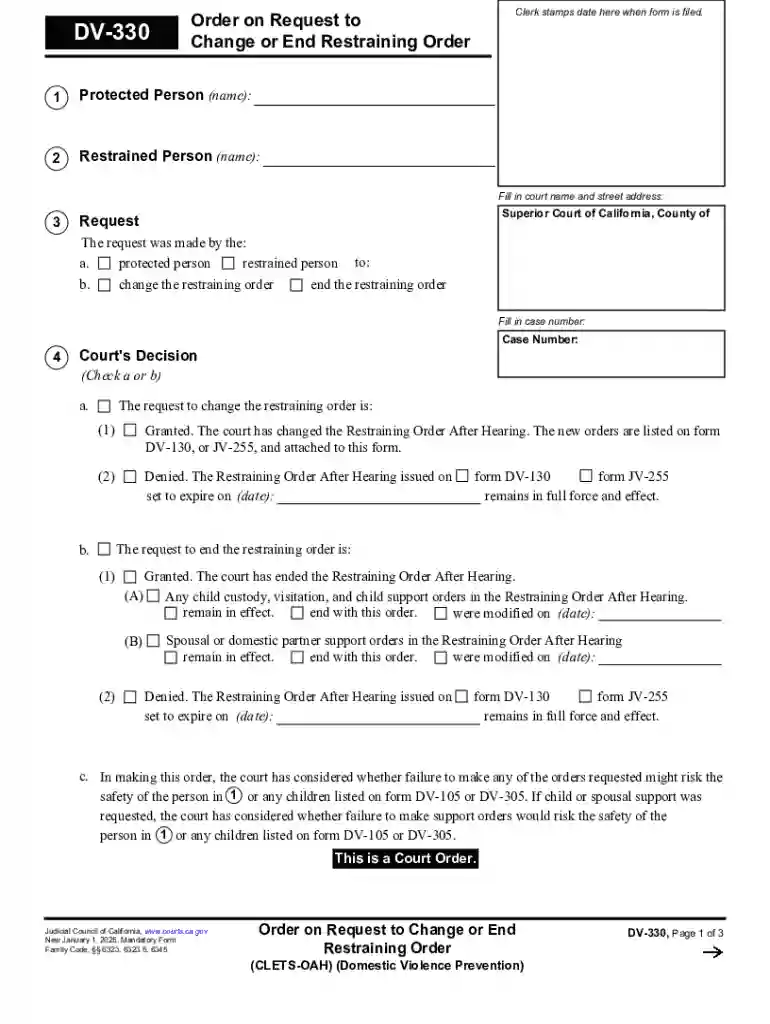
DV-330 Order on Request to Change or End Restraining Order Judicial Council forms Preview on Page 1

Here's how it works

01. Edit your form online
Type text, add images, blackout confidential details, add comments, highlights and more.

02. Sign it in a few clicks
Draw your signature, type it, upload its image, or use your mobile device as a signature pad.

03. Share your form with others
Send it via email, link, or fax. You can also download it, export it or print it out.

Definition and Meaning of DV-330

The DV-330, officially titled the "Order on Request to Change or End Restraining Order," is a Judicial Council form used in California. This form serves as a formal legal request to modify or terminate an existing restraining order. It addresses both the protected and restrained parties involved, ensuring that any changes adhere to legal protocols and safety considerations.

How to Use the DV-330 Form

  1. Identification: Begin by filling out your personal details, including name and case number.
  2. Request Details: Specify whether you are requesting a change or termination and provide a detailed explanation.
  3. Justification: Include reasons for the request, such as a change in circumstances or resolved conflicts.
  4. Additional Support: Attach any supporting documentation that strengthens your case for modification or termination.

Steps to Complete the DV-330 Form

  1. Acquire the Form: Obtain the DV-330 from the California Courts website or local court.
  2. Fill in Personal Information: Complete sections with your and the other party's details.
  3. Specify Request: Clearly state your desired changes to the existing order.
  4. Detail Changes: Use the sections provided to outline specific amendments or reasons for ending the order.
  5. Serving the Form: Ensure the other party is served with a copy of the completed form and any attachments.
  6. Attend the Hearing: Be prepared to present your case in court, including any evidence or testimonials.

Important Terms Related to DV-330

  • Restraining Order: A legal order issued to prohibit specific actions by one individual against another.
  • Protected Person: The individual who benefits from the protections of the restraining order.
  • Restrained Person: The individual restricted by the terms of the order.
  • Judicial Council Form: Standardized forms used within the California legal system for various proceedings.

Key Elements of the DV-330 Form

  • Identification Section: Ensures clarity on who is making the request.
  • Request Type: Indicates if the request is to change or end the order.
  • Explanation Section: Provides space for a detailed narrative for the request.
  • Signature Block: Requires the requesting party's signature before submission.

Legal Use of the DV-330 Form

The DV-330 is legally employed when either party involved in a restraining order needs to alter the terms or cease the restrictions altogether. Correct filing and use of this form are essential for legal compliance and for ensuring the safety of all parties involved.

State-Specific Rules for the DV-330 Form

  • California Specific: The DV-330 is exclusive to the state of California, following state-specific guidelines and legal processes.
  • Hearing Requirement: In most cases, a court hearing is necessary to review the requested changes.

Examples of Using the DV-330 Form

  • Scenario 1: A restrained person has completed rehabilitation and requests a modification of restrictions to allow contact under specific conditions.
  • Scenario 2: A protected person moves to a different state and requests termination of the order due to lack of necessity.
  • Scenario 3: Mutual agreement for the modification after relationship reconciliation.

Required Documents for the DV-330 Process

  • Completed DV-330 Form: With accurate and thorough information.
  • Supporting Evidence: Documentation or statements supporting the need for change.
  • Proof of Service: Evidence that the other party was informed of the request.

Filing Deadlines and Important Dates

  • Timeliness: Filing should adhere to court deadlines to ensure a timely hearing.
  • Hearing Date: Attend the appointed date once the court notifies all involved parties.

Form Submission Methods

  • In-Person: Submit at the local courthouse where your case is filed.
  • By Mail: Ensures all enclosures are complete and mailed to the correct judicial venue.
  • Online: If available, utilize the California Courts e-filing system for submission.

Penalties for Non-Compliance

Failure to comply with filing requirements and deadlines can result in the denial of your request. Additionally, not adhering to the existing order until changes are approved can lead to legal penalties or contempt charges.

In-depth understanding and application of the DV-330 form are crucial for ensuring the legal proceedings align with California's judicial standards. Each section of the form requires careful attention to detail to facilitate an accurate and persuasive submission to the court.

be ready to get more

Complete this form in 5 minutes or less

Get form

Got questions?

We have answers to the most popular questions from our customers. If you can't find an answer to your question, please contact us.
Contact us
Fill out all required forms Request for Civil Harassment Restraining Orders (form CH-100) Confidential CLETS Information (form CLETS-001) Notice of Court Hearing (form CH-109) Temporary Restraining Order (form CH-110) Civil Case Cover Sheet (form CM-010)

Security and compliance

At DocHub, your data security is our priority. We follow HIPAA, SOC2, GDPR, and other standards, so you can work on your documents with confidence.
Learn more
ccpa2
pci-dss
gdpr-compliance
hipaa
soc-compliance
be ready to get more

Complete this form in 5 minutes or less

Get form