




01. Edit your form online
Type text, add images, blackout confidential details, add comments, highlights and more.

Type text, add images, blackout confidential details, add comments, highlights and more.

Draw your signature, type it, upload its image, or use your mobile device as a signature pad.

Send it via email, link, or fax. You can also download it, export it or print it out.
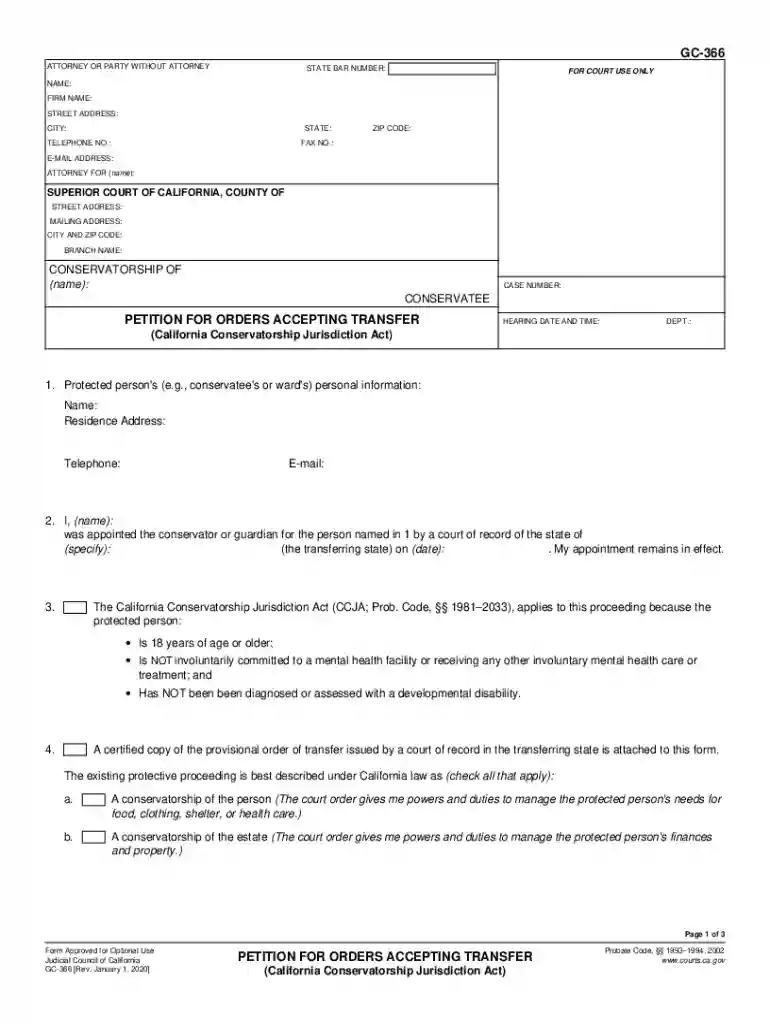
The GC-366, officially titled "Petition for Orders Accepting Transfer," serves as a legal document used under the California Conservatorship Jurisdiction Act. It facilitates the transfer of conservatorship jurisdiction from another state to California. This petition includes crucial information regarding the conservatee and requests the California courts to assume authority over the conservatorship case, outlining the necessity and legal basis for such a move. The document ensures that all legal and logistical details about the conservatorship are clearly communicated to the California state judicial system.
Gather Required Personal Details:
Prepare Transfer Justification:
Detail Connections to California:
Submit Supporting Documentation:
Finalize and Submit:
The GC-366 form is available through the California courts' website, aimed at providing easy access to individuals seeking to transfer conservatorship. You can download the document in PDF format, fill it out digitally, or print and complete it manually. Those requiring further assistance can contact their local courthouse for additional guidance or visit legal aid clinics offering expertise in conservatorship matters.
The GC-366 is a critical legal instrument ensuring adherence to the California Conservatorship Jurisdiction Act. Legal compliance requires that all information be accurate and truthful, with any falsification potentially resulting in the petition's rejection. Moreover, all transfers must respect federal and state privacy laws to protect the conservatee's rights and well-being.
While the GC-366 is primarily used in California, understanding state-specific legal requirements is essential. Different states may have unique prerequisites and supportive documentation requirements for transferring conservatorships. Applicants must ensure they comply with both the originating state's and California's legal frameworks to facilitate a smooth transition.
At DocHub, your data security is our priority. We follow HIPAA, SOC2, GDPR, and other standards, so you can work on your documents with confidence.



This manual was prepared to help you understand the operation and mainte- nance of your vehicle so that you may enjoy many miles (kilometers) of driving.
A certified copy of the provisional order of transfer issued by a court of record in the transferring state is attached to this form. The
May 3, 2017 Typically, the clerk uses AOC form SP-202, which is the Order on Petition for Adjudication of. Incompetence. The appeal of the order on


