




01. Edit your form online
Type text, add images, blackout confidential details, add comments, highlights and more.

Type text, add images, blackout confidential details, add comments, highlights and more.

Draw your signature, type it, upload its image, or use your mobile device as a signature pad.

Send it via email, link, or fax. You can also download it, export it or print it out.
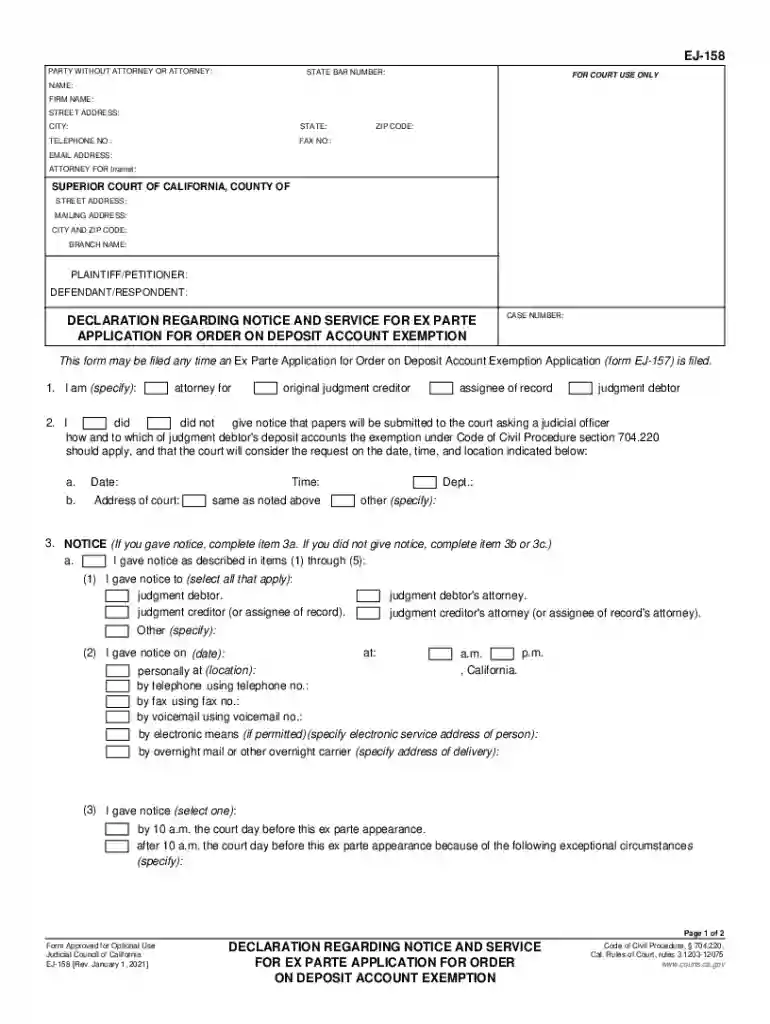
The EJ-158 is a critical legal document used predominantly within the Superior Court of California. It plays a central role in the legal framework surrounding the Ex Parte Application for Order on Deposit Account Exemption. This declaration serves as a formal record that confirms the notification and service requirements have been met concerning parties involved in an ongoing legal matter. By outlining the processes of notifying interested parties and affirming and recording the occurrence of these notifications, the form is instrumental in ensuring all procedural aspects comply with legal standards. Specifically, the declaration details when and how the notice of the ex parte application was given, or why such notice was waived or deemed unnecessary.
Completing the EJ-158 form requires careful attention to detail, as it confirms the procedural compliance of the notification process in legal proceedings.
Identify the Case Information: Include the case number and the corresponding court's name in which the proceedings are occurring. This establishes the form's context and relevance.
Declare Notice Details: Precisely document the method of notification provided to each party. If applicable, justify why notice was waived, citing specific legal grounds if necessary.
Describe Service Process: Detail how service of the application was conducted, specifying the means such as in-person or mailed delivery. Include exact dates, times, and locations to ensure a comprehensive record.
Include Party Specifics: Clearly enumerate the parties notified, their roles, and any pertinent relationships to the case. This section may include individuals, organizations, or legal representatives.
Sign and Date: Finally, sign and date the form to authenticate the declaration. This final step ensures that the document is legally binding and represents truthful compliance with notification procedures.
The legal importance of the EJ-158 document cannot be overstated. It substantiates compliance with procedural law, particularly regarding notifications in the specific context of the Ex Parte Application for Order on Deposit Account Exemption. It acts as proof that all involved parties have been informed of the application and, if needed, allows for tracking potential discrepancies or oversight in the notice service. Additionally, it offers protection against claims of improper service, thus safeguarding the interests of both the notifying party and the court. This form enables the court to proceed with an application on a solid procedural foundation.
Understanding the key elements of the EJ-158 form will facilitate its completion and submission:
The primary users of the EJ-158 form are legal professionals and parties engaged in litigation within the California Superior Court system. This includes attorneys who must provide declarations regarding notice compliance, involved parties seeking or contesting orders, and court clerks who ensure correct documentation supports ongoing proceedings. Additionally, individuals involved in estate proceedings, financial disputes, or property issues may frequently interact with this form, as they require validation of proper notice for ex parte applications.


Obtaining the EJ-158 form is a straightforward process, typically involving the following steps:
Visit the Court's Website: Access the official website of the California Superior Court, which provides downloadable forms including the EJ-158.
Court Clerk's Office: Physically visit the clerk's office at the relevant Superior Court location. Staff can often provide assistance and print a copy of the form.
Legal Counsel: Contact a lawyer or legal representative who can supply the form and offer guidance on its completion.
Online Legal Resources: Use legitimate online legal resources or document management platforms like DocHub that specialize in providing access to such forms.
Several terms are critical when dealing with the EJ-158 form to ensure precision and adherence to legal processes:
Submitting the completed EJ-158 form entails a few options depending on the court's available services:
Electronic Submission: If permitted, submit the form via the court's online filing system. This modern option streamlines the process and provides immediate confirmation of receipt.
Mail Submission: Send the completed form via certified or registered mail to ensure receipt gets documented.
In-Person Submission: Physically deliver the document to the court clerk’s office, which is often the quickest method for ensuring timely file entry.
Every submission method requires adherence to specific deadlines and procedural rules for them to be accepted and recorded officially.
Failing to comply with the expectations outlined when completing and submitting the EJ-158 can lead to serious repercussions:
Understanding and fulfilling these mandates are crucial to uphold the integrity of legal proceedings.
At DocHub, your data security is our priority. We follow HIPAA, SOC2, GDPR, and other standards, so you can work on your documents with confidence.
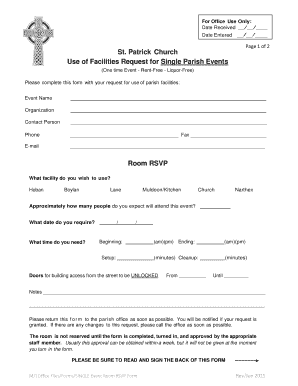
DECLARATION REGARDING NOTICE AND SERVICE FOR EX PARTE. APPLICATION FOR ORDER ON DEPOSIT ACCOUNT EXEMPTION. This form may be filed any time an Ex Parte
Chapter 2 Trade Secret Law Primer. 2.1 Introduction .
Sep 19, 2016 This is a user manual for the D-Link Wireless AC750 Dual Band Router, model DIR-819. The purpose is to create a constant network connection.


