WV-716 Order to Reschedule Hearing to Renew Restraining Order (CLETS-WHO) (Workplace Violence Preven 2026

Get Form
WV-716 Order to Reschedule Hearing to Renew Restraining Order (CLETS-WHO) (Workplace Violence Preven Preview on Page 1

Here's how it works

01. Edit your form online
Type text, add images, blackout confidential details, add comments, highlights and more.

02. Sign it in a few clicks
Draw your signature, type it, upload its image, or use your mobile device as a signature pad.

03. Share your form with others
Send it via email, link, or fax. You can also download it, export it or print it out.

Definition & Meaning

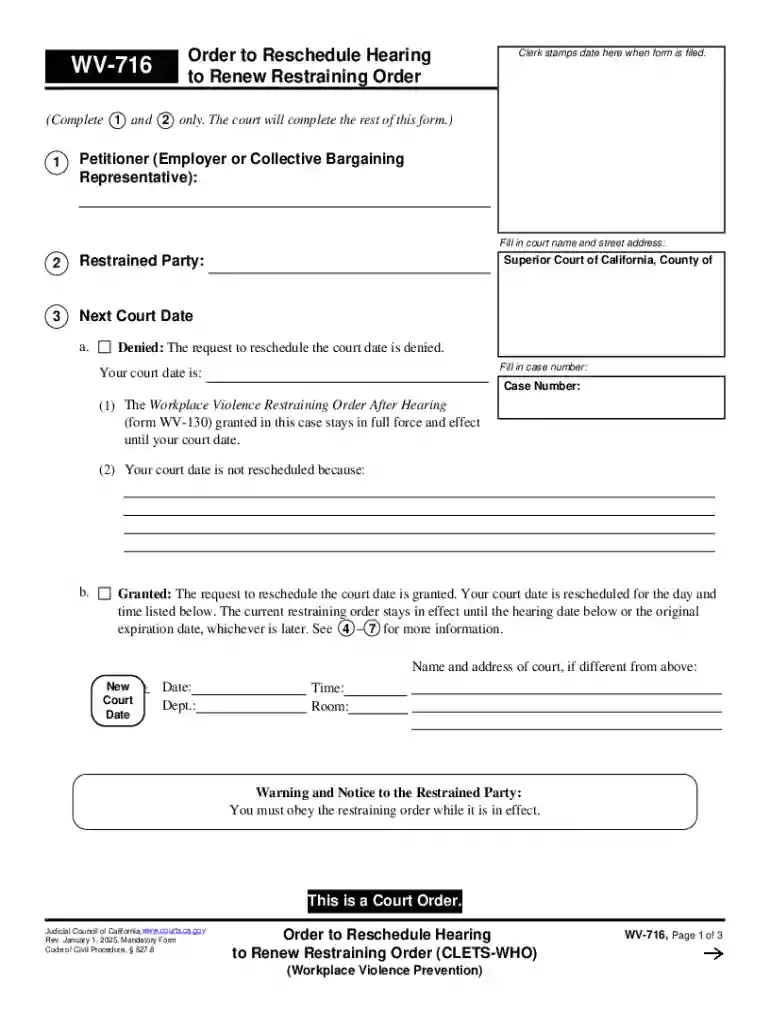
The WV-716 Order to Reschedule Hearing to Renew Restraining Order (CLETS-WHO) (Workplace Violence Prevention) is a legal document utilized within the U.S. legal system to formally request the rescheduling of a hearing related to the renewal of a workplace violence restraining order. This form is essential in maintaining an existing restraining order's effectiveness until the newly appointed hearing date. It serves as a procedural tool to ensure that due process is followed when an existing workplace violence restraining order is up for renewal but cannot be addressed on the originally scheduled date.


How to Use the WV-716 Order to Reschedule Hearing to Renew Restraining Order

  1. Identify Necessary Details: Before filling out the form, gather all relevant details, such as the existing restraining order information, the originally scheduled hearing date, and the reasons for requesting a rescheduling.
  2. Complete the Form: Accurately fill out the form with the collected information. Clearly articulate the reasons for rescheduling to help the court understand the necessity of the request.
  3. Submit the Form to the Court: Once completed, submit the form to the appropriate court where the original case is filed. Be sure to follow any specific submission procedures required by the court.

Steps to Complete the WV-716 Order to Reschedule Hearing to Renew Restraining Order

  1. Header Information: Enter the case number, court location, and names of involved parties.
  2. Request Details: Provide a detailed explanation of the need to reschedule. Include reasons such as scheduling conflicts or new evidence becoming available.
  3. Next Hearing Date Proposal: Suggest a range of dates for the new hearing, ensuring they comply with the court’s availability.
  4. Signature and Date: Sign and date the form, confirming the accuracy and authenticity of the provided information.

Who Typically Uses the WV-716 Order to Reschedule Hearing to Renew Restraining Order

  • Victims of Workplace Violence: Individuals who have an existing workplace violence restraining order and need to ensure its continuity.
  • Legal Representatives: Lawyers or legal aides representing clients involved in workplace violence cases who need to adjust legal timelines.
  • Employers or HR Departments: In situations where the employer is taking actions to protect employees from workplace violence.
decoration image ratings of Dochub

Key Elements of the WV-716 Order to Reschedule Hearing to Renew Restraining Order

  • Current Restraining Order Information: Details of the current order, such as date issued and expiration.
  • Arguments for Rescheduling: Justifications for why rescheduling is necessary.
  • Requested New Date for Hearing: A proposed timeline that fits both parties' schedules and the court’s docket.

Legal Use of the WV-716 Order to Reschedule Hearing to Renew Restraining Order

This form is legally binding and must be used in accordance with court rules and regulations. It allows parties involved in workplace violence cases to notify the court of scheduling conflicts in a formal manner. This ensures the protection offered by the restraining order remains uninterrupted until the new hearing is conducted.

State-Specific Rules for the WV-716 Order

Rules for filing the WV-716 form can vary by state:

  • California: Requires filing in the same court that issued the original restraining order.
  • New York: May have additional requirements for notification to opposing parties.
  • Texas: Might require a fee or proof of scheduling conflict alongside the form.

Examples of Using the WV-716 Order

  • Case of Missing Evidence: Jane Doe files WV-716 to reschedule her hearing when crucial evidence supporting her workplace violence claim is delayed in arrival.
  • Legal Representation Conflicts: A lawyer files WV-716 on behalf of a client due to a conflicting trial schedule on the original hearing date.
be ready to get more

Complete this form in 5 minutes or less

Get form

Got questions?

We have answers to the most popular questions from our customers. If you can't find an answer to your question, please contact us.
Contact us
If you want to postpone the court date, you must submit your request at least 10 days before your court date. You will need the SC-150 Request to Postpone Trial and the SC-112A Proof of Service by Mail. Complete the SC-150 and make a copy for all other Plaintiff(s) and Defendant(s) in the case.
If you require the final hearing date to be changed, you must ask the other party if they agree to that change and include their comments in your request along with 3 mutually agreed dates.
If you need to request an adjournment a formal application should be made as soon as possible. A formal application (form N244) requesting an adjournment has to be issued at the court. There will be a court fee to pay and you will need to provide witness evidence in support.
A motion for a continuance is a request asking the judge to make an order changing your hearing date. If the judge grants your motion, your court date will be postponed to a later time. For most requests for continuances, you must provide the judge with a suitable reason (good cause) for postponing your court date.

Security and compliance

At DocHub, your data security is our priority. We follow HIPAA, SOC2, GDPR, and other standards, so you can work on your documents with confidence.
Learn more
ccpa2
pci-dss
gdpr-compliance
hipaa
soc-compliance