




01. Edit your form online
Type text, add images, blackout confidential details, add comments, highlights and more.

Type text, add images, blackout confidential details, add comments, highlights and more.

Draw your signature, type it, upload its image, or use your mobile device as a signature pad.

Send it via email, link, or fax. You can also download it, export it or print it out.
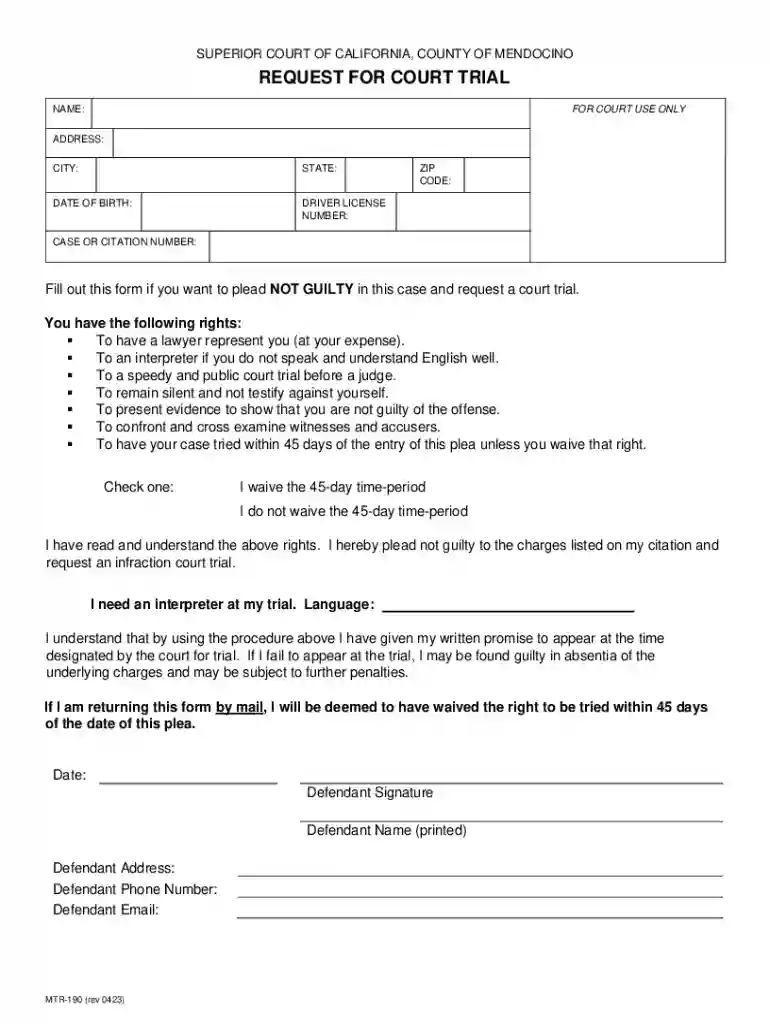
A "Request for Court Trial" is a legal document used primarily in the United States, particularly within the Superior Court of California, for individuals pleading not guilty to a citation or case. This form allows defendants to formally petition the court for a trial by a judge, rather than resolving the issue through a plea agreement or other less formal means. It is a critical tool for individuals who wish to assert their rights in a court setting, ensuring they receive due process and a fair opportunity to present their case.
To utilize the "Request for Court Trial" effectively, it's essential to understand its components and the information required. Typically, defendants must fill out personal details such as name, address, and case number. Additionally, they are prompted to indicate if they are waiving their right to a speedy trial, usually defined as holding the trial within 45 days of submitting the request. Defendants should also review any specific instructions provided by the court to ensure all necessary sections are completed appropriately. Once filled out, the form can be submitted to the court either in person or through designated electronic means, where available.
The legal framework surrounding the "Request for Court Trial" is designed to protect defendants' constitutional rights. By requesting a court trial, individuals exercise their right to present their case before a judge, participate in a structured legal process, and have the opportunity to contest allegations brought against them. Legal representatives often assist in completing the form to ensure all legal nuances are properly addressed, and strategic decisions, such as whether to waive a speedy trial, are made with informed legal counsel.
Different states may have variations in how the "Request for Court Trial" is processed or executed. For instance, California's interpretation of a speedy trial might differ from other jurisdictions regarding timelines or procedural necessities. Additionally, other states may require supplementary documentation or additional steps. Therefore, individuals should consult with legal professionals familiar with local regulations or reach out to their local court clerks for guidance on any state-specific requirements.
Consider a scenario where an individual receives a traffic citation that they believe is unjust. Rather than paying the fine or accepting penalties, they may choose to file a "Request for Court Trial" to dispute the charges in front of a judge. In another example, a business owner facing allegations of minor regulatory infractions could opt for a court trial to clear their name and uphold their company's reputation.
Filing deadlines for the "Request for Court Trial" are typically stringent to ensure efficient court operations. Defendants often need to submit their requests within designated timeframes—possibly correlating with the issuance of the citation or court appearance date. Missing these deadlines can result in forfeiting the right to a trial, leading to automatic penalties. It is crucial to confirm deadlines with the court administration promptly.
At DocHub, your data security is our priority. We follow HIPAA, SOC2, GDPR, and other standards, so you can work on your documents with confidence.



1) In court proceedings, a request is when a party asks the court or opposing counsel to act, demands a right, or asks a question.
You can get District Court case records in these ways: Online, Register for a free e-filing/case access portal account.
First, read the courts decisions on Notice of Entry of Judgment (either form SC-130 or form SC-200). It will tell you the courts judgment in this case.


