



01. Edit your form online
Type text, add images, blackout confidential details, add comments, highlights and more.

Type text, add images, blackout confidential details, add comments, highlights and more.

Draw your signature, type it, upload its image, or use your mobile device as a signature pad.

Send it via email, link, or fax. You can also download it, export it or print it out.
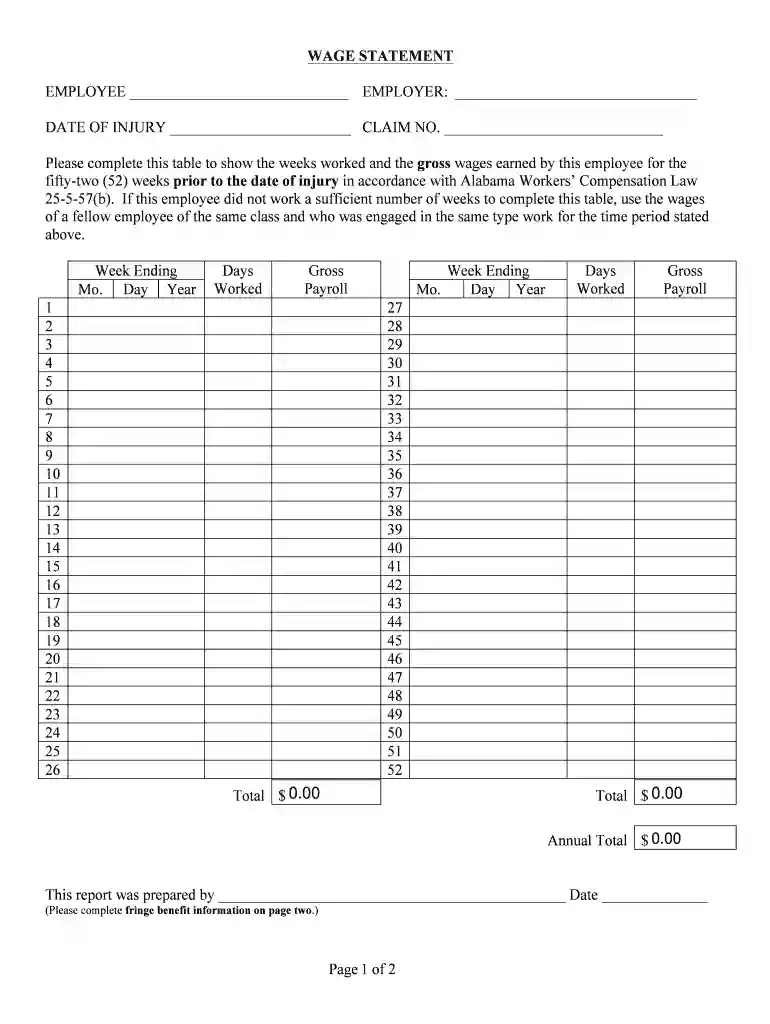
The "Wage Statement - AlaCOMP" is a mandatory document as per Alabama Workers' Compensation Law. It records the gross wages earned by an employee for the fifty-two weeks preceding their injury date. This precise documentation is crucial as it serves as a basis for calculating compensation benefits. The statement includes sections that record not only weekly earnings but also fringe benefits like health insurance or retirement contributions provided by the employer. Moreover, it accounts for deductions related to child support garnishments or participation in work release programs if applicable. Understanding these elements ensures compliance and proper compensation calculations.
Weekly earnings are recorded meticulously to provide an accurate representation of the employee's income. This includes base pay, overtime, and bonuses. It's essential to capture every aspect of the employee's income to calculate any compensation they may be entitled to receive correctly. For instance, if an employee typically works varying hours, the average weekly wage is calculated by considering the total hours worked over the fifty-two weeks.
Employers must list all fringe benefits on this form. Examples include contributions to health savings accounts, retirement benefits, and company-provided housing or transportation. Including comprehensive information about these benefits is crucial as they can influence the overall compensation calculation. Also recorded are any deductions such as child support garnishments; these deductions must be specified clearly to prevent any wage miscalculations.
Utilizing the Wage Statement - AlaCOMP involves several structured steps designed to ensure accuracy and compliance with the state regulations.
Gather Necessary Information: Employers must collect details about all wages, benefits, and deductions the employee received during the fifty-two weeks before their injury.
Complete Weekly Earnings: Fill out sections detailing weekly earnings, ensuring all forms of payment, including hourly, salary, and specific bonuses, are included.
Document Fringe Benefits and Deductions: Accurately note down fringe benefits and any deductions that could affect the employee's net compensation.
Review for Accuracy: After filling in the details, review the entire form for any errors or omissions to avoid any potential discrepancies in the compensation process.
Submit the Form: Once completed and reviewed, the form should be submitted to the relevant workers' compensation authority within the state for processing.
Obtaining a Wage Statement - AlaCOMP is straightforward, typically handled through the employer's human resources or payroll department. Employers can:
Completion of the Wage Statement - AlaCOMP demands careful attention to detail:
Access the Form: Download or obtain a physical copy of the form.
Enter Employee Information: Include all personal and employment details of the injured employee accurately.
Record Weekly Earnings: Enter detailed weekly earnings data, ensuring all types of compensation are represented.
List Fringe Benefits: Fill out fringe benefits accurately to reflect any additional compensation provided by the employer.
Document Deductions: Clearly itemize any deductions that were regularly made from the employee's paycheck.
Review and Submit: Ensure all information is accurate before submitting the completed form to the necessary authorities.
Accurately completing each section helps prevent any legal repercussions and ensures the employee receives fair compensation based on the correct earnings data.
The Wage Statement - AlaCOMP comprises essential sections that employers must address with precision:
The form must be signed by an authorized personnel to confirm that all data provided is true and accurate. This certification is critical to avoid any disputes or claims of misinformation.
At DocHub, your data security is our priority. We follow HIPAA, SOC2, GDPR, and other standards, so you can work on your documents with confidence.




by AF Southwick Cited by 49 Legal liability of a hospital for injury to a patient may, depending upon the facts, be based upon either the negligence of the hospital.
This is a long-term commitment by which a financially strong employer pays benefits to injured employees as mandated by the Alabama Workers Compensation Law.


