01. Edit your form online
Type text, add images, blackout confidential details, add comments, highlights and more.

Type text, add images, blackout confidential details, add comments, highlights and more.

Draw your signature, type it, upload its image, or use your mobile device as a signature pad.

Send it via email, link, or fax. You can also download it, export it or print it out.
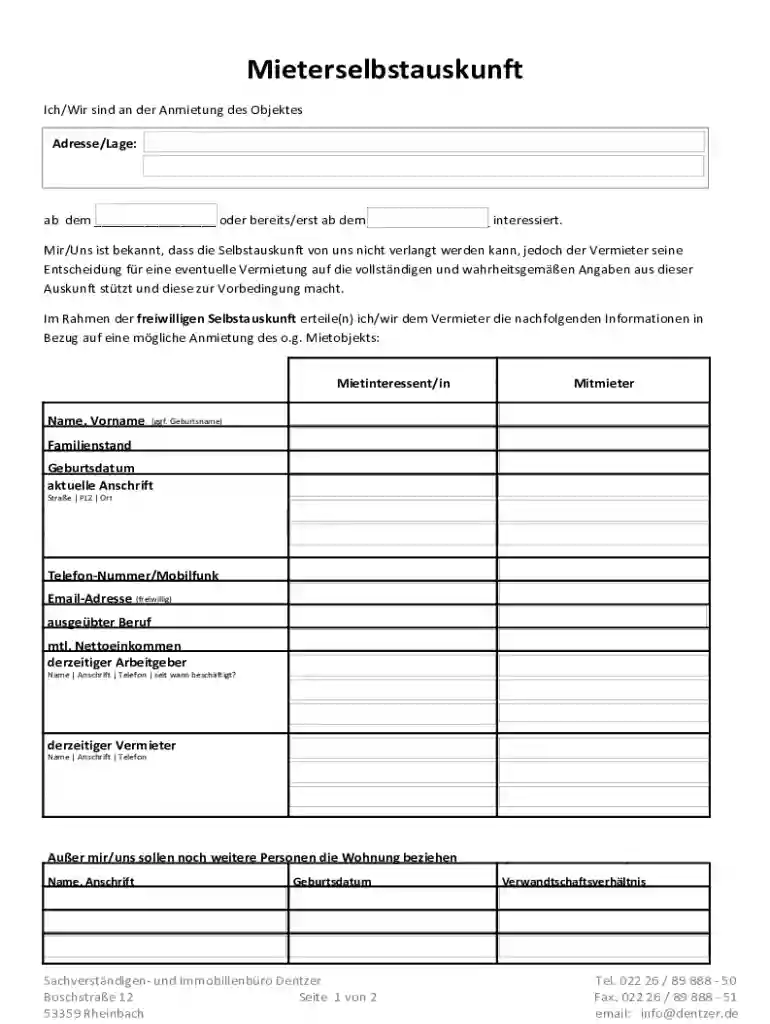
The Mieterselbstauskunft, or Rental Self-Disclosure, serves as a critical document for potential tenants interested in leasing a property. This form gathers comprehensive personal information, financial details, and rental history, providing landlords with essential data to make informed leasing decisions. It focuses on the accuracy and honesty of disclosures, with significant implications for providing false information, which could lead to legal consequences and losing rental opportunities.
Filling out the Mieterselbstauskunft form involves providing a wide range of data about your financial stability and rental background. Start by ensuring you have all necessary documents ready, such as proof of income, identification, and references. Each section of the form requires careful attention; for instance, in the financial section, income and expenses should be detailed clearly. Remember, this document supports your application, so thoroughness and transparency can significantly impact a landlord’s evaluation.
The Mieterselbstauskunft is crucial for both tenants and landlords. For tenants, it offers an opportunity to showcase their reliability and suitability as renters. For landlords, it acts as a safeguard, ensuring that they are entrusting their property to responsible individuals who are financially capable of maintaining lease agreements. Providing detailed and truthful information can facilitate a smoother rental process and foster trust between both parties.
Legal compliance with the Mieterselbstauskunft is mandatory to ensure fair housing practices. Tenants must provide honest and accurate information, as fraudulent details are grounds for immediate rental disqualification and potential legal consequences. Landlords are also required to handle all tenant information confidentially in accordance with privacy laws, ensuring that personal data is not misused or disclosed improperly.
While the Mieterselbstauskunft form is broadly applicable, specific state regulations may influence its structure and requirements. For instance, some states might mandate additional disclosures regarding tenant rights or landlord obligations. Potential renters should familiarize themselves with state-specific rental laws to ensure adherence and avoid legal complications during the application process.
Consider a scenario where a potential tenant, Alex, is looking to rent an apartment in a competitive market. By completing the Mieterselbstauskunft form thoroughly, Alex provides his prospective landlord with a complete financial picture and a positive tenant history, thereby increasing his chances of securing the lease. Alternatively, if Alex skips key sections or provides unclear data, his application might be overlooked in favor of more comprehensive applications.
To complete the Mieterselbstauskunft form accurately, prepare the following documents:
Submitting the Mieterselbstauskunft can typically occur through several methods:
These options provide flexibility depending on tenant preferences and landlord requirements.
Potential tenants are generally eligible to complete a Mieterselbstauskunft if they are at least 18 years old, possess a verifiable source of income, and have a legal status to enter into rental agreements. Young adults with limited rental history may need additional guarantors or co-signers to support their application, demonstrating the ability to meet rent obligations.


Disclosure in the Mieterselbstauskunft must include detailed and truthful representations of financial and rental backgrounds. Failure to disclose accurate information can result in immediate application rejection or lease termination if discovered post-acceptance. Tenants should ensure that all provided data is up-to-date, clearly stated, and corroborated by supporting documents to mitigate risks of non-disclosure penalties.
By providing comprehensive, honest, and well-documented information within the Mieterselbstauskunft, potential tenants can significantly improve their chances of securing a rental property while fostering a transparent relationship with their prospective landlords.
At DocHub, your data security is our priority. We follow HIPAA, SOC2, GDPR, and other standards, so you can work on your documents with confidence.