




01. Edit your form online
Type text, add images, blackout confidential details, add comments, highlights and more.

Type text, add images, blackout confidential details, add comments, highlights and more.

Draw your signature, type it, upload its image, or use your mobile device as a signature pad.

Send it via email, link, or fax. You can also download it, export it or print it out.
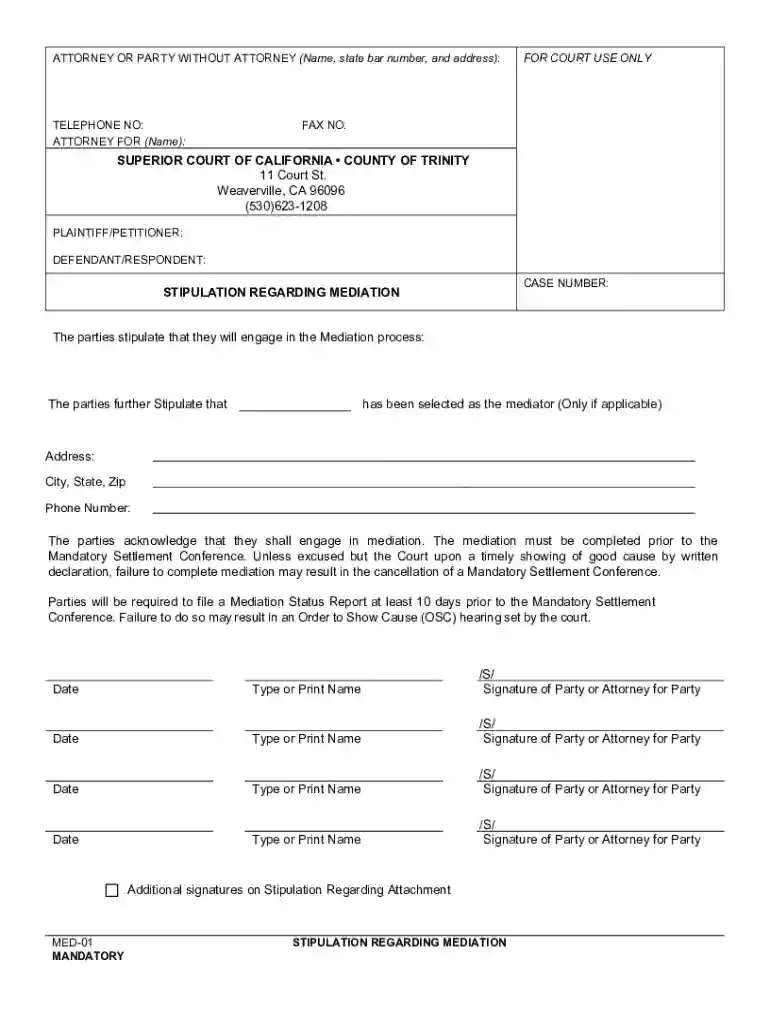
Civil Mediation is a form of alternative dispute resolution used to resolve conflicts without litigation. It is a voluntary process where a neutral third party, known as a mediator, facilitates communication between parties to reach a mutually acceptable agreement. The Civil Mediation Program Information Packet provides detailed information on this mediation process as offered by the Superior Court of California, County of Trinity. It outlines key aspects, such as confidentiality, the eligibility of cases for mediation, and procedural guidelines. Unlike courtroom litigation, mediation is informal, emphasizing cooperation over adversarial behavior, and is often faster and less costly.
The Civil Mediation Program Information Packet contains several crucial components that guide the users through the mediation process. These include:
To effectively use the Civil Mediation Program Information Packet, follow these steps:
Several terms are essential to understanding mediation as presented in the packet:
The Civil Mediation Program Information Packet serves as a legal guide for those considering mediation. It ensures that parties understand their legal rights and obligations during the mediation process. Mediation under this program does not replace legal filings necessary for court proceedings but offers an alternative route for conflict resolution. Parties must comply with any court orders and maintain proper documentation as required by the court.
Eligibility for the Civil Mediation Program includes:


The following are scenarios where the Civil Mediation Program Information Packet could be effectively utilized:
While the Civil Mediation Program Information Packet provides general guidelines, it's essential to understand state-specific rules:
At DocHub, your data security is our priority. We follow HIPAA, SOC2, GDPR, and other standards, so you can work on your documents with confidence.





Overview. Mediation is a useful alternative to litigation that allows individuals to resolve disputes outside of court in a cooperative manner.
by TH Wiedemeier Cited by 358 The use of a spreadsheet program or one of the mathematical software programs, such as. Mathcad. simplifies solution of analytical models


