







Definition and Meaning of Personal Property Tax Relief for Veterans
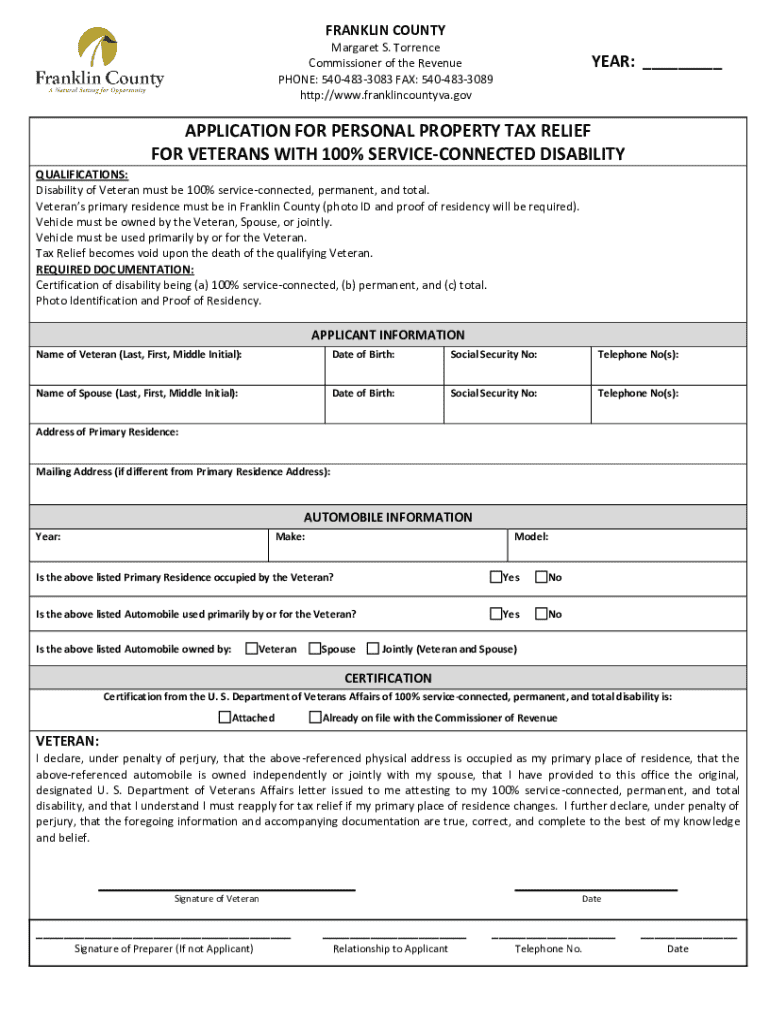
The "Application for Personal Property Tax Relief for Veterans" is a form designed to provide eligible veterans with a reduction or exemption from taxes levied on personal property, typically a motor vehicle. This tax relief is aimed at veterans with a 100% service-connected disability, recognizing their service and sacrifices made for the country. The exemption is usually applicable only to vehicles used primarily by or for the veteran during their lifetime, offering financial alleviation in acknowledgment of their contributions.
How to Obtain the Application for Personal Property Tax Relief for Veterans
To acquire the application form, veterans can often obtain it through their local county tax office or the website of the local government that administers property taxes. In some locations, such as Franklin County, the form may be downloadable online, or veterans may need to request a physical copy sent by mail. It's essential for applicants to verify the source to ensure they receive the correct version corresponding to their locality, as the process and form availability may differ between jurisdictions.
Eligibility Criteria for Personal Property Tax Relief
Eligibility for the tax relief typically requires veterans to demonstrate a 100% service-connected disability. Some jurisdictions may require additional proof, such as certification from the Department of Veterans Affairs. The tax relief applies solely to property used by or for the veteran, with exceptions possibly noted for surviving spouses or dependents. Applicants might have to be current on other tax obligations to qualify, supporting the premise that those receiving relief are compliant with broader tax duties.


Required Documents for Application Submission
Applicants will need to provide specific documents, which may include:
- A completed application form.
- Proof of 100% service-connected disability, often in the form of a VA disability letter.
- Identification documents confirming veteran status.
- Vehicle registration to establish the property's primary use.
Additional documentation requirements can depend on local regulations, so it is advisable for applicants to check their local tax office's guidelines to ensure all necessary paperwork is included.
Steps to Complete the Application for Personal Property Tax Relief
- Obtain the Form: Access the application form from the local tax office or their official website.
- Gather Documentation: Collect necessary documents such as disability proof and vehicle registration.
- Complete the Form: Fill in all required sections, ensuring accuracy and completeness.
- Attach Documentation: Include copies of required documents with the application.
- Submit the Application: Submit through the recommended method (online, mail, or in-person) as specified by local guidelines.
Reviewing every section for accuracy will help avoid delays or denials based on incomplete or incorrect submissions.
Legal Use and Compliance
Using the "Application for Personal Property Tax Relief for Veterans" appropriately provides legally sanctioned tax exemptions. Misrepresentation or inaccurate claims can result in penalties, including the repayment of any relief received and potential legal action. It's critical for applicants to ensure that their claim aligns precisely with the law's requirements, using accurate data and legitimate documentation.
State-Specific Rules for Application
Each state might have distinct rules governing tax relief applications. For instance, some states may have unique exemptions for different types of property, such as additional allowances for adaptive vehicles required due to disability. Prospective applicants should consult their specific state guidelines or contact their local tax office for detailed instructions and rules tailor-made for their jurisdiction, ensuring compliance and maximizing potential benefits.
Important Terms Related to the Application
Understanding key terms is crucial for accurately navigating the application process:
- Service-Connected Disability: A condition incurred or aggravated during military service.
- Primary Use: Refers to the vehicle's main use by the veteran, affecting eligibility.
- Exemption: A waiver of certain taxes owed on qualifying personal property.
Grasping these concepts can empower applicants to pursue tax relief confidently and correctly.
Examples of Using the Personal Property Tax Relief
Consider a veteran with a 100% disability rating who uses their vehicle exclusively for travel to medical appointments and daily activities. Applying for this tax relief would substantially ease their financial burden by exempting them from personal property taxes on the vehicle.
Similarly, in regions like Franklin County, applying correctly can mean significant savings, yet inaccuracies might lead to missed opportunities for relief. Veterans should explore how others in their area have leveraged the form successfully, learning from past examples and testimonies available through support groups or local veterans' affairs offices.
Application Process and Approval Time
After submission, the application undergoes a review process that varies in duration depending on the completeness of the paperwork and the current volume of applications being processed. Applicants can typically expect a response within a few weeks, though times may vary by locality. Following up after a reasonable period is advisable if no communication is received.
By understanding these components, veterans better navigate the personal property tax relief process, ensuring they fully benefit from the available provisions designed to support their service and sacrifice.




