
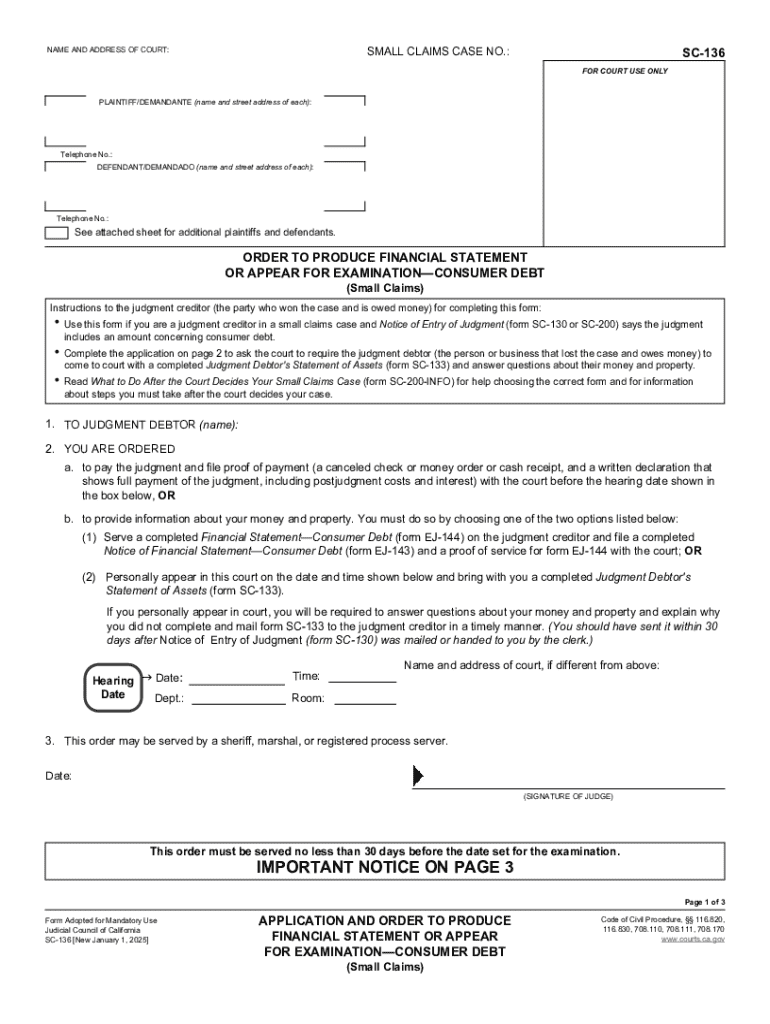







Definition and Meaning of SC-136
The SC-136 is a legal document used in the context of small claims cases related to consumer debt in the United States. It serves as an application and order for judgment creditors, instructing them on how to compel judgment debtors to either settle the debt or divulge financial information concerning their assets. This form is central to the enforcement of judgment debts and helps streamline the communication between involved parties. By outlining specific instructions, the SC-136 aids creditors in understanding their rights and the procedures to follow when trying to collect debts legally. Additionally, this form highlights potential legal consequences for debtors who fail to comply with the orders stipulated within.
Steps to Complete the SC-136
-
Fill in the Form Information:
- Write the case identification number, names of the parties involved, and the court details at the top of the form.
- Specify what action is requested of the judgment debtor (e.g., payment or disclosure of assets).
-
Detail Financial Information:
- Clearly document the amount owed, including any interests or fees accumulated post-judgement.
- List any previous attempts made to collect the debt and their outcomes for reference.
-
Outline Required Actions:
- State explicitly what the debtor is ordered to do, such as submitting financial documents or attending a court hearing.
-
Signature and Submission:
- Sign the form as the judgment creditor or attorney representing them.
- Submit the form per court instructions, ensuring compliance with any local requirements.
By following these steps, creditors can ensure that the form is accurately completed, thereby avoiding unnecessary delays in enforcement actions.
Legal Use of the SC-136
The SC-136 has significant legal importance in small claims courts as it facilitates the enforcement of judgments. It empowers creditors by providing a legal framework to require debtors to comply with debt settlement agreements. This document is in accordance with U.S. legal standards, ensuring its use aligns with lawful debt collection practices. The form's instructions and obligations are legally binding, meaning that non-compliance by the debtor can lead to enforced legal actions, such as wage garnishments or claims on the debtor's assets. Understanding the legal framework surrounding the SC-136 is crucial for both creditors and debtors to know their rights and obligations under the law.
How to Obtain the SC-136
Obtaining the SC-136 form can be done through several methods:
-
Court Website: Many state court websites provide downloadable versions of the form. Navigate to the small claims section and locate the SC-136 under judgment and enforcement forms.
-
Physical Copies from Courthouse: You can visit your local courthouse, specifically the small claims division, to obtain a paper version of the form.
-
Legal Aid Organizations: If you are receiving assistance from a legal aid service, they can provide access to the form and guidance on its completion.
Ensuring you obtain the form from an official source is critical, as this confirms its validity and compliance with state-specific legal requirements.
Important Terms Related to SC-136
- Judgment Creditor: The party that has won a monetary judgment against another in court.
- Judgment Debtor: The individual or entity ordered by the court to pay the judgment amount.
- Execution of Judgment: The process by which a court order is put into effect, potentially involving asset seizure or wage garnishment.
Grasping these terms helps in understanding the roles and responsibilities of each party involved when dealing with the SC-136.
Key Elements of the SC-136
The SC-136 includes several critical elements integral to its function:
-
Debtor Information: Clear identification details of the debtor, including their full legal name and contact information.
-
Debt Details: A comprehensive outline of the debt amount, including any interest and costs accrued since the judgment date.
-
Requested Actions: Explicit orders for the debtor, such as payment instructions or required financial disclosures.
-
Consequences of Non-Compliance: Outline of the potential legal repercussions for failing to comply with the order, including possible attorney's fees for the creditor.
These elements ensure the form is adequately structured for effective usage in legal proceedings.
Penalties for Non-Compliance
When a debtor does not comply with the SC-136 orders, they may face several potential penalties:
-
Contempt of Court: Non-compliance can be seen as disobeying a court order, leading to additional legal actions or fines.
-
Additional Fees: The debtor might incur extra costs, including attorney's fees for the creditor pursuing compliance.
-
Enforced Collections: Courts may issue additional orders to enforce the collection of debts, such as wage garnishments or bank account levies.
Understanding these penalties underscores the importance of adhering strictly to the orders detailed within the SC-136.
Examples of Using the SC-136
Several practical scenarios illustrate the utility of the SC-136:
-
Timely Debt Recovery: A creditor uses the SC-136 to submit an order compelling a debtor to pay a $5,000 debt following a small claims court decision.
-
Asset Disclosure: A debtor is ordered via SC-136 to reveal comprehensive details about their financial assets, ensuring transparency and aiding in settlement negotiations.
-
Structured Payment Plans: A creditor requests an SC-136 to formalize a payment agreement with a debtor, thereby facilitating systematic debt repayment over an agreed period.
These examples show the SC-136's versatility in different debt recovery contexts.
State-Specific Rules for the SC-136
While the SC-136 maintains a standard format, rules may vary slightly by state:
-
Filing Procedures: States may have unique filing requirements or fees associated with filing the SC-136 in small claims court.
-
Form Content: Some states might require additional details, such as more in-depth financial disclosures.
-
Compliance Timeframes: Regulations regarding the time allowed for a debtor to comply with the SC-136 may differ across states.
Awareness of these state-specific rules ensures creditors correctly utilize the form within their jurisdiction, preventing mishandling or non-compliance.




