
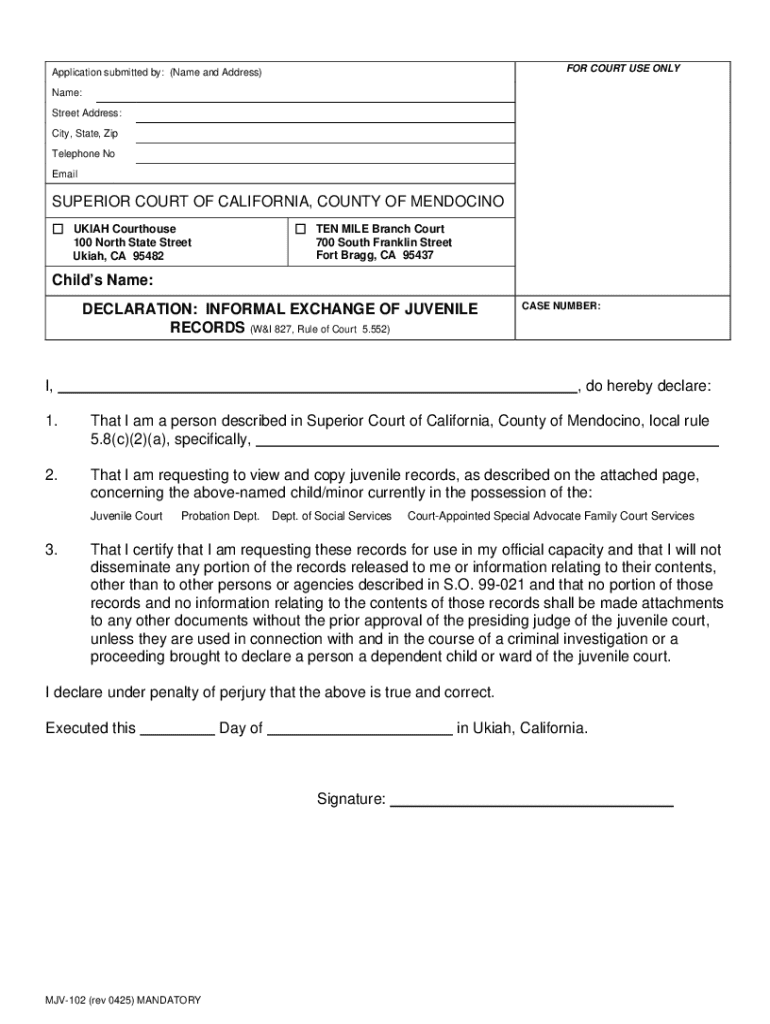







Definition and Purpose of the J-16 Juvenile Case File Access Form
The J-16 juvenile case file access form serves as an official application for individuals seeking permission to access juvenile records within the Superior Court of California, specifically in Mendocino County. This form is essential for individuals who need to view and potentially copy these sensitive records for legitimate, official purposes. To ensure compliance with legal standards, applicants must affirm their eligibility and agree to maintain confidentiality, thereby adhering to restrictions regarding the dissemination of the accessed information.
How to Use the J-16 Juvenile Case File Access Form
Using the J-16 form involves several critical steps to ensure proper submission and compliance. Applicants need to correctly fill out all required sections of the form, which includes providing personal details and a clear statement of the purpose for accessing juvenile records. The form may require attachments or additional documentation to support the applicant's request. It's crucial to provide accurate and truthful information to avoid any potential legal consequences or denial of access.
Important Tips for Completing the Form
- Personal Information: Include full legal name, contact details, and any identification numbers requested.
- Purpose of Access: Clearly articulate the reasons for requesting access to the records.
- Supporting Documentation: Attach any necessary documents that prove eligibility or need for access.
- Signature Requirements: Ensure all signatures are completed as required to validate the application.
Steps to Complete the J-16 Juvenile Case File Access Form
Completing the J-16 form involves a step-by-step process that demands attention to detail and accuracy. Follow these steps for successful form submission:
- Obtain the Form: Download the fillable form from a trusted source or acquire it directly from the court.
- Read Instructions: Carefully review the included instructions to understand all requirements.
- Fill Personal Details: Enter your full name, address, and any other personal identifiers as requested.
- State Your Purpose: Clearly explain the legitimate reasons for accessing the juvenile records.
- Attach Required Documents: Ensure all necessary supporting documents are attached.
- Review and Sign: Double-check all entries for accuracy and sign where necessary to affirm the information provided.
- Submit the Form: Follow the outlined submission methods, whether via mail, in-person, or online.
Eligibility Criteria for Accessing Juvenile Records
Eligibility for accessing juvenile records via the J-16 form is contingent upon several factors:
- Professional Requirement: Applicants must demonstrate a professional or official need to view the records.
- Confidentiality Agreement: A commitment to confidentiality is necessary, with a full understanding of the legal implications of information misuse.
- Rightful Purpose: Records must be used for the intended and declared purpose only.


Legal Use and Confidentiality of the J-16 Form
Legal use of the J-16 form strictly involves the application for access to records under authorized conditions. By completing the form, applicants agree to adhere to legal frameworks that govern juvenile record access, ensuring the information is used solely for scholarly, legal, or official duties. Any breach of confidentiality can result in severe legal repercussions, emphasizing the importance of understanding and complying with these regulations.
Key Elements of the J-16 Form
When engaging with the J-16 form, it is crucial to focus on its key elements:
- Applicant Information: Required fields must be completed accurately to identify the requester.
- Verification Statement: A section requiring a declaration of truth and accuracy of the data provided.
- Declaration of Purpose: A clear declaration outlining why access to the juvenile records is necessary.
- Confidentiality Clause: Agreement to maintain the confidentiality of the accessed records.
State-Specific Regulations for Juvenile Record Access in California
Access to juvenile records in California is subject to specific rules and conditions:
- Variable Court Procedures: Different counties may have unique procedures, emphasizing the need to confirm local requirements.
- Legal Conditions: Requests must align with state laws governing juvenile privacy and record management.
- Approval Protocols: The Mendocino County court requires thorough vetting of applications before granting access.
Examples and Scenarios for Using the J-16 Form
Consider the following scenarios where the J-16 form may be used:
- Legal Practitioners: Attorneys representing clients in juvenile cases may require document access for case preparation.
- Academic Researchers: Scholars conducting research on juvenile justice might need the records for data collection.
- Social Services Personnel: Workers in social services may need access to records to support service provision decisions.
This section explores various uses, providing context for potential applicants to decide if the form aligns with their needs.




