




01. Edit your form online
Type text, add images, blackout confidential details, add comments, highlights and more.

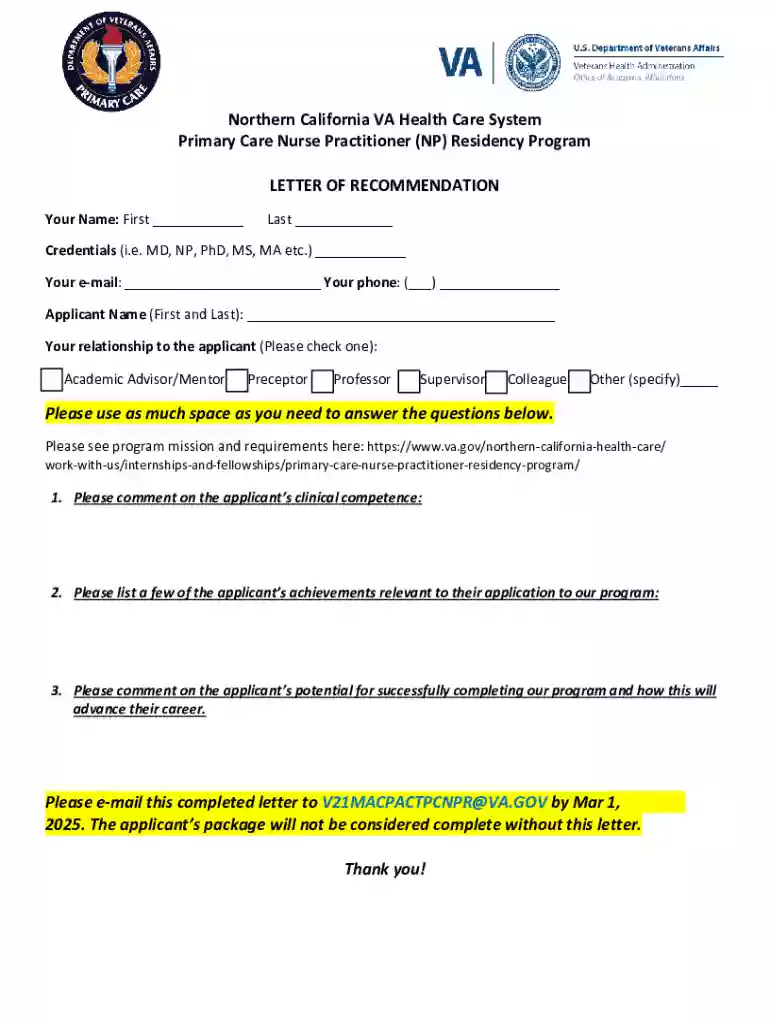
Type text, add images, blackout confidential details, add comments, highlights and more.

Draw your signature, type it, upload its image, or use your mobile device as a signature pad.

Send it via email, link, or fax. You can also download it, export it or print it out.
The "Primary Care Nurse Practitioner Residency Program Recommendation" is a formal document used to highlight an applicant's qualifications when they apply to residency programs, such as those offered by the Northern California VA Health Care System. This document reflects the candidate’s clinical skills, achievements, and potential to excel in a rigorous training environment. It is usually written by someone who is familiar with the applicant's professional capabilities and character, providing insights into their readiness for advanced clinical training. The letter serves as a crucial component of the application process, often influencing admission decisions based on the evaluator’s perspective of the candidate’s aptitude for the program.
Utilizing the recommendation effectively involves several steps. First, the applicant needs to identify potential recommenders who have a direct understanding of their clinical competencies and potential for success. Once the recommender consents, the applicant should provide them with all necessary materials, such as their resume or CV, a personal statement, and details about the specific program. This will help the recommender tailor the letter to emphasize the applicant's strengths pertinent to the program’s requirements.
Recommendations should be submitted according to the program’s guidelines, which usually detail online or mailed submissions. Applicants often follow up with recommenders to confirm submission, ensuring nothing is left incomplete that might delay their application process.
In the U.S., the recommendation letter is used solely within the context of residency applications. It must reflect an honest and accurate portrayal of the applicant's abilities and character. Providing false or exaggerated information can have serious legal implications, potentially affecting both the applicant and the recommender. Institutions require accurate data to make informed decisions on program entries, hence integrity in these recommendations carries significant legal weight.
While the usage of recommendation letters follows a general format, some states may have specific prerequisites or formats that need to be met. For example, some states may necessitate additional attestations or verification of the recommender's credentials. It is crucial for applicants to verify any state-specific requirements through the residency program to prevent any issues during the application process.
Typically, eligibility for needing a recommendation involves being an applicant to a nurse practitioner residency program. These applicants must have completed a nurse practitioner program successfully and should be licensed to practice within the relevant state. Their application should reflect their readiness and capability for advanced practice and residency training, often substantiated through the recommendation letter.


The application process for the program includes gathering recommendation letters as part of the submission package. After submission, each letter is thoroughly reviewed as part of the selection criteria. Approval times can vary but often align with the residency program’s intake periods and decision cycles, which applicants should check to ensure adherence to timely completion and submission.
At DocHub, your data security is our priority. We follow HIPAA, SOC2, GDPR, and other standards, so you can work on your documents with confidence.



Jun 17, 2025 Candidates for the Primary Care Nurse Practitioner Residency must be a graduate of a masters or doctoral level nurse practitioner program
Detailed information on duty hour citations, including duty hour citations and time to next RRC review by specialty, is shown at Exhibit 1.
Sep 9, 2025 This 12-month post-graduate program offers clinical and academic exposure to recent graduates transitioning into professional roles as Nurse Practitioners.


