
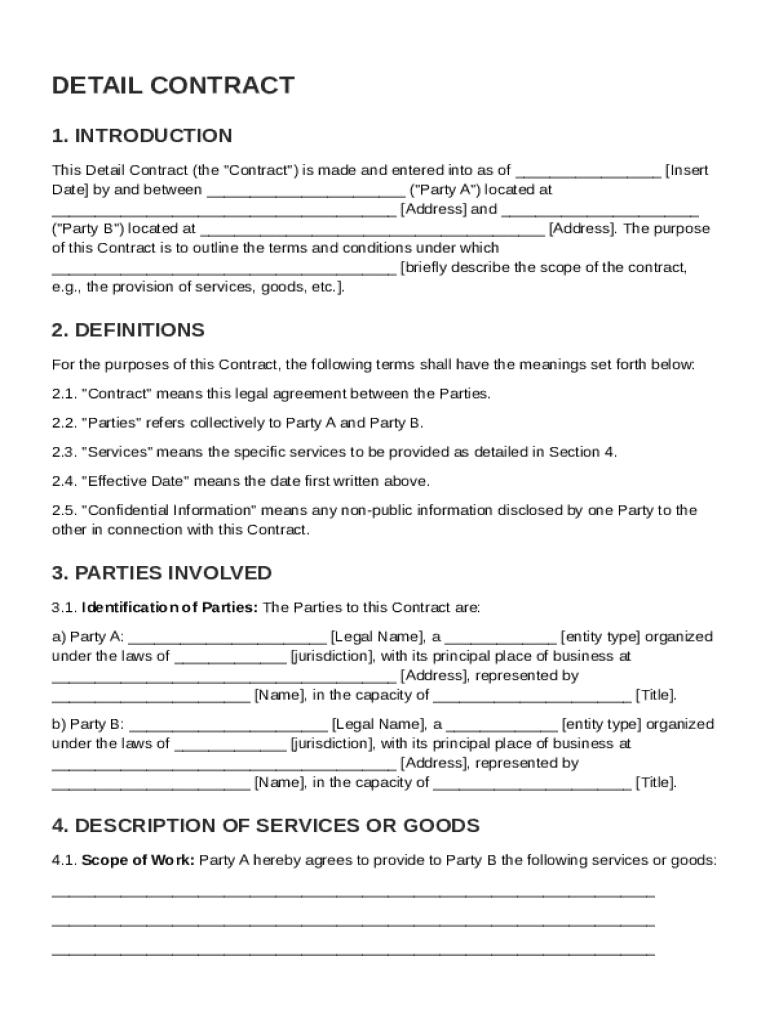







Definition and Meaning
A Detail Contract Template is a structured document used to outline the terms and conditions between two parties engaged in a service or goods transaction. It serves as a formal agreement that ensures both parties adhere to agreed responsibilities, obligations, and expectations. These templates are essential in creating a comprehensive framework highlighting various legal aspects such as definitions, obligations, and payment terms. By using a Detail Contract Template, parties can maintain clarity in their contractual relationship and avoid potential misunderstandings or disputes.
Key Elements of the Detail Contract Template
Definitions and Terms
A Detail Contract Template must include a section for definitions that explains key terms used throughout the document. This ensures that both parties have a clear understanding of meanings, minimizing the risk of misinterpretation.
- Parties involved: Identifies Party A and Party B, delineating roles and responsibilities.
- Goods or services: Clearly defines what will be provided or rendered, including quality and scope.
Obligations of Both Parties
This section outlines the specific duties each party is expected to perform. It includes timelines and standards of performance to ensure that all contract elements are executed according to agreed terms.
- Party A's obligations: Details tasks and deliverables.
- Party B's obligations: Covers responsibilities to ensure cooperation and coordination.
Payment Terms
Payment terms are crucial as they define how, when, and what amount will be paid for the services or goods provided. It includes:
- Payment schedule: Specifies dates and amounts for each payment.
- Methods of payment: Outlines acceptable forms of payment, like bank transfer or check.
- Penalties for late payment: Details consequences, fostering accountability.
Who Typically Uses the Detail Contract Template
This template is commonly used by businesses, freelancers, and service providers who need to formalize agreements with clients or partners. The users include:
- Small businesses: To ensure clarity in business transactions and partnerships.
- Service providers: Including consultants and freelancers, to detail scope and payments.
- Corporations: For large-scale agreements that involve complex arrangements and multiple stakeholders.


Legal Use of the Detail Contract Template
The Detail Contract Template is designed to be legally binding, complying with applicable laws and regulations. It includes:
- Governing law: Specifies the legal jurisdiction under which the contract will be interpreted.
- Dispute resolution: Provides methods for addressing conflicts, such as arbitration or mediation.
- Force majeure: Accounts for unforeseeable events that may prevent fulfillment of contractual obligations.
Steps to Complete the Detail Contract Template
- Review Definitions: Understand and modify definitions to suit specific transaction needs.
- Outline Obligations: Specify tasks and responsibilities for each party.
- Set Payment Terms: Define payment methods, schedules, and amounts.
- Incorporate Confidentiality Clauses: Protect sensitive information with non-disclosure agreements.
- Clarify Termination Terms: Detail conditions under which the contract may be terminated.
- Draft Dispute Resolution Procedures: Establish agreed processes for conflict management.
- Finalize and Sign: Both parties should review the completed document, making necessary revisions before signing.
Important Terms Related to Detail Contract Template
Understanding relevant legal jargon is essential for drafting a Detail Contract Template, such as:
- Confidentiality: Safeguards private business information from unauthorized disclosure.
- Termination: Conditions or events that allow parties to exit the contractual agreement.
- Severability: Ensures that if one part of the contract is found invalid, the remainder still applies.
State-Specific Rules for the Detail Contract Template
Although the Detail Contract Template is designed for use across the United States, individual states might have specific requirements:
- State statutory requirements: Variables due to differing state laws regarding contracts.
- Local business practices: Customary practices that may affect contractual terms.
- Notarization: Some states might require notarization to validate the contract.
Examples of Using the Detail Contract Template
Scenario A: Freelance Graphic Design Contract
A freelance graphic designer uses the Detail Contract Template to formalize an agreement with a client for branding material. The contract specifies:
- Deliverables: Logo design, business cards, and social media graphics.
- Payment terms: Total fee divided into milestones – initial deposit, first draft payment, and final approval balance.
- Timeline: Exact dates for each phase of the project.
Scenario B: Small Business Vendor Agreement
A local boutique contracts with a clothing vendor for the seasonal supply of apparel. The contract outlines:
- Product details: Specifications on quality, type, and quantity of clothing.
- Delivery schedule: Bi-weekly shipments coordinated for timely inventory restocking.
- Quality assurance: Inspection protocols to ensure merchandise meets standards.
By using the Detail Contract Template, these examples illustrate how parties can clearly outline expectations, secure transaction legitimacy, and manage business relationships efficiently.




