
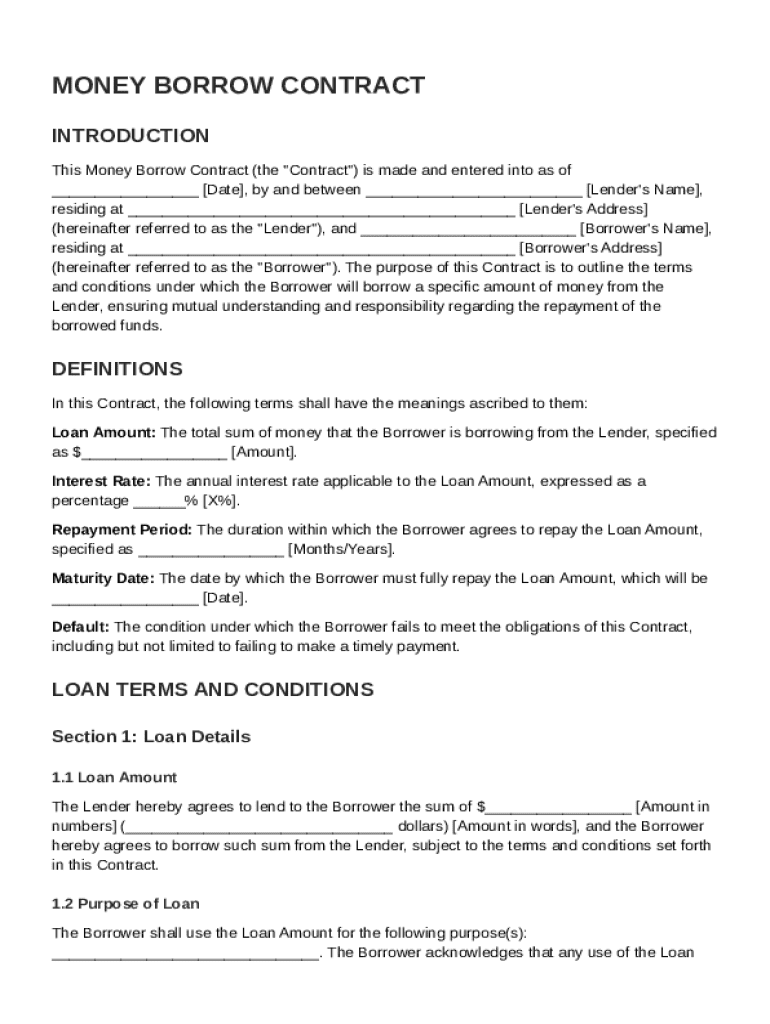







Definition and Meaning
A Money Borrow Contract Template is a formal document that defines the terms and conditions under which a Borrower agrees to borrow a sum of money from a Lender. This contract outlines critical aspects such as the loan amount, interest rate, repayment terms, and governs the relationships and responsibilities of both parties. It serves as a legal framework to ensure mutual understanding and to protect the interests of both the Borrower and the Lender.
Key Elements of the Money Borrow Contract
- Loan Amount: Specifies the precise amount of money being borrowed.
- Interest Rate: Details the percentage of interest to be applied to the borrowed amount.
- Repayment Schedule: Outlines the timeline and method for payments.
- Default Conditions: Describes what constitutes a default and the consequences thereof.
- Governing Law: Indicates the jurisdiction under which the contract is governed and interpreted.
Real-world scenarios highlight the importance of clearly defining these elements to prevent potential disputes or misunderstandings.
How to Use the Money Borrow Contract Template
To effectively use the Money Borrow Contract Template, it is essential to customize the template based on the specific agreement details between the Borrower and Lender.
- Fill in Personal Details: Include names and contact information of both parties.
- Specify Loan Details: Add the amount, interest rate, and repayment schedule.
- Include Any Special Terms: Document particular conditions or clauses that are mutually agreed upon.
- Review and Sign: Both parties should carefully review the contract before signing to ensure all details are accurate.
Practical examples include small business loans or personal loans among family members, where using a template ensures all parties have a written record of their agreement.
Legal Use of the Money Borrow Contract Template
Ensuring the legality of the Money Borrow Contract Template is critical for it to be enforceable in a court of law.
Compliance with ESIGN Act
- Electronic Signatures: The contract can include electronic signatures, which are legally binding under the ESIGN Act.
- Verification Processes: Utilize authentication protocols like OAuth 2.0 for secure access.
Confidentiality and Protection
- Data Encryption: Use platforms like DocHub that offer 256-bit SSL encryption to protect personal information.
- Governing Law Clause: Clearly state which state’s laws will govern the contract to address any legal disputes.
Important Terms Related to Money Borrow Contract Template
Familiarity with specific terms is crucial for comprehending the Money Borrow Contract Template:
- Principal: The initial amount borrowed.
- Interest Rate: The cost of borrowing the money.
- Amortization: The process of reducing the debt through regular payments over time.
- Collateral: Assets pledged as security for the loan.
Understanding these terms can help both parties better navigate their obligations and rights within the contract.
Steps to Complete the Money Borrow Contract Template
Completing a Money Borrow Contract Template requires attention to detail and careful execution of steps:
- Gather Information: Collect all necessary details about the loan terms and party information.
- Customize Template: Adapt the template to include specific details relevant to your agreement.
- Review Legal Clauses: Ensure that the contract complies with pertinent legal requirements and includes necessary clauses.
- Finalize and Execute: Both parties review, sign, and retain a copy of the contract for their records.
Practical steps like these help prevent common errors such as missing information or unclear terms that might invalidate the contract.
Examples of Using the Money Borrow Contract Template
Several scenarios illustrate how this contract template can be used effectively:
- Small Business Loans: Entrepreneurs borrow funds to start or expand their businesses.
- Peer-to-Peer Lending: Agreements between individuals for personal loans.
- Short-term Financing: Temporary loans for immediate financial needs.
These examples demonstrate the flexibility and utility of the Money Borrow Contract Template in various contexts.
State-Specific Rules for the Money Borrow Contract Template
Different states may have unique requirements or conditions related to money borrowing contracts:
- Interest Rate Caps: Some states impose limits on the interest rates that can be charged.
- Usury Laws: Regulations in certain states may affect how loans are structured.
- Filing Requirements: Some jurisdictions require filing or registration of larger loan agreements.
Awareness of these state-specific rules is vital for ensuring compliance and avoiding legal complications.
Software Compatibility
The Money Borrow Contract Template is compatible with various software platforms, enhancing convenience and flexibility:
- DocHub: Seamless document editing, signing, and sharing.
- Google Workspace: Direct integration with Google Drive and Gmail for document management.
- Cloud Storage Services: Compatibility with popular services like Dropbox and OneDrive.
Such compatibility allows users to work on their documents across multiple platforms, facilitating efficient document management and collaboration.




