






Definition & Meaning
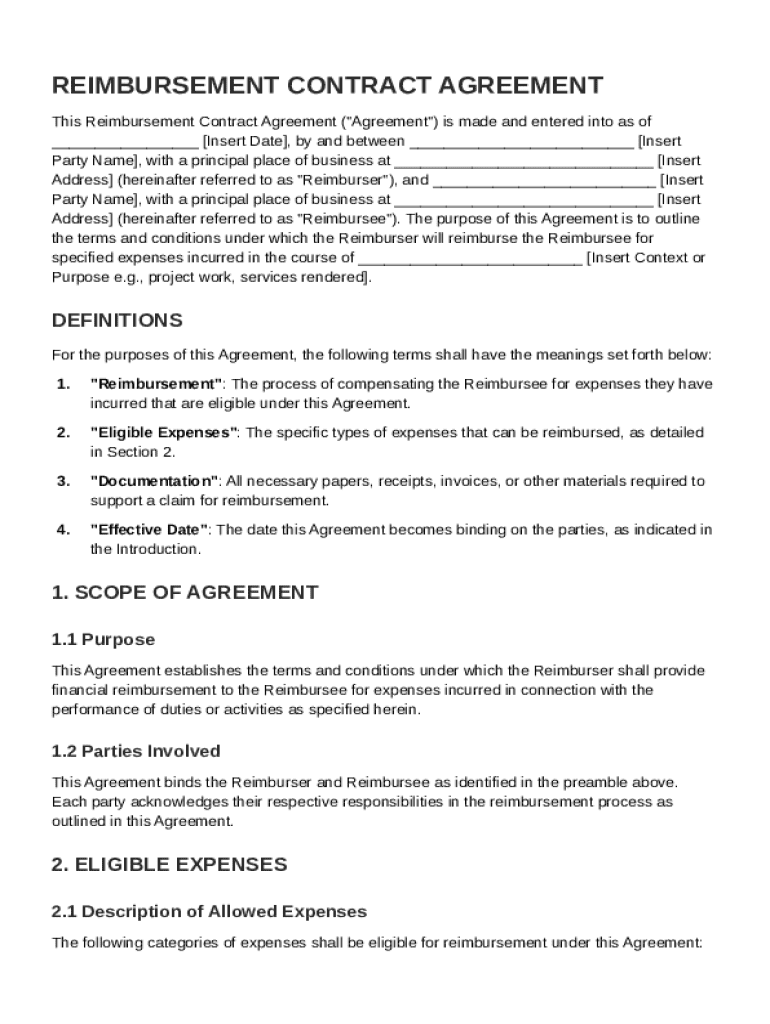
The Reimbursement Contract Template is a legal document that establishes the agreement between two parties: the Reimburser, who promises to compensate the Reimbursee for eligible expenses incurred during a specific project or service. This template provides a structured framework to define key terms like eligible expenses, excluded expenditures, and reimbursement procedures. By outlining the conditions under which reimbursements will be made, both parties gain clarity and security regarding financial interactions.
Key Terms in the Template
- Eligible Expenses: These include all costs that qualify for reimbursement under the contract. Examples may include travel costs, equipment purchases, or other project-related expenses.
- Excluded Expenditures: Costs that are not covered by the contract, often specified to prevent misunderstandings.
- Reimbursement Process: Detailed steps for submitting claims, including documentation and deadlines.
The Reimbursement Contract Template serves as a comprehensive guide for individuals and businesses to manage and formalize financial agreements effectively.
Key Elements of the Reimbursement Contract Template
The contract includes several critical elements designed to ensure a clear understanding between all involved parties.
Essential Clauses
- Definitions: Precise definitions of terms used throughout the contract ensure mutual understanding. Terms like 'project', 'service', and 'expenses' are clearly defined.
- Claim Submission: Specifies how and when claims must be submitted, including necessary documentation such as receipts and invoices.
- Approval and Payment Terms: Details the timeline and method of reimbursements after claim approval.
Developing a thorough understanding of these elements is essential to prevent disputes and facilitate smooth transactions.
Steps to Complete the Reimbursement Contract Template
Completing the Reimbursement Contract Template involves several straightforward steps:
- Initial Review: Carefully read through all sections of the template to understand its scope and the obligations of each party.
- Fill in Party Information: Enter the full names and contact details of the Reimburser and Reimbursee.
- Define the Project/Service: Clearly describe the project or service that incurs the expenses.
- List Eligible Expenses: Specify which expenses are considered eligible, providing detailed descriptions where necessary.
- Attach Documentation Requirements: Outline the necessary documents for claims, such as receipts or proof of payment.
- Signatures: Ensure all parties sign and date the document, indicating their agreement to the terms.
These steps help ensure accuracy and completeness when finalizing the contract.
Important Terms Related to Reimbursement Contract Template
Understanding related terminology is crucial for effectively using the template.
Critical Definitions
- Reimburser: The individual or entity responsible for reimbursing expenses.
- Reimbursee: The person or entity who incurred expenses and seeks reimbursement.
- Claim Submission: The process by which the Reimbursee submits proof of expenses for reimbursement.
Additional Terms
- Dispute Resolution: Methods for resolving disagreements that might arise from the contract.
- Alterations: Conditions under which the contract can be amended or terminated.
Grasping these terms is vital for the successful implementation and management of the contract.
Legal Use of the Reimbursement Contract Template
The legal implications of using the Reimbursement Contract Template are significant, as it forms a binding agreement between the parties.
Compliance and Enforceability
- Legally Binding: Once signed, both parties are legally obligated to adhere to the terms.
- Modification Rights: Specifies how the contract can be legally modified or terminated.
Understanding these legal aspects ensures that both parties are aware of their rights and responsibilities, reducing the risk of disputes.
Examples of Using the Reimbursement Contract Template
Real-world scenarios illustrate the versatility of the Reimbursement Contract Template.
Practical Applications
- Business Travel: An employee traveling for work may incur travel-related expenses that the employer agrees to reimburse.
- Freelancer Projects: A freelancer can be reimbursed for materials purchased for a project, provided receipts and proof of expense.
Diverse Contexts
- Non-Profits: Volunteers can be reimbursed for costs incurred during events or campaigns.
- Government Contracts: Contractors working on government projects may use reimbursement contracts for project expenses.
These examples highlight the template's wide applicability in various industry sectors.
Filing Deadlines / Important Dates
Adhering to specified deadlines is critical for ensuring timely processing of reimbursements.
Key Timelines
- Submission Deadlines: Each contractual agreement will specify the timeframe for submitting reimbursement claims, often within 30 to 60 days post-expense.
- Payment Timelines: Details the period within which reimbursement payments will be processed after claim approval, typically within 15 days.
Punctual submissions and payments help maintain a smooth financial workflow between parties.
Form Submission Methods (Online / Mail / In-Person)
Various methods exist for submitting completed reimbursement contracts and related claims.
Submission Options
- Online: Using platforms like DocHub for secure online submissions, enabling digital documentation and easy tracking.
- Mail: Traditional submission via postal services, requiring physical copies and additional mailing time.
- In-Person: Direct handover of documents during meetings or formal transactions.
The choice of submission method may depend on convenience, security, and the parties' access to technology.
Software Compatibility (TurboTax, QuickBooks, etc.)
Ensuring compatibility with existing software systems maximizes efficiency.
Platform Integration
- Accounting Software: Templates that integrate with systems like QuickBooks can simplify financial tracking and reporting.
- Document Management: Compatibility with platforms like DocHub facilitates seamless edits, signatures, and sharing.
Leveraging compatible software ensures that the contract management process is efficient and error-free.
Business Types That Benefit Most from Reimbursement Contract Template
Certain business types gain significant advantages by using a Reimbursement Contract Template.
Beneficial Entities
- Small Businesses: Use reimbursement contracts to manage employee expenses efficiently.
- Freelancers and Consultants: Formalize expense reimbursement agreements with clients.
Industry Examples
- Construction: Contractors may need to itemize and claim various project-related expenses.
- Healthcare: Medical professionals can seek reimbursement for supplies and services related to patient care.
These businesses benefit from structured templates that provide clear guidelines for reimbursement processes.
Digital vs. Paper Version
Selecting between digital and physical versions depends on specific needs and preferences.
Benefits of Each Format
- Digital: Easier to store, edit, and share; reduces paper waste and allows for secure online submissions.
- Paper: Useful where digital access may be limited or when hard copies are legally required.
Opting for a format that aligns with operational needs ensures the contract's effectiveness and compliance.
By examining these aspects, users can effectively utilize the Reimbursement Contract Template for a wide range of financial agreements.