






Definition & Meaning
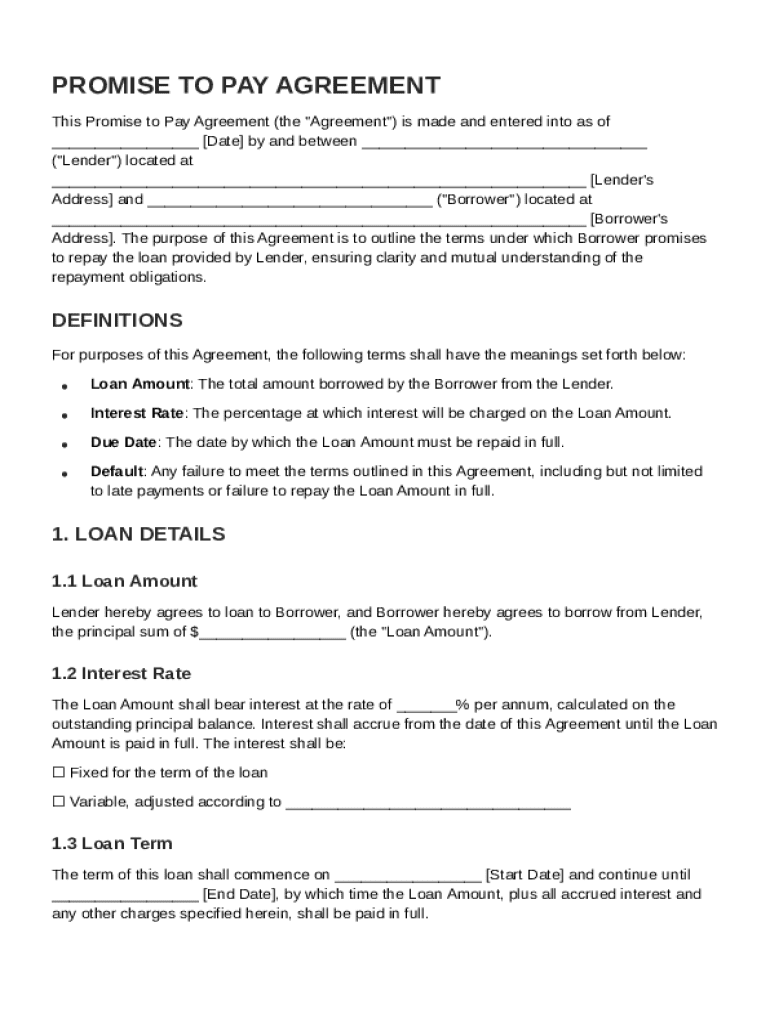
A Promise To Pay Contract Template is a legally binding document that outlines an agreement between a lender and a borrower. It typically specifies the terms of a loan, including the loan amount, interest rate, repayment schedule, and consequences of default. This document serves as a formal acknowledgment of a debt, ensuring both parties understand their obligations. By detailing the repayment methods and including representations from both parties, the contract helps prevent misunderstandings and provides legal recourse if the terms are not met.
Key Components
- Loan Amount: Clearly states the principal amount borrowed.
- Interest Rate: Specifies the interest rate applied to the loan.
- Repayment Schedule: Outlines when and how payments should be made.
- Consequences of Default: Details penalties or legal actions if the borrower fails to meet obligations.
Real-World Examples
In a typical scenario, a small business might use this template to secure a short-term loan to cover operational costs. The lender can be assured of repayment terms, while the borrower understands their financial commitments.
How to Use the Promise To Pay Contract Template
Utilizing the Promise To Pay Contract Template involves a series of structured steps to ensure the document fulfills its purpose effectively. Proper usage guarantees that both lender and borrower are protected under the agreed terms.
Step-by-Step Instructions
- Download the Template: Obtain the template from a reliable source like DocHub.
- Customize the Terms: Fill in specific loan details including the amount, interest rate, and repayment schedule.
- Review Legal Conditions: Ensure compliance with local and state laws to maintain enforceability.
- Signatures: Both parties should sign the document, preferably in the presence of a notary.
- Distribute Copies: Provide each party with a copy of the signed agreement.
Practical Scenario
Consider an individual lending money to a friend. Customizing the template with clear terms and securing signatures strengthens trust and provides a legal safety net.
Key Elements of the Promise To Pay Contract Template
The structure of the Promise To Pay Contract Template is designed to address multiple aspects crucial for a binding agreement. Each element serves a specific purpose to protect the interests of both parties involved.
Essential Sections
- Identifying Information: Includes full names and contact details of both lender and borrower.
- Loan Details: Comprehensive description of the loan amount and terms.
- Payment Terms: Breakdown of monthly payment amounts and due dates.
- Default Provisions: Detailed explanation of actions taken in case of non-payment.
- Signatures and Dates: Ensures both parties acknowledge and agree to the terms.
Variations and Edge Cases
In some cases, additional clauses may be added for clarity, such as penalties for late payments or options for early repayment. Customization allows the contract to cater to unique requirements or unusual circumstances.
Legal Use of the Promise To Pay Contract Template
The enforceability of the Promise To Pay Contract Template hinges on compliance with applicable laws. Understanding these legal aspects is critical for both drafting and executing the document.
Compliance Requirements
- Governing Law: The agreement should specify which jurisdiction's laws apply.
- Legally Compliant Terms: Ensure that all contractual terms are in line with statutory requirements.
- Notarization: While not always required, notarization can add an extra layer of authenticity and legality.
State-Specific Legalities
Laws regarding lending and debt recovery can vary by state. It is crucial to review state-specific rules to ensure all aspects of the contract adhere to local regulations.
Important Terms Related to the Promise To Pay Contract Template
A comprehensive understanding of the terminology used within the Promise To Pay Contract Template is essential for its proper execution. This ensures both parties can navigate the agreement confidently.
Glossary of Key Terms
- Lender: The party providing the loan.
- Borrower: The party receiving the loan.
- Principal: The original sum of money borrowed.
- Interest Rate: The rate charged on the borrowed money.
- Collateral: Any asset pledged as security for the repayment of the loan.
Application in Context
For first-time borrowers, understanding these terms helps clarify their responsibilities and the lender's rights. This knowledge can also aid in negotiations, ensuring fair and reasonable terms.
State-Specific Rules for the Promise To Pay Contract Template
State laws can significantly impact the creation and enforcement of the Promise To Pay Contract Template. Familiarity with these variations ensures that the agreement remains legally sound.
Common State Variations
- Interest Rate Caps: Some states have maximum interest rates that can be charged.
- Statute of Limitations: Varies for how long a lender has to enforce the debt.
- Consumer Protection: States may have specific protections for borrowers to prevent predatory lending practices.
Case Study: California vs. New York
In California, consumer protection laws are stringent, requiring explicit disclosure of all terms. New York may have different requirements for interest rate caps, illustrating the necessity of tailoring each contract to the relevant jurisdiction.
Examples of Using the Promise To Pay Contract Template
Practical examples showcase how the Promise To Pay Contract Template can be utilized in various scenarios. These highlight its versatility and effectiveness in different situations.
Personal Loans
Individuals borrowing money from friends or family often rely on this template to ensure there are no misunderstandings and to document the lending terms officially.
Small Business Financing
Entrepreneurs may use this template to secure funding for business expansion, ensuring detailed, clear terms that protect both the investor's and the business owner's interests.
Steps to Complete the Promise To Pay Contract Template
Completing the Promise To Pay Contract Template requires attention to detail to ensure accuracy and completeness. Each step is vital for creating an enforceable, clear agreement.
Completion Process
- Gather Required Information: Collect all necessary details, such as the loan amount, terms, and personal information of both parties.
- Draft Initial Terms: Enter the basic framework of the agreement, focusing on critical financial terms.
- Seek Legal Review: Have a legal professional review the draft to ensure compliance and comprehensiveness.
- Finalize and Sign: After any necessary revisions, both parties should formally sign the document.
- File the Contract: Keep a copy safely stored and easily accessible for future reference.
Considerations for Borrowers
Borrowers should ensure clarity and agreement on all terms before signing to avoid future disputes. Agreeing to feasible repayment terms can prevent potential conflicts.