
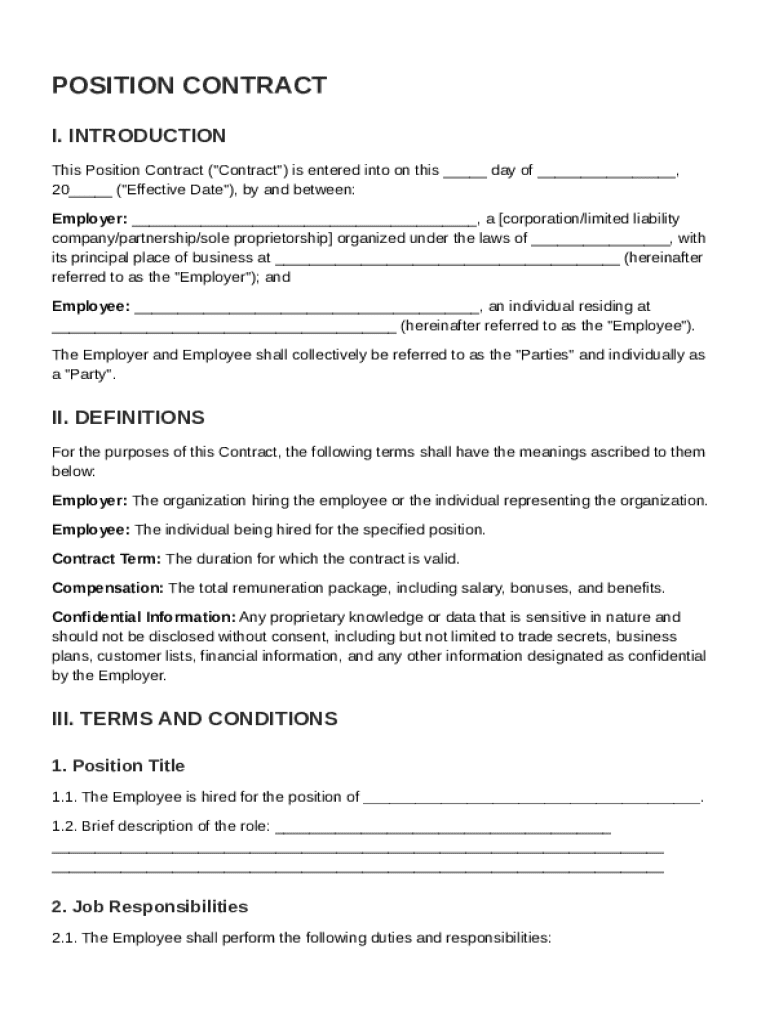







Definition and Purpose of a Position Contract Template
A Position Contract Template serves as a formal agreement between an employer and an employee. It outlines the employment terms, including the job title, responsibilities, compensation, benefits, work schedule, contract duration, termination conditions, confidentiality obligations, dispute resolution procedures, and other legal provisions. This template provides a structured approach to documenting the expectations, roles, and obligations of both parties. By using a consistent template, companies ensure clarity and uniformity in employment agreements, which can minimize misunderstandings and potential legal disputes.
Why Use a Position Contract Template?
- Clarity and Consistency: Provides a clear framework for employment terms, reducing ambiguity.
- Legal Compliance: Ensures that the employment agreement meets legal standards and includes necessary provisions.
- Efficiency: Saves time by standardizing contracts for multiple employees.
- Risk Mitigation: Helps avoid legal disputes by clearly defining each party's obligations and rights.
How to Use the Position Contract Template
Using a Position Contract Template involves customizing it to fit the specific needs of the employer and the role. The process generally includes:
-
Review and Customize: Start by reviewing the template to ensure it covers necessary aspects such as responsibilities and compensation. Customize sections to reflect the specific details of the job the employee will perform.
-
Legal Review: If necessary, involve legal counsel to ensure the terms meet legal requirements and company policies.
-
Employee Input: Allow the employee to review the contract and provide input or ask questions to ensure mutual understanding and agreement.
-
Finalizing: Once both parties agree on the terms, the contract should be printed, signed, and stored properly.
-
Updating: Periodically review and update the contract as necessary to accommodate changes in roles, company policies, or laws.
How to Obtain the Position Contract Template
Finding a Position Contract Template can be done through several methods:
- HR Software Platforms: Many human resource management software solutions offer standard contract templates.
- Online Legal Services: Websites like DocHub provide downloadable templates that can be customized.
- Legal Professionals: Employers can consult with legal professionals to obtain a tailored template that fits specific organizational needs.
- Professional Associations: Industry-specific associations often provide templates for common use within that field.
Key Elements of the Position Contract Template
The Position Contract Template includes several critical components that must be addressed:
-
Employment Details:
- Job Title and Description
- Employment Type (full-time, part-time, contractual)
- Work Schedule and Location
-
Compensation and Benefits:
- Salary or Wage Details
- Benefits Package (healthcare, retirement plans)
- Bonus and Incentive Structures
-
Legal and Compliance Aspects:
- Confidentiality Agreements
- Non-compete Clauses
- Termination Conditions and Notice Periods
-
Other Provisions:
- Dispute Resolution Procedures
- Modification and Review Clauses
- Signature Lines for Employer and Employee
Legal Use of the Position Contract Template
Ensuring that a Position Contract Template complies with U.S. labor laws is vital. Legal use primarily involves:
- Inclusion of Essential Terms: Every contract must address basic employment rights and obligations.
- State and Federal Compliance: The terms within the contract should align with state and federal employment laws.
- Modifications and Updates: Regularly updating the contract to reflect changes in employment law is crucial.
- Documentation and Retention: Properly document and retain employment contracts to provide legal protection to both parties.
Examples of Legal Considerations
- Discrimination Laws: Contracts must comply with laws prohibiting discrimination based on race, gender, age, religion, or disability.
- Employment-at-Will: In many states, employment is at-will unless otherwise specified in the contract, meaning either party can terminate the employment relationship at any time.
State-Specific Rules for Position Contracts
Employment laws can vary significantly between states in the U.S. This means that a Position Contract Template may need adjustments based on state-specific requirements:
- Minimum Wage Laws: Each state has its own rules regarding minimum wage, which must be reflected accurately in the contract.
- Overtime Regulations: Varying state laws will dictate how overtime must be compensated.
- Employment Classifications: State laws might affect how different employment classifications (e.g., exempt vs. non-exempt) are handled.
Common State Variations
- California: Known for its stringent labor laws, including extensive employee benefits and rights protections.
- Texas: Generally follows more employer-friendly labor laws, impacting contract terms.
Versions or Alternatives to the Position Contract Template
Employers may choose various alternatives or versions of a Position Contract Template depending on their needs:
- Executive Templates: Designed for higher-level positions with additional clauses for stock options, severance, and more.
- Temporary or Seasonal Worker Agreements: Tailored for short-term employment arrangements.
- Freelancer or Independent Contractor Agreements: Different structure focusing on project-based work rather than traditional employment.
Other Considerations
- Digital vs. Paper Contracts: Many companies are shifting towards using electronic contracts for ease of use and storage.
- Field-Specific Templates: Some industries may require specialized templates that include sector-specific compliance requirements.
Who Typically Uses the Position Contract Template?
Position Contract Templates are used by:
- Human Resource Departments: To standardize employment contracts within organizations.
- Small Business Owners: To formalize employment agreements with simplicity and legal compliance.
- Legal Advisors: To ensure contracts meet legal obligations and support organizational policies.


Typical Users by Business Type
- Startups: Often need templates that can be easily customized as the company grows.
- Corporations: Require detailed, comprehensive contracts to manage numerous employees.
- Non-Profits: Use these templates to document roles while ensuring compliance with specific funding requirements.




