




Definition and Meaning
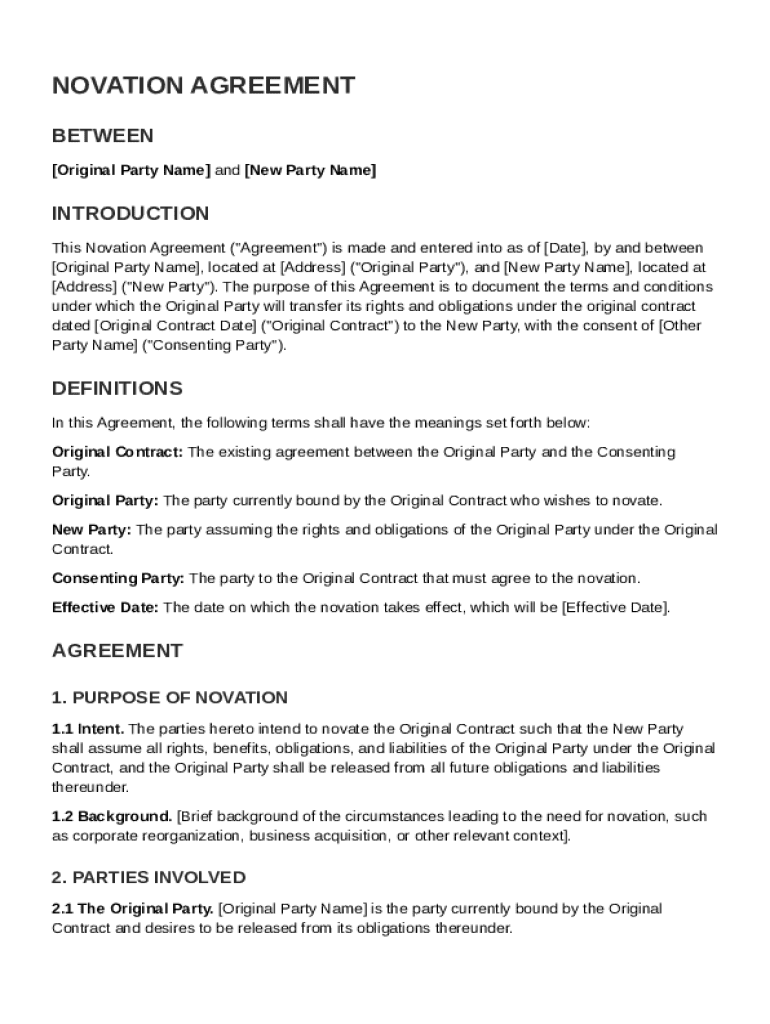
A Novation Contract Template is a legal document used to transfer the rights and obligations of an original party in a contract to a new party, with the agreement of a consenting party. This process, known as novation, allows the original party to be released from the contract, while the new party assumes all related responsibilities and rights. The key purpose of a novation contract is to assure that all involved entities—original, new, and consenting parties—agree to the changes and continue adhering to the contract’s terms. The template ensures uniformity, helping parties accurately capture necessary details to enforce legal responsibilities and rights under the new arrangement.
How to Use the Novation Contract Template
When using the Novation Contract Template, the involved parties must tailor it to accurately reflect the specifics of their situation. Here’s how:
-
Identify the Parties: Clearly specify the details of the original party, new party, and consenting party, including names, addresses, and roles.
-
Detail the Transfer: Outline which rights and obligations are being transferred to the new party. Specify dates and any conditions affecting the transfer.
-
Include Consent: Document the consenting party’s agreement to the transfer, ensuring their role and acceptance are clear.
-
Signatures and Dates: Obtain signatures from all parties involved, along with the dates of signatory consent, guaranteeing legal enforceability.
The document must be reviewed to confirm that all information aligns with the specific agreement terms before finalizing and implementing the novation.
Key Elements of the Novation Contract Template
A well-prepared Novation Contract Template should comprise several critical elements:
- Identification of Parties: Names and contact details of the original, new, and consenting parties.
- Contract Details: An explicit description of the rights and obligations being transferred.
- Consent Clause: A section confirming the consent of the third party involved.
- Indemnification: A clause stating indemnification terms to protect the parties from future liabilities arising from the original contract.
- Effective Date: The date when the novation takes effect.
- Governing Law: The laws that govern the novation contract, typically relevant to the jurisdiction where the contract is executed.
These elements assure clarity, legal authority, and the proper enforcement of the novation agreement.
Steps to Complete the Novation Contract Template
Implementing a novation contract requires completing the template accurately to avoid disputes:
- Gather Information: Collect all necessary details and documents from all involved parties.
- Draft the Contract: Use the template to draft the agreement, ensuring each section is tailored to the specific terms of the transfer.
- Review and Amend: Verify the content with all parties, making any necessary amendments to reflect agreed-upon terms.
- Execute the Contract: Obtain signatures from all parties, indicating consent and understanding of the agreement’s details.
- Document Storage: Safely store copies of the signed contract for all parties, ensuring easy access for future reference.
These steps aid in facilitating a smooth transition and maintaining legal integrity.
Legal Use of the Novation Contract Template
In the United States, novation contracts are generally recognized as legally binding instruments when executed correctly. To ensure compliance:
- Check State Laws: State-specific regulations can vary, thus consulting local laws is crucial.
- Adhere to Federal Laws: Ensure compliance with any relevant federal statutes that might apply to the novation process.
- Legal Review: Consider having a legal expert review the document, especially for complex agreements involving significant obligations or rights.
This attention to legal detail secures the transaction against potential legal challenges.
Who Typically Uses the Novation Contract Template
The Novation Contract Template is valuable across various sectors, primarily in business and legal fields. Common users include:
- Corporations and Businesses: When one company acquires contracts from another or during mergers and acquisitions.
- Law Firms: Advising clients on transferring contractual obligations to new entities.
- Government Agencies: When public-private partnerships change public or private sector partners.
By utilizing this template, users ensure that their rights and obligations transfer smoothly and legally.

Examples of Using the Novation Contract Template
Practical scenarios where novation contracts are necessary include:
- Corporate Acquisitions: A company purchasing another’s contracts during a takeover.
- Real Estate Transactions: Transferring lease agreements to new owners in property sales.
- Public-Private Partnerships: Transitions of contracts within infrastructure projects when consortium members change.
These examples highlight situations necessitating the use of a well-structured novation agreement.
Versions or Alternatives to the Novation Contract Template
Various versions or alternatives exist for the novation contract, often tailored to specific circumstances or industries. Examples include:
- Assignment Agreements: Used when the consenting party agrees to a simpler transfer of rights, without completely releasing the original party from obligations.
- Amendment Agreements: Useful when minor changes to the parties involved are required without a full novation.
- Tri-Party Agreements: Employed often in banking, these can manage complex novations.
Each alternative has unique uses, benefiting different business scenarios for changing contract parties.