







Definition & Meaning
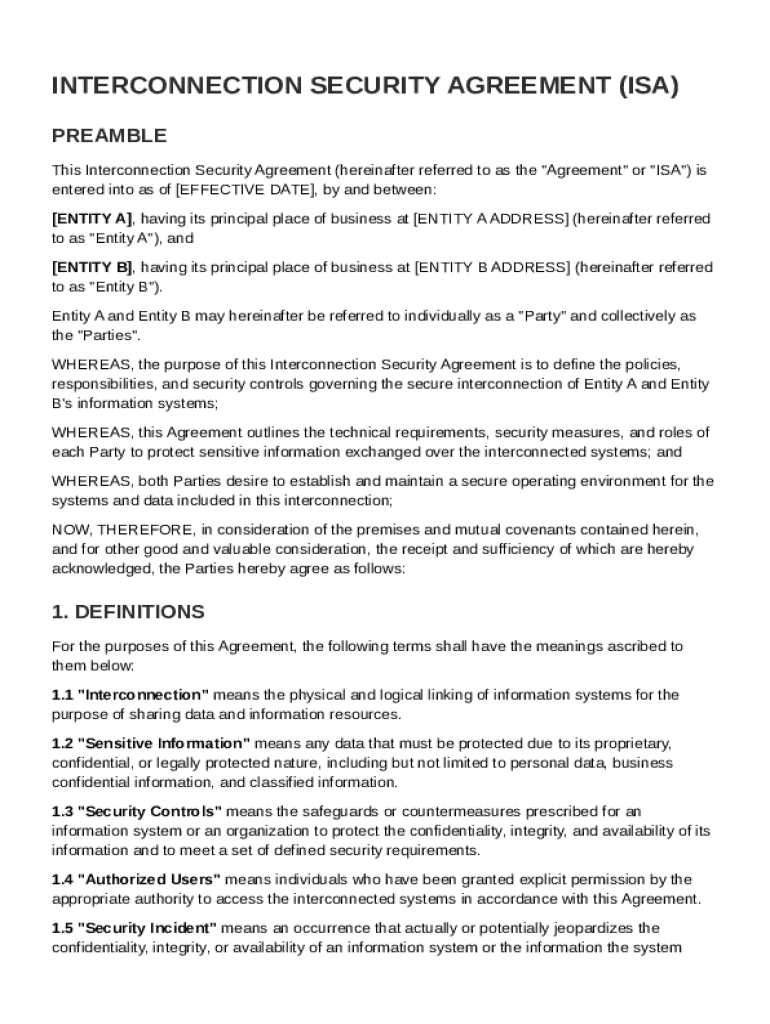
The Interconnection Security Agreement (ISA) is a formal document that establishes the cybersecurity controls and responsibilities required for securely interconnecting two or more information systems between different organizations or entities. It ensures that data flowing across these interconnected systems remains secure, detailing obligations related to security measures, compliance standards, and protective mechanisms. The ISA outlines the scope and definitions, assigning specific responsibilities to each party involved, and ensures that all security protocols are aligned with applicable cybersecurity frameworks.
Key Elements of the Interconnection Security Agreement Template
The ISA template includes several critical components that provide structured guidance for drafting the agreement:
- Security Requirements: Stipulates specific security controls and measures that each party must implement to protect the interconnected systems.
- Risk Assessment: Details the process for regularly evaluating and mitigating potential threats to the systems' security posture.
- Compliance Obligations: Outlines legal and regulatory requirements that must be adhered to by all parties, typically in alignment with national statutes such as the GLBA or HIPAA.
- Roles and Responsibilities: Defines the duties and responsibilities each party assumes once the systems are interconnected, ensuring accountability.
- Termination Conditions: Specifies the circumstances under which the agreement can be terminated, including the process for decommissioning the interconnected systems.
Steps to Complete the Interconnection Security Agreement Template
Completing the ISA template involves a series of coordinated steps:
- Initial Assessment: Evaluate potential risks and determine if an interconnection is necessary based on organizational goals.
- Define Interconnection Requirements: Identify security requirements, responsibilities, and compliance measures tailored to both parties’ needs.
- Draft Agreement: Use the template to draft initial sections, detailing each party's roles, responsibilities, and specific controls.
- Review and Modify: Conduct collaborative reviews with stakeholders to finalize terms that meet security and operational needs.
- Sign and Formalize: Ensure all parties review the final document, secure signatures from authorized representatives, and implement the agreed controls.
Why Use the Interconnection Security Agreement Template
Utilizing an ISA template offers significant benefits:
- Consistency: Provides a standardized framework ensuring all essential elements are consistently addressed, reducing the risk of oversight.
- Efficiency: Accelerates the drafting process by providing pre-structured sections, allowing parties to focus on content rather than format.
- Compliance: Helps align organizational practices with legal and regulatory obligations, ensuring all necessary security measures are documented.
- Risk Mitigation: Offers a clear understanding of risks and precautions, leading to better-informed decisions and improved overall security.
Who Typically Uses the Interconnection Security Agreement Template
Different organizations and sectors utilize ISA templates, including:
- Federal and State Agencies: For secure data sharing and system integration across government networks.
- Private Sector Corporations: Particularly in industries like finance and healthcare, where data sensitivity demands robust security agreements.
- Educational Institutions: When academic databases require secure interconnection with external research partners.
- Non-Profit Organizations: To ensure secure collaborations and data exchanges with partner entities.


Legal Use of the Interconnection Security Agreement Template
The legal use of an ISA is tied to its role in documenting security arrangements aligned with statutory requirements. It serves as both a preventive and a compliance measure, helping to avoid breaches of sensitive data. The ISA formalizes commitments regarding:
- Confidentiality: Protects against unauthorized access to sensitive information exchanged through the interconnected systems.
- Integrity: Ensures that data transmitted between systems retains its original format and content without unauthorized alteration.
- Availability: Guarantees reliable access to data and resources when authorized users need it.
State-Specific Rules for the Interconnection Security Agreement Template
While many ISA elements are universally applicable, certain state-specific rules may affect how ISAs are drafted and enforced:
- California Consumer Privacy Act (CCPA): Impacts how interconnections handle consumer data privacy, requiring explicit consent and transparency.
- New York SHIELD Act: Enhances protections for New Yorkers' private data held by out-of-state companies, affecting interconnection permissions.
Software Compatibility
Interconnection security agreements are often integrated into digital workflows supported by platforms like DocHub:
- File Format Compatibility: ISA templates should be easily editable across popular software such as Microsoft Word and Adobe PDF.
- Digital Signature Integration: Supports legally binding electronic signatures for expediting formal agreements, compatible with tools like DocHub.
- Cloud Storage Synchronization: Seamlessly imports and exports documents to and from cloud services like Google Drive, facilitating ease of access and collaboration.
Examples of Using the Interconnection Security Agreement Template
Real-world scenarios for ISA application demonstrate utility across various sectors:
- Health Information Exchanges (HIEs): Hospitals and clinics use ISAs to establish secure data sharing channels for patient information.
- Financial Services Networks: Banks interconnect with service partners to provide integrated financial products, using ISAs to manage risks and regulatory compliance.
- Academic Research Collaborations: Universities and research institutions interconnect systems for sharing academic and research data, using ISAs to protect intellectual property.
Each scenario illustrates the ISA's role in facilitating secure and compliant interconnections across diverse operational landscapes.




