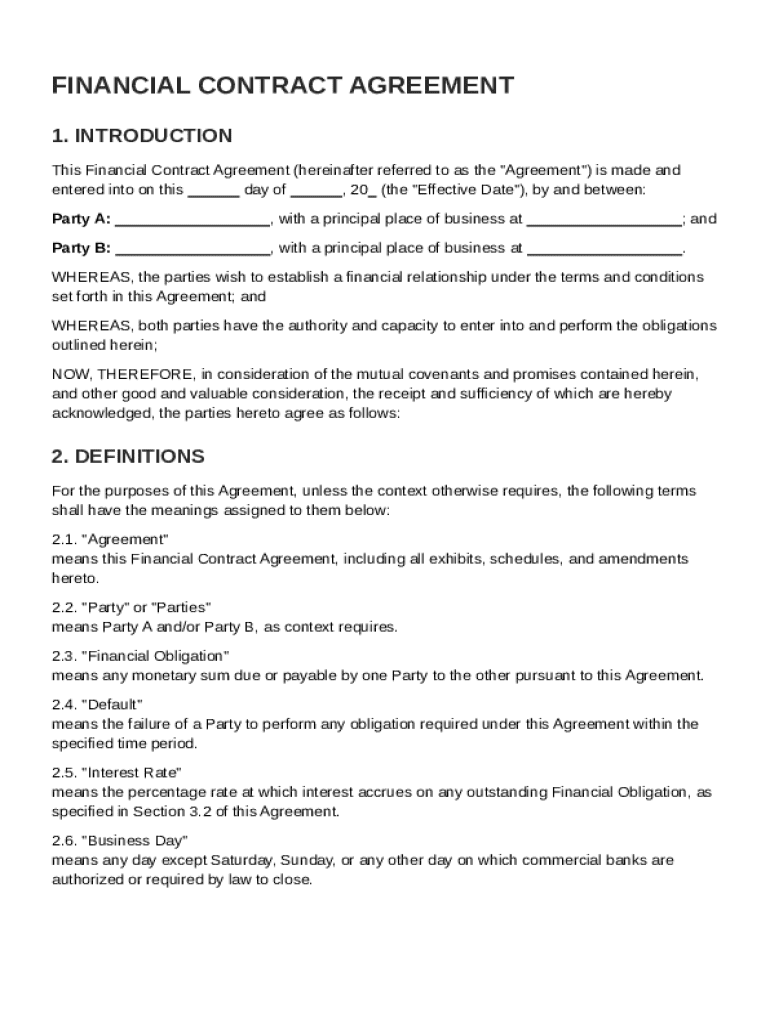







Key Elements of the Financial Contract Template
The Financial Contract Template is designed to outline crucial elements that define the agreement between two parties. These elements set the framework for the financial relationship, ensuring clarity and mutual understanding.
-
Definitions and Terms: Establishes the meaning of key terms used throughout the contract, such as "party," "confidentiality," and "default."
-
Financial Obligations: Details each party's commitments, including payment amounts, due dates, and conditions under which payments may change.
-
Interest Rates: Outlines the applicable interest rate on overdue payments, if any, and how it is calculated.
-
Rights and Responsibilities: Clarifies the roles of each party, including any rights to terminate the agreement or demand performance.
-
Dispute Resolution Methods: Provides steps for resolving disputes, often through mediation or arbitration, without resorting to litigation.
-
Governing Law: Identifies the jurisdiction’s laws that will govern the contract, typically based on the location of the parties.
How to Use the Financial Contract Template
This template is structured to guide users in customizing the agreement to fit their specific needs. Users should adapt each section to align with their financial relationship.
-
Reviewing the Template: Begin by carefully reading through the entire template to understand its scope and components.
-
Customizing Key Sections: Modify sections such as payment schedules and financial obligations to reflect the specifics of your agreement.
-
Adding Additional Clauses: Feel free to append any necessary clauses that address unique aspects of your relationship, like confidentiality or exclusivity agreements.
-
Consulting with Legal Experts: It is advisable to have a legal professional review the customized template to ensure compliance with applicable laws.
-
Finalizing and Signing: Once both parties have agreed on the terms, ensure that all signing parties are present for the signing to validate the contract.
Steps to Complete the Financial Contract Template
Completing the Financial Contract Template involves several precise steps, each critical to ensuring the contract's effectiveness.
-
Preparation: Gather all necessary information, including financial details and personal information of the parties involved.
-
Customization: Input specific details, such as party names, contact information, and transaction specifics, into the relevant sections of the template.
-
Verification: Double-check the accuracy of all entered information, ensuring there are no errors or omissions.
-
Legal Review: Have the document reviewed by a legal professional to address any legal implications or potential conflicts within the terms.
-
Execution: Once verified, obtain signatures from each party, ensuring each understands and accepts the contract’s provisions.
-
Distribution: Provide each party with a copy of the executed contract for their records and future reference.
Legal Use of the Financial Contract Template
The template is constructed to adhere to legal standards applicable within the United States, offering users confidence in its enforceability.
-
Compliance with ESIGN Act: Ensures electronic signatures used in the document are legally binding, recognizing the document as authentic in digital format.
-
Governing Law Provisions: Allows users to specify the legal jurisdiction governing the contract, essential for litigation or dispute purposes.
-
Contractual Legitimacy: By clearly defining roles, responsibilities, and financial terms, the template establishes a legally enforceable agreement.
State-Specific Rules for the Financial Contract Template
While the Financial Contract Template follows federal guidelines, users must consider state-specific regulations that may influence its terms.
-
Usury Laws: Determine the maximum interest rate allowed in your state to ensure compliance with local law.
-
Statute of Limitations: Understand the time frame within which any legal action must be initiated, which varies by state.
-
Notarization Requirements: In some states, notarization may be necessary to increase the enforceability of the document.
Digital vs. Paper Version
The Financial Contract Template is available in both digital and paper formats, each with its unique benefits and limitations.
-
Digital Version: Offers easy accessibility, quick updates, and storage efficiency. It supports the use of electronic signatures for speedy execution.
-
Paper Version: Provides a tangible record, which some parties may prefer for archival purposes and negotiation ease.
-
Decision Criteria: Choose based on convenience, the technical proficiency of involved parties, and any legal mandates.
Software Compatibility
DocHub maintains compatibility with a variety of software solutions, ensuring users can integrate and manage their templates efficiently.
-
Document Formats: The template can be used and edited across multiple platforms, including DOC, PDF, and more.
-
Platform Integration: Capable of synching with cloud services such as Google Drive, facilitating seamless workflow management.
-
Editing Tools: Users can apply DocHub’s suite of editing tools to refine the contract, add or change text, and append electronic signatures.
Important Terms Related to Financial Contract Template
Understanding the terminology in a Financial Contract Template is paramount to its effective execution.
-
Obligor/Obligee: Distinguish between parties committed to action versus those receiving benefits.
-
Force Majeure: Terms allowing for contract suspension due to extraordinary events outside the parties' control.
-
Amendments: Procedures for altering contract terms post-execution, ensuring modifications are mutually agreed upon.
These sections comprehensively cover the essential aspects of the Financial Contract Template, ensuring users can navigate and utilize the template effectively and legally.