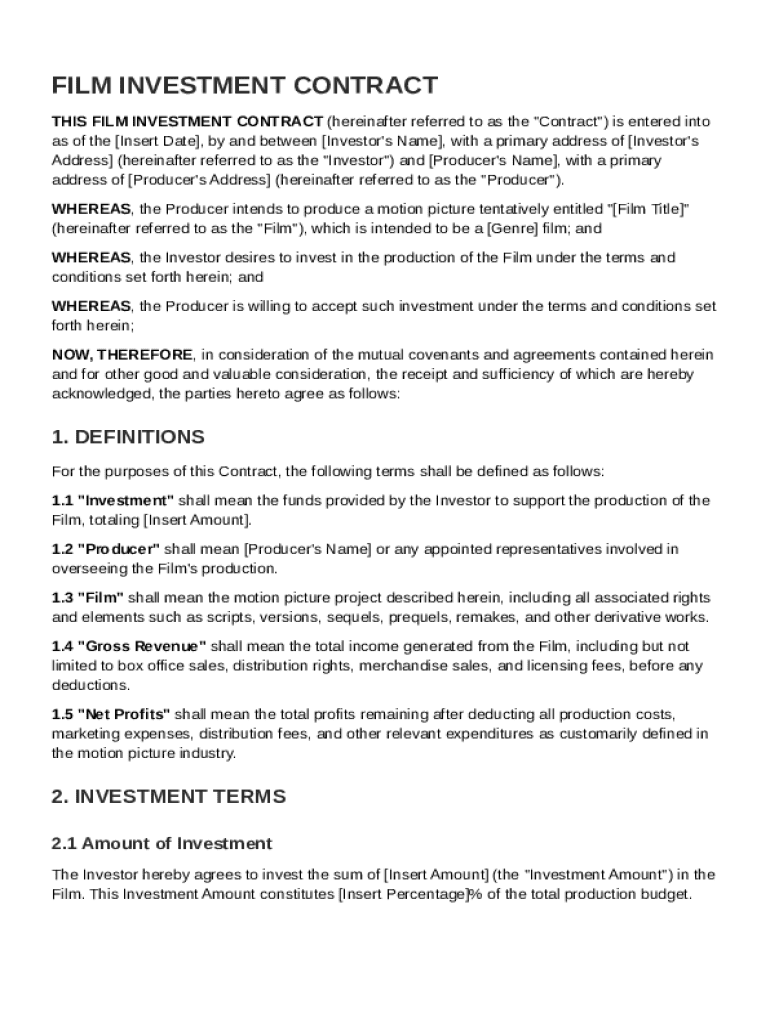







Definition and Importance of a Film Investment Contract
A Film Investment Contract is an essential document that outlines the agreement between an Investor and a Producer for the financing of a motion picture. This contract details several key aspects of the investment process, ensuring clarity and legal security for both parties. The document serves as a formal acknowledgment of the investment terms, including the amount of capital provided, the payment schedule, the rights and ownership of the film, profit participation, and conditions for termination.
As a binding legal agreement, the contract guarantees that the Producer retains ownership of the film while the Investor receives a portion of net profits and may be credited in the film's end credits. This arrangement not only ensures transparency between the parties but also encourages a collaborative approach towards the production, potentially reducing disputes.
How to Use the Film Investment Contract Template
To effectively use a Film Investment Contract Template, one should approach it as a structured guide that simplifies the drafting of the actual agreement. The template serves as a starting point, providing a comprehensive framework that can be customized as per specific business needs.
-
Identify Details of Both Parties: Ensure that the names, addresses, and contact details of both the Investor and the Producer are accurately entered.
-
Clarify Investment Amount: Clearly state the total amount of investment being made and any associated payment terms or schedules agreed upon.
-
Define Rights and Obligations: Use the template to outline the specific rights granted to the Investor, such as access to certain information or involvement in decision-making.
-
Specify Profit Participation: Clearly document how profits will be shared, including percentages or amounts due to the Investor.
-
Include a Description of the Project: Provide a brief synopsis of the film, including genre and production timeline, to give context to the investment.
-
Add Termination Conditions: Detail the specific conditions under which the contract may be terminated by either party.
Steps to Complete the Film Investment Contract Template
Completing a Film Investment Contract Template involves a series of steps that ensure both parties' interests are adequately represented.
-
Prepare Preliminary Details: Prior to completing the template, gather all necessary information, such as the contact details of parties and financial specifics.
-
Fill Out Party Information: Enter the full legal names and addresses of the Investor and Producer.
-
Detail Investment Terms: Specify the total investment amount, payment terms, and method of delivery.
-
Define Rights and Ownership: Clearly delineate the ownership rights of the film, including any creative control or oversight roles promised to the Investor.
-
Establish Profit Distribution: Outline how and when profits will be distributed, including any necessary conditions for payouts.
-
Review and Finalize: Both parties should review the document to ensure all terms are accurate and reflective of their understanding. Once agreed upon, the contract should be signed by both parties.
Key Elements of the Film Investment Contract Template
A thorough understanding of the key elements within a Film Investment Contract is crucial for its proper drafting and execution.
- Investment Amount and Schedule: Specifies the sum of money being invested and the timeline for its transfer.
- Rights and Credits: Defines the rights granted to the Investor, including any credits in the film.
- Profit Participation Clause: Details the distribution of net profits, including percentages or specific shares.
- Production Timeline: Outlines the timeline for the film's production and any related milestones.
- Termination Conditions: Lists specific conditions under which the parties can terminate the agreement.
- Dispute Resolution: Includes methods for resolving disputes, whether through mediation, arbitration, or legal proceedings.
- Confidentiality Obligations: Ensures that all parties agree to non-disclosure of sensitive information regarding the project.
Legal Use of the Film Investment Contract Template
Understanding the legal implications of the Film Investment Contract is vital to uphold its enforceability.
- Binding Nature: This contract, once signed, becomes a legally binding agreement that holds up in a court of law.
- Compliance with State and Federal Laws: The contract should comply with both state-specific investment regulations and federal securities laws to prevent legal complications.
- Ensuring Legitimacy: Inclusion of legal language that confirms the contract’s adherence to relevant laws and statutes.
Who Typically Uses the Film Investment Contract Template
The Film Investment Contract Template is most commonly used by individuals and entities engaged in the production and financing of films.
- Film Producers: As the primary party responsible for making the film, producers use this template to detail investment specifics and secure funding.
- Investors: Often individuals or financial entities looking to diversify portfolios through film investments.
- Entertainment Attorneys: Legal professionals specializing in drafting and reviewing these agreements.
- Film Studios: For managing large-scale investments in movie productions.


Examples of using the Film Investment Contract Template
Real-world examples highlight how this template caters to diverse needs in the film industry.
- Independent Films: Often require detailed contracts to secure funding from private investors committed to smaller-scale or niche projects.
- Studio Productions: Larger productions may use the template to streamline contracts with multiple investors, often necessitating detailed clauses covering complex financial arrangements.
- Co-Productions: When two or more production companies collaborate, this contract ensures equitable distribution and management of investment and profits.
State-Specific Rules for the Film Investment Contract
Investment contracts sometimes vary based on jurisdictional requirements.
- California: Known for its specific laws around entertainment contracts, agreements often require additional clauses covering labor laws.
- New York: Generally requires a detailed articulation of rights and investment returns due to stringent securities regulations.
- Texas: May include specific stipulations regarding dispute resolution and arbitration procedures, reflecting local legal practices.
By comprehensively understanding and utilizing these aspects, both Investors and Producers can navigate the complexities of film investment with greater confidence and mutual satisfaction.