






Definition & Meaning
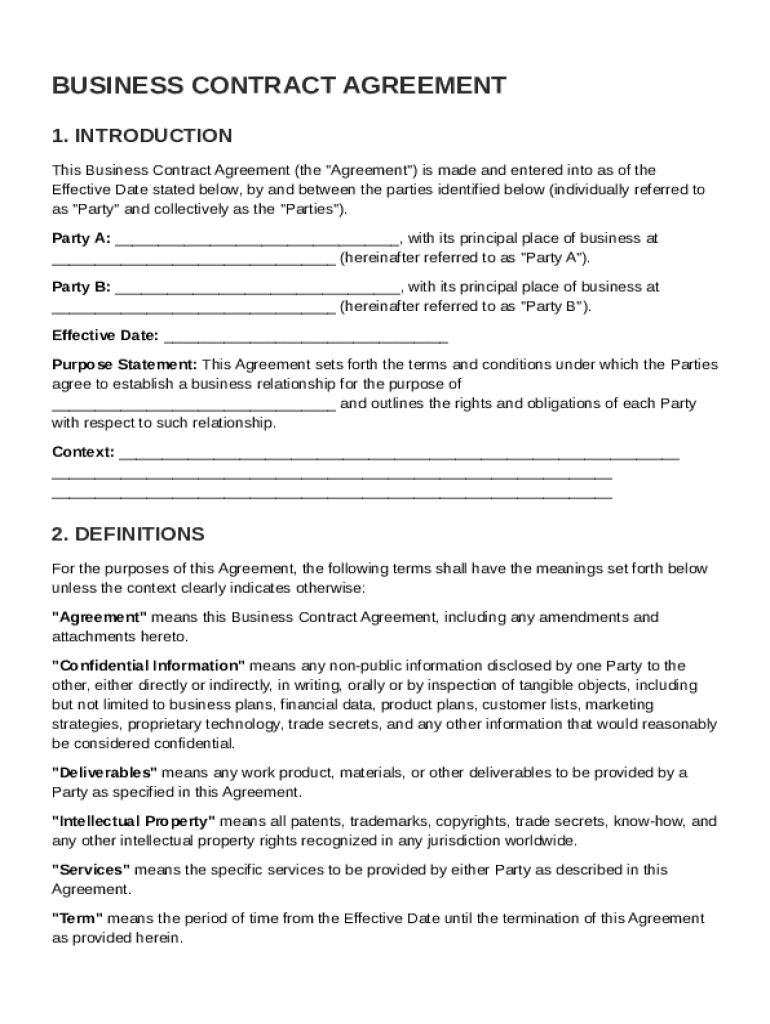
The Business Contract Template serves as a foundational document that outlines the terms and conditions between two involved parties, typically referred to as Party A and Party B. This template acts as a blueprint for clearly establishing mutual business objectives, legal protections, and the responsibilities of each party. Its sections cover essential components such as definitions, core agreement terms, payment conditions, confidentiality obligations, dispute resolution mechanisms, indemnification clauses, and limitations of liability. By providing a structured format, the template helps parties ensure that all necessary details are addressed to prevent misunderstandings and legal disputes.
Key Elements of the Business Contract Template
A comprehensive Business Contract Template includes several critical elements that ensure the agreement is legally sound and enforceable:
- Definitions: Clearly define key terms used throughout the contract to avoid ambiguity.
- Core Agreement Terms: Outline the primary obligations and rights of each party involved.
- Payment Terms: Specify payment amounts, due dates, and methods of payment.
- Confidentiality: Establish protocols for handling sensitive information exchanged between parties.
- Dispute Resolution: Detail the process for resolving conflicts, including arbitration or mediation clauses.
- Indemnification: Address compensation for losses incurred due to a party’s failure to meet contract obligations.
- Limitations of Liability: Set boundaries on the extent of either party’s legal liabilities in specific situations.
Thoroughly addressing these elements helps clarify expectations and responsibilities, reducing the risk of disputes.
Steps to Complete the Business Contract Template
Completing a Business Contract Template requires careful attention to detail and a methodical approach:
- Identify the Parties: Clearly state the names and roles of Party A and Party B in the contract.
- Fill in Contract Terms: Populate the core terms, payment conditions, and obligations specific to each party.
- Detail Confidentiality Provisions: Specify what information must be kept confidential and describe how it should be protected.
- Outline Dispute Resolution Methods: Establish how disagreements will be addressed, choosing between mediation, arbitration, or other legal processes.
- Address Indemnification and Liability: Clearly state each party's liability limitations and indemnity responsibilities.
- Review and Revise: Thoroughly review the contract for accuracy and completeness before finalizing.
- Signatures: Collect signatures from authorized representatives of each party to validate and activate the contract.
These steps ensure that the template is properly completed and aligns with the intentions of both parties involved.
Why Use a Business Contract Template
Using a Business Contract Template offers several advantages, making it a valuable tool for businesses:
- Consistency: Templates provide a standardized format that ensures all essential components of a contract are covered consistently.
- Time Efficiency: Pre-structured templates reduce the time spent drafting contracts from scratch, freeing up resources for other business activities.
- Legal Assurance: Well-crafted templates help safeguard both parties' interests by including legally prescribed clauses and stipulations.
- Reduced Errors: Structured templates help minimize the risk of omitting crucial contract details or including contradictory terms.
- Clear Communication: Templates ensure that expectations and obligations are communicated clearly, promoting better understanding and cooperation between parties.
With these benefits, templates play a significant role in the efficient management of business transactions.
Who Typically Uses the Business Contract Template
A variety of individuals and organizations rely on Business Contract Templates to facilitate their commercial activities:
- Entrepreneurs and Startups: Help new businesses establish formal agreements with partners, suppliers, and customers.
- Small to Medium Enterprises (SMEs): Ensure consistency in contracts that might be frequently used in regular business operations.
- Consultants and Freelancers: Standardize client agreements, detailing services offered, payment terms, and confidentiality.
- Corporations: Use templates to simplify the process of creating agreements with subsidiaries or external partners.
- Nonprofit Organizations: Formalize partnerships, sponsorships, and grant agreements.
By catering to different business needs, templates are versatile tools used across various sectors and industries.

Legal Use of the Business Contract Template
In the United States, Business Contract Templates hold legal significance when properly executed. They must adhere to state and federal contract laws to ensure enforceability. Key considerations include:
- Mutual Agreement: Both parties must agree to the terms laid out in the template for it to be legally binding.
- Consideration: There should be an exchange of value, such as goods, services, or monetary compensation, to validate the contract.
- Competent Parties: All parties entering the contract must have the legal capacity to do so.
- Legality of Purpose: The contract’s objectives must align with legal standards and not involve illegal activities.
Ensuring compliance with these legal principles is crucial for the validity and enforceability of the contract.
Examples of Using the Business Contract Template
Business Contract Templates find application in a wide range of scenarios, each demonstrating their adaptability and utility:
- Supplier Agreements: Define delivery schedules, product specifications, and payment methods with suppliers to ensure smooth operations.
- Service Contracts: Detail the scope, duration, and cost of services provided by consultants, agencies, or freelancers.
- Partnership Agreements: Outline the contributions, profit-sharing, and decision-making processes among business partners.
- Lease Agreements: Establish terms for renting commercial spaces, including rent, upkeep responsibilities, and lease duration.
- Employment Contracts: Specify job roles, salary details, and work conditions for new hires within an organization.
These examples illustrate the versatility of business contracts in formalizing diverse commercial relationships.
State-Specific Rules for the Business Contract Template
Although Business Contract Templates provide a general framework, state laws may dictate specific additional requirements:
- Jurisdiction Clauses: Certain states may require contracts to specify the jurisdiction governing the agreement.
- Notary Requirements: Some jurisdictions necessitate notarization of contracts to enhance legal validity.
- Statutory Guarantees: State laws may impose warranties or other mandatory terms that must be incorporated into business contracts.
Understanding and incorporating state-specific rules is vital to ensure a contract’s legality and enforceability within that jurisdiction.