
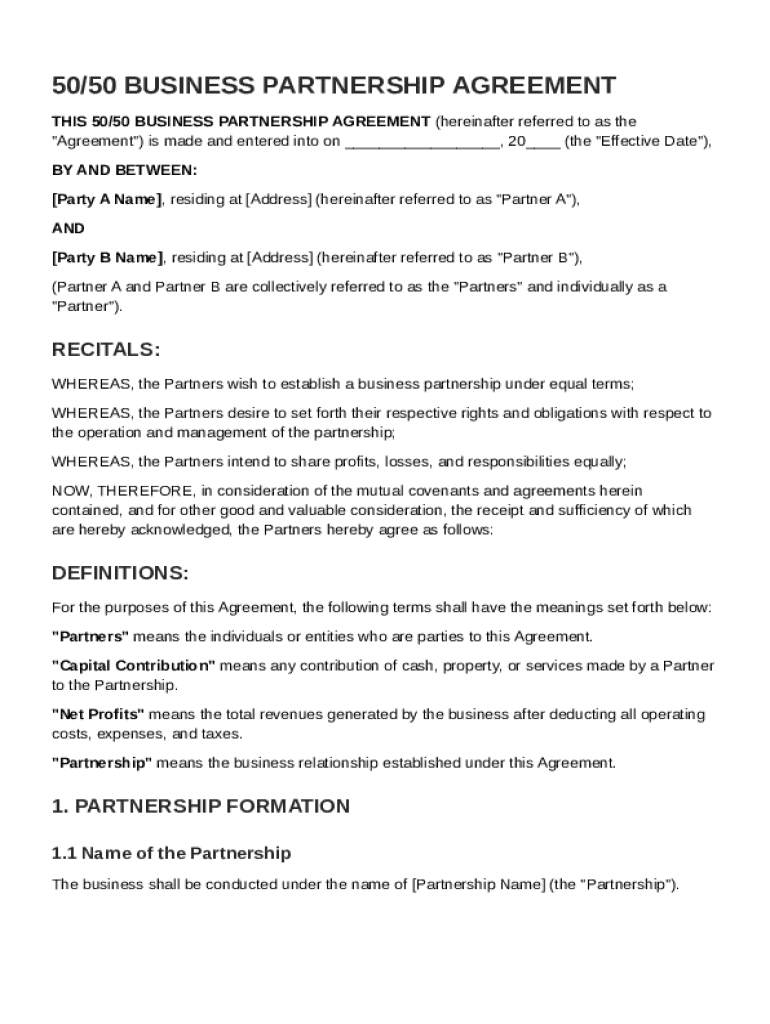







Definition & Meaning
A "50-50 Business Contract Template" refers to a legally binding agreement designed to formalize a partnership where both parties have equal ownership rights, responsibilities, and shares in profits and losses. This type of contract is critical for ensuring transparency and clarity in business operations, providing both partners with an equal voice in major decisions. It lays the foundation for how the partnership will be managed and guides the allocation of resources and obligations.
Features of the Template
- Equal Profit Sharing: Clearly outlines how profits and losses will be shared equally between the parties.
- Capital Contributions: Details the initial and ongoing financial investments required from each partner.
- Decision-Making Processes: Establishes procedures for making joint business decisions.
- Dispute Resolution: Provides methods for resolving conflicts that may arise during the partnership.
- Conditions for Dissolution: Sets forth the terms under which the partnership may be dissolved.
Key Elements of the 50-50 Business Contract Template
The "50-50 Business Contract Template" contains several essential clauses and sections that define the operational structure of the partnership. Understanding these elements is crucial for both partners to ensure mutual satisfaction and compliance.
Capital Contributions
- Describes the initial and subsequent financial contributions required from each partner.
- May include guidelines for additional capital injections if needed to support business growth.
Profit and Loss Sharing
- Provides a clear breakdown of how profits and losses are to be distributed equally.
- Includes provisions for situations where profits are reinvested into the business rather than distributed.
Decision-Making Framework
- Establishes a framework for making business decisions, ensuring both partners have an equal say.
- Covers scenarios where unanimous consent is required and when a majority decision will suffice.
Dispute Resolution Mechanisms
- Outlines the processes for managing and resolving conflicts between partners.
- May include mediation or arbitration clauses as alternatives to litigation.
Steps to Complete the 50-50 Business Contract Template
Filling out a "50-50 Business Contract Template" requires careful consideration of each section to accurately reflect the partnership's terms. Here’s a step-by-step guide to assist you:
-
Identify the Parties: Clearly state the full legal names and addresses of both partners involved.
-
Define the Partnership’s Purpose: Describe the business's objectives and operations.
-
Outline Capital Contributions: Specify the amount each partner will contribute initially and any ongoing commitments.
-
Detail Profit and Loss Sharing: Agree on how profits and losses will be split and document it.
-
Establish Management Duties: Allocate responsibilities for daily operations and strategic decision-making.
-
Add Dispute Resolution Procedures: Specify how disputes will be handled to avoid costly legal battles.
-
Review Legal Compliance: Ensure the contract aligns with legal standards and obtain legal review if necessary.
Legal Use of the 50-50 Business Contract Template
A properly executed "50-50 Business Contract Template" ensures that the partnership is recognized legally, providing a framework for protecting the interests of both parties. Each partnership should ensure compliance with federal and state laws governing business entities.
Important Legal Considerations
- Compliance with State Laws: The contract must adhere to regulations specific to the state where the business operates.
- Legally Binding Signature: Both parties must sign the document, often requiring a witness or notary public for added validity.
- Amendment Procedures: The contract should outline procedures for making amendments, requiring mutual consent from both partners.
Who Typically Uses the 50-50 Business Contract Template
This template is commonly used by individuals looking to form a business partnership where both parties invest equal resources and decision-making power. It is particularly beneficial for:
- Entrepreneurs: Starting new ventures with a co-founder or partner who shares equal stakes.
- Small Business Owners: Formalizing existing business arrangements between equals.
- Family Businesses: Structuring partnerships between family members who wish to maintain equal rights and responsibilities.


State-Specific Rules for the 50-50 Business Contract Template
Different states in the U.S. may have unique requirements for partnership agreements, impacting the enforceability and specific provisions of a "50-50 Business Contract Template."
Examples of State-Specific Requirements
- California: Requires partnerships to maintain transparent financial records and file regular reports with relevant state bodies.
- New York: May need additional disclosures regarding the personal liabilities of each partner.
- Texas: Demands inclusion of specific mediation clauses as part of dispute resolution mechanisms.
Examples of Using the 50-50 Business Contract Template
To illustrate the practical application of the "50-50 Business Contract Template," consider these scenarios:
Scenario 1: A Tech Startup
Two software engineers decide to pool their expertise and resources to launch a tech startup. They use the template to outline initial capital contributions, detail their role in product development, and establish rules for external fundraising.
Scenario 2: Opening a Boutique
Two fashion designers form a partnership to open a boutique. Their agreement details shared responsibilities in design, marketing, and sale duties, and includes provisions for overcoming any creative disputes that may arise.
Scenario 3: Expanding a Family Business
Siblings looking to expand their family restaurant use the template to formally legalize their equal ownership and management roles, ensuring transparency in profit-sharing and decision-making.
Important Terms Related to 50-50 Business Contract Template
Understanding key terms associated with a 50-50 partnership is critical for interpreting the contract correctly.
Key Terms
- Joint Venture: A business arrangement where two or more parties agree to pool resources for a particular task or business activity.
- Indemnification: A clause ensuring one partner will compensate the other for any loss or damage incurred as a result of their activities.
- Fiduciary Duty: A legal obligation for partners to act in the best interest of the partnership, maintaining loyalty and care.
By thoroughly exploring these aspects, both parties can approach their business partnership with clear expectations and a mutual understanding, which is the foundation of a successful partnership.




