
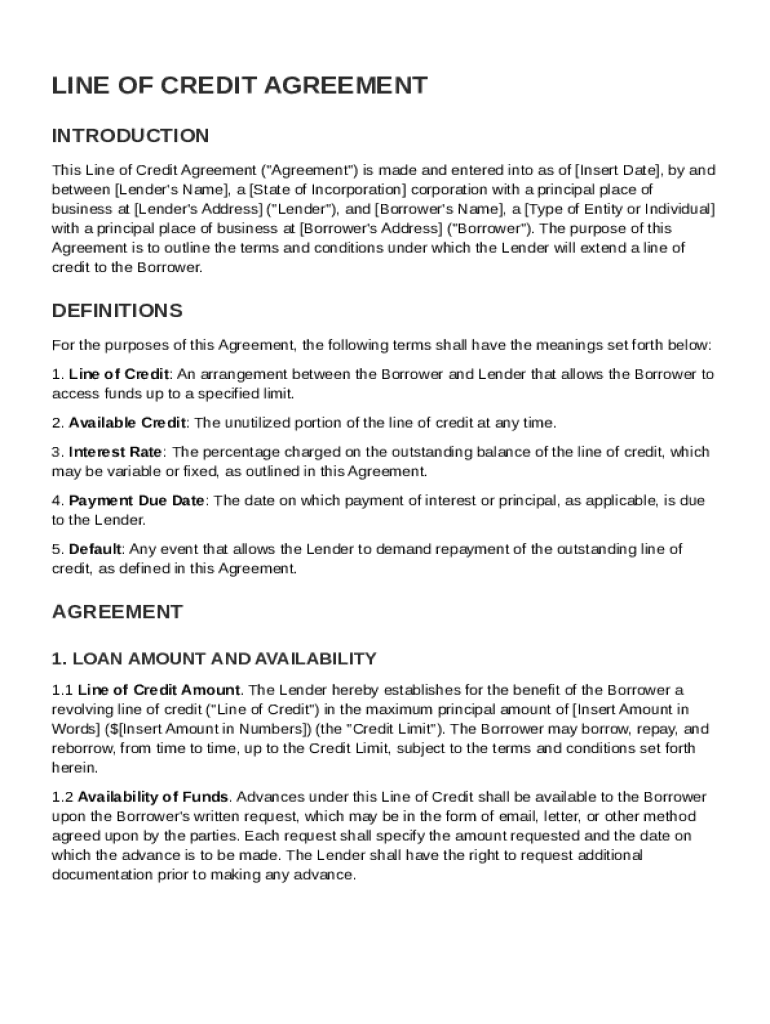







Definition and Meaning
A Line of Credit Contract Template is a document that outlines the terms between a lender and a borrower concerning a revolving line of credit. This template serves as a legal framework, detailing how both parties will manage the credit line. It contains sections that define critical components such as the loan amount, interest rates, repayment terms, permitted uses of funds, and the borrower's covenants. The agreement is typically activated from a specific start date, and any amendments require mutual consent in writing.
- Loan Amount and Structure: Specifies the maximum credit limit extended to the borrower and the arrangement of credit drawdowns.
- Interest Rate Details: Clarifies the applicable interest rates, including how and when they may be adjusted.
- Repayment Terms: Outlines the schedule and terms under which the borrower must make repayments.
- Permitted Uses of Funds: Defines acceptable purposes for which borrowed funds can be used, ensuring compliance with the agreement.
Key Elements of the Line of Credit Contract Template
The Line of Credit Contract Template encapsulates several fundamental elements that guide the credit relationship:
- Definitions and Interpretations: Establishes clarity by defining key terms and expressions used within the contract.
- Conditions Precedent: Lists specific requirements that must be met before the credit line becomes available to the borrower.
- Covenants and Representations: Encompasses the promises and assurances made by the borrower concerning the conduct of their affairs.
- Events of Default and Remedies: Details scenarios that would trigger default and the corresponding actions the lender can pursue.
Examples of Situations Covered
- Debt covenants breach, such as failing to maintain certain financial ratios.
- Material adverse changes in the borrower's financial condition.
- Unauthorized use of credit proceeds leading to an event of default.
How to Use the Line of Credit Contract Template
Utilizing the Line of Credit Contract Template effectively involves understanding its structure and provisions:
- Initial Review: Thoroughly read through the template to familiarize yourself with its components.
- Customizing Terms: Adapt the template to fit specific terms agreed upon with the lender, including adjustments in interest rates or credit limits.
- Legal Consultation: Engage with legal counsel to ensure the template's terms align with applicable regulations and adequately protect both parties.
- Execution and Archival: Once finalized and signed by both parties, securely store the document for future reference and compliance.
Steps to Complete the Line of Credit Contract Template
To complete the Line of Credit Contract Template, follow these steps:
- Identify Parties Involved: Clearly state the names and addresses of the lender and borrower.
- Specify Credit Terms: Define the credit limit, interest rate, and other financial terms.
- Outline Repayment Obligations: Include detailed repayment schedules and mechanisms.
- Include Legal Clauses: Incorporate necessary legal language and clauses to mitigate risks.
- Execution and Signatures: Ensure the contract is duly signed and dated by both parties.
Practical Tips
- Consult financial advisors to verify the feasibility of the financial terms.
- Regularly review the contract in the context of changing market conditions.
Important Terms Related to Line of Credit Contract Template
Understanding some important terms is crucial for navigating the contract:
- Open-end Credit: Refers to a revolving line of credit that can be borrowed against multiple times.
- APR (Annual Percentage Rate): The annual rate charged for borrowing, expressed as a single percentage.
- Draw Period: The time during which the borrower can withdraw funds from the credit line.
Clarifications
- Differentiate between interest and fees; both are separate components of borrowing costs.
- Recognize the significance of the expiration date, especially for the revolving nature of the line of credit.
Legal Use of the Line of Credit Contract Template
Ensuring the legality of the contract involves adherence to applicable laws and regulations, such as:
- Compliance with Federal Laws: Ensures adherence to laws like the Truth in Lending Act (TILA).
- State-specific Regulations: Variations may exist depending on the jurisdiction, such as usury laws or credit reporting requirements.
Common Legal Challenges
- Disagreements over contract interpretation or enforcement.
- Compliance issues arising from improper disclosure of terms.
Who Typically Uses the Line of Credit Contract Template
The template is generally employed by various entities and individuals, including:
- Small Businesses: Often use lines of credit for handling fluctuating cash flow needs.
- Corporations: May leverage credit for significant investments or operational expenses.
- Individual Consumers: Typically use it for personal credit needs, such as home equity lines.


User Profiles
- A startup looking to stabilize cash flow amidst varying operational costs.
- A contractor managing cyclical work opportunities by leveraging a flexible credit line.
Business Types that Benefit Most from Line of Credit Contract Template
The template is particularly beneficial for businesses that experience irregular cash flow:
- Retailers: Often face seasonal variations that necessitate flexible funding options.
- Manufacturers: Require funding for raw material purchases ahead of production cycles.
- Service Providers: Profit from having funds available to manage receivables efficiently.
Advantages
- Provides a buffer against cash flow shortfalls.
- Enables scaling of operations without the immediate requirement for a lump sum upfront.
State-specific Rules for the Line of Credit Contract Template
State regulations may impose specific stipulations on the application and execution of credit contracts:
- Usury Limits: States may enforce maximum interest rates chargeable on credit.
- Disclosure Requirements: Mandates on clear communication of all credit terms and conditions.
Implications
- Non-compliance with state laws can result in penalties or invalidation of the contract.
- Regular consultations with legal experts help in adapting the template in accordance with state laws.
Digital vs. Paper Version
The transition between digital and paper versions has implications for usability and legal compliance:
- Digital Versions: Offer ease of modification, storage, and sharing, supported by platforms like DocHub.
- Paper Versions: Traditional, tangible format preferred in contexts requiring physical documentation.
Considerations
- Assess the impact of digital signatures versus ink signatures on enforceability.
- Evaluate cybersecurity measures for digital records to ensure data protection and confidentiality.
Software Compatibility
Compatibility with different software systems ensures smooth implementation of the template:
- Document Management Systems: Such as DocHub, enabling easy editing, storage, and sharing of templates.
- Accounting Software: Like QuickBooks, for integration of credit terms with financial records.
Practices for Seamless Integration
- Ensure ongoing updates to software for compatibility with legal standards.
- Utilize integrated systems for tracking credit utilization and repayments efficiently.




