
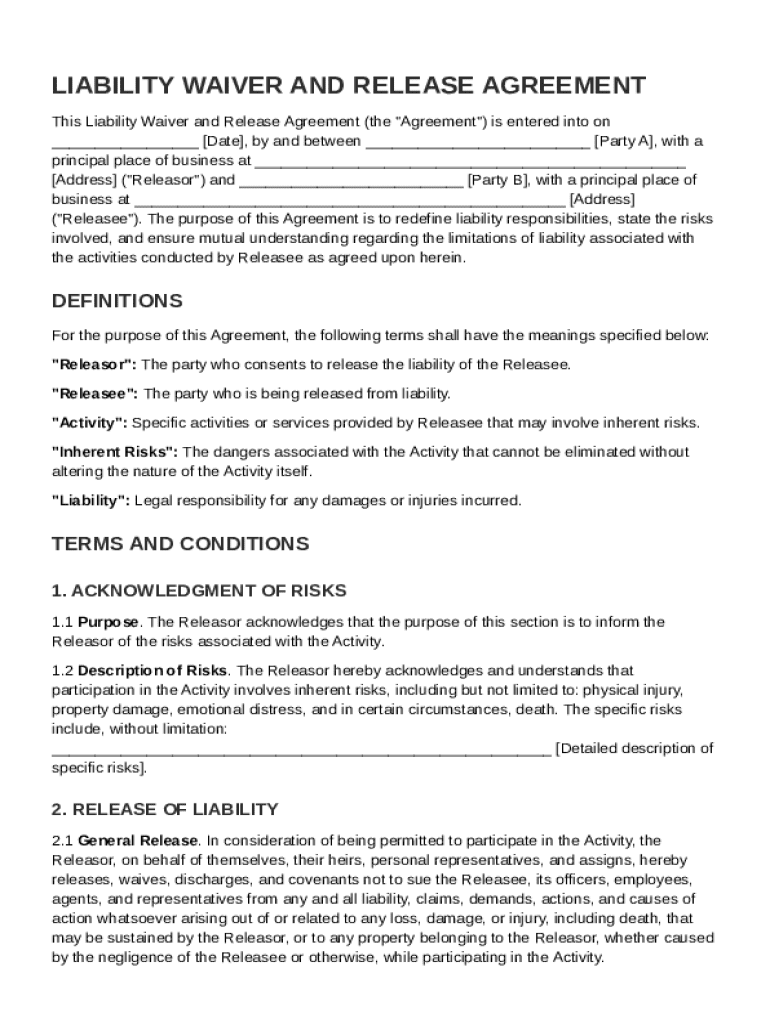







Definition & Meaning
A liability contract template is a formal document that details the terms and conditions under which one party, referred to as the "Releasor," agrees to release another party, known as the "Releasee," from liability for potential risks involved in specific activities. This template serves as a structured framework to legally outline the scope of responsibilities and protections associated with various interactions or ventures. Typically used in business, recreational, or legal contexts, the liability template ensures all parties are informed and agree to the outlined terms, which can include clauses like indemnification and governing law provisions.
Key Elements of the Liability Contract Template
The liability contract template comprises several essential sections that ensure a comprehensive interpretation of agreements between parties. Key elements generally include:
- Definitions of Key Terms: Clearly defines the parties involved and specific terms used throughout the document.
- Acknowledgment of Risks: Requires the Releasor to acknowledge understanding of the inherent risks involved.
- General Release of Liability: This clause releases the Releasee from legal liability for certain circumstances.
- Indemnification Clause: Provides detailed terms under which one party agrees to protect the other from potential financial losses.
- Governing Law: States which jurisdiction's laws will apply in the event of a dispute.
- Amendment and Termination Conditions: Outlines procedures for modifying or terminating the contract.
How to Use the Liability Contract Template
Using a liability contract template efficiently involves understanding and applying its components to specific scenarios. Here’s a step-by-step guide:
- Identify the Parties: Clearly fill in details about the Releasor and Releasee.
- Specify the Activity or Event: Define the context in which the liability waiver is applicable.
- Highlight the Risks: Explicitly state the risks involved and ensure acknowledgment from the Releasor.
- Outline the Release Terms: Detail the conditions under which liability is waived.
- Include Signatures: Ensure both parties or their representatives sign the document, verifying their consent.
Steps to Complete the Liability Contract Template
Completing a liability contract involves several detailed steps to ensure accuracy and enforceability:
- Gather Information: Collect all necessary personal and activity-specific details from both parties.
- Customize the Template: Adjust the template text to reflect the specifics of the agreement and jurisdiction.
- Review Legal Terms: Ensure understanding of the legal implications and terminology.
- Seek Legal Assistance: When necessary, consult with a legal professional to confirm compliance with state and federal regulations.
- Finalize the Document: After review, sign the contract in the presence of a witness if required, and securely store a copy for both parties.
Important Terms Related to Liability Contract Template
Understanding the legal and technical terms associated with a liability contract template can aid in effective usage:
- Releasor and Releasee: Identifies the parties giving and receiving the liability release.
- Assumption of Risk: Agreement by the Releasor to undertake the risks involved in the activity.
- Waiver of Liability: The act of relinquishing the right to hold the Releasee accountable for risks.
- Consideration: Any benefit exchanged between parties to validate the contract.
- Breach of Contract: A violation of any of the agreed-upon terms.
Who Typically Uses the Liability Contract Template
The liability contract template is versatile and serves a range of users across different sectors:
- Businesses: Companies use it to protect themselves from legal claims during client interactions or events.
- Event Organizers: Needed for activities where there’s a potential for physical harm.
- Contractors: Individuals or business entities use it to mitigate risk when providing services.
- Sports Venues: Facilities require patrons to sign as a safety precaution.


Examples of Using the Liability Contract Template
Liability contracts are used in various real-world scenarios:
- Sporting Events: Competitions often require participants to waive liability for injuries.
- Adventure Tours: Participants sign beforehand acknowledging potential risks involved.
- Volunteer Work: Organizations use it to protect against claims from unpaid workers.
- Company Outings: Employers may use these templates to safeguard against liabilities during corporate events or retreats.
Legal Use of the Liability Contract Template
The enforceability of a liability contract template hinges upon its legal use:
- Compliance with State Laws: Must adhere to state-specific standards to be considered valid.
- Clear Understanding: Contracts are void if it is proven that the Releasor was not fully aware of the contract terms.
- Fair Clauses: Unreasonably biased language against one party may render the agreement unenforceable.
Versions or Alternatives to the Liability Contract Template
Aside from standard liability contracts, there are alternative forms and specialized versions:
- General Release: Simpler form used for broad releases not tied to specific events.
- Specific Release: Tailored for one-time events or activities.
- Minor’s Liability Waiver: Adapted version considering legal guardianship for underage participants.
- Digital Templates: These allow for integration with software platforms for easier management and signature collection.




