
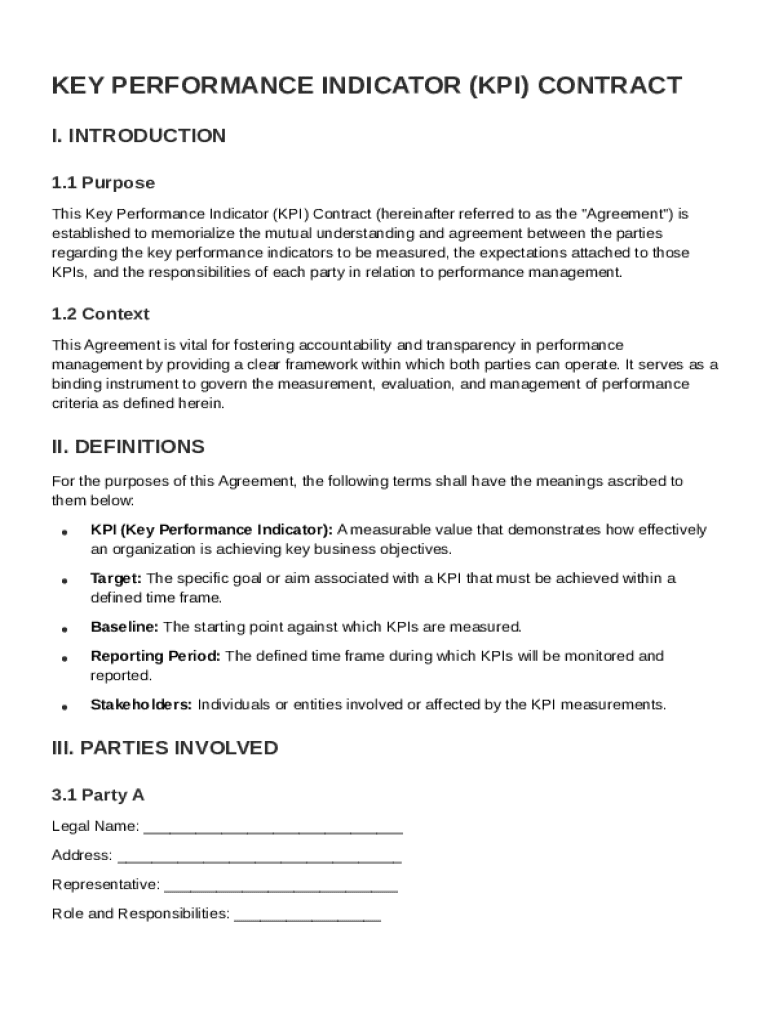







Definition & Meaning
A KPI Contract Template serves as a comprehensive document that outlines the agreed-upon key performance indicators (KPIs) between two parties. It is a critical tool in business management that ensures accountability and transparency by defining how performance will be measured and evaluated. The document typically includes specific details on what constitutes successful performance, how KPIs align with strategic goals, and the metrics or benchmarks used to gauge success. This contract not only facilitates clear communication between involved parties but also helps in maintaining focus on the desired outcomes by setting measurable and agreed-upon objectives.
Key Elements of the KPI Contract Template
The KPI Contract Template is structured around several essential components that form the backbone of effective performance tracking. These elements include:
- KPIs and Targets: Clearly defined KPIs that are directly tied to business goals, along with measurable targets for each KPI.
- Responsibilities: Roles and duties of each party involved in achieving the KPIs.
- Reporting Structure: Methods and frequency of performance reporting, detailing how information will be shared and reviewed.
- Confidentiality: Provisions to ensure that sensitive performance data is protected.
- Dispute Resolution: Established procedures for handling disagreements regarding KPI assessments.
- Termination Conditions: Conditions that may lead to the termination of the contract if KPIs are not met.
These components provide a framework that guides both parties in tracking and managing performance effectively.
How to Use the KPI Contract Template
Using the KPI Contract Template involves several key steps to ensure its effectiveness:
- Identify Business Goals: Start by clearly defining the strategic goals of your organization, as these will guide the selection of relevant KPIs.
- Select Relevant KPIs: Choose KPIs that best align with your goals, ensuring they are specific, measurable, achievable, relevant, and time-bound (SMART).
- Set Benchmarks and Targets: Establish clear benchmarks and targets for each KPI to provide a standard against which performance can be measured.
- Assign Responsibilities: Clearly assign roles and responsibilities to each party involved to avoid confusion and ensure accountability.
- Draft and Review: Use the template to draft the contract, ensuring all relevant sections are filled out, and review with all stakeholders for completeness and clarity.
- Sign and Implement: Once approved, have all parties sign the contract and implement it, using the defined KPIs to track progress.
Steps to Complete the KPI Contract Template
Completing the KPI Contract Template involves a systematic process:
- Gather Necessary Information: Collect relevant data and insights about your current business processes, performance metrics, and strategic objectives.
- Customizing the Template: Tailor the template to fit your specific needs, ensuring it aligns with organizational goals and industry standards.
- Define Each KPI: Provide a detailed description of each KPI, including what it measures and why it’s important.
- Detail Metrics and Measurement Tools: Specify the tools and methodologies that will be used to measure each KPI, such as software programs, surveys, or manual calculations.
- Outline the Review Process: Establish a clear process for performance review, including timelines for regular check-ins and adjustments if needed.
- Finalize: Ensure all sections are complete and have been reviewed by all parties involved before finalizing.
Important Terms Related to KPI Contract Template
Understanding the terminology used in a KPI Contract Template is crucial for effective implementation:
- Key Performance Indicators (KPIs): Quantifiable measures used to evaluate success in meeting business objectives.
- Benchmarks: Standards or points of reference against which things may be compared or assessed.
- Targets: Specific goals set for performance levels in relation to KPIs.
- Metrics: Systems or standards of measurement used to assess the inputs, processes, outputs, outcomes, and policies of a program.
- Performance Review: A process of assessing progress against set KPIs and targets.
Having a clear understanding of these terms enhances the utility of the KPI Contract Template.
Who Typically Uses the KPI Contract Template
The KPI Contract Template is widely used across various sectors:
- Businesses: Companies of all sizes utilize KPI contracts to align team and individual performance with corporate goals.
- Project Managers: Use the template to track project performance and ensure objectives are met on time and within budget.
- Human Resources: HR professionals use KPI contracts to guide employee evaluations and development plans.
- Consultants: Consultants incorporate KPI contracts to assess client project outcomes and demonstrate value-added services.
- Performance Analysts: Analysts leverage KPI contracts to provide insights into organizational performance and support decision-making processes.
These users rely on the template to drive performance improvements and achieve strategic goals effectively.


Examples of Using the KPI Contract Template
Examples of applying the KPI Contract Template include:
- Sales Performance: Setting KPIs related to sales revenue, customer acquisition, and client retention to ensure sales teams are on track.
- Marketing Campaigns: Tracking metrics such as engagement rates, conversion rates, and ROI to evaluate campaign effectiveness.
- Operational Efficiency: Implementing KPIs like production cost per unit, downtime, and quality control metrics to enhance operational processes.
- Customer Service: Measuring KPIs such as customer satisfaction scores, response times, and resolution rates to improve service quality.
- Product Development: Establishing KPIs for time to market, defect rates, and innovation success to drive product growth.
These examples demonstrate how the KPI Contract Template can be applied across various contexts to improve organizational performance.
Legal Use of the KPI Contract Template
The legal application of the KPI Contract Template involves ensuring that it meets all contractual obligations:
- Compliance with Laws: The template should comply with relevant local, state, and federal regulations.
- Binding Agreement: It must be signed by authorized representatives of all parties to be legally binding.
- Confidentiality Provisions: Include clauses to protect sensitive performance data from unauthorized disclosure.
- Dispute Resolution: Clearly outline the methods for resolving any disputes that may arise from KPI assessments.
- Enforcement: Make sure that all terms of the contract are enforceable under applicable law.
By addressing these legal aspects, the KPI Contract Template serves as a robust tool for managing performance in a compliant manner.




