




Definition and Meaning of the Buy Out Contract Template
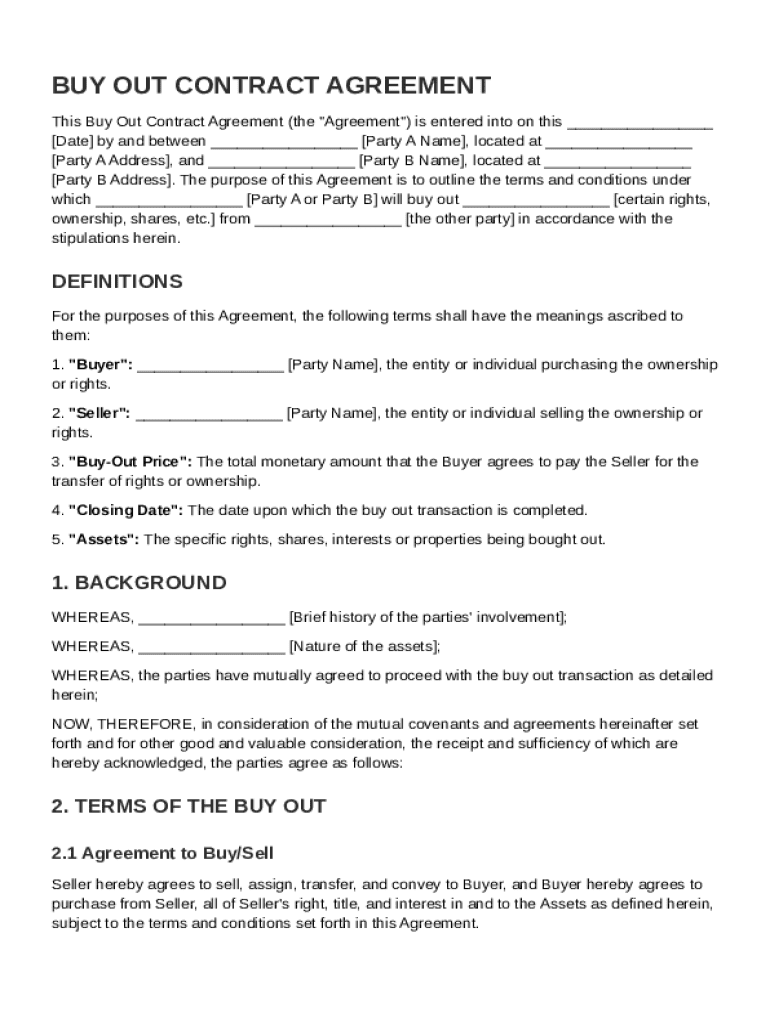
The Buy Out Contract Template is a structured legal document used in transactions where one party purchases the interests, rights, or shares held by another party. It serves to clarify the terms of the buyout, ensuring that all involved parties have a mutual understanding of the transaction's conditions. This document includes important details such as the purchase price, payment terms, and the specific assets or shares being transferred. The template is designed to be comprehensive, covering all necessary legal elements to form a valid agreement between the interested parties.
How to Use the Buy Out Contract Template
Using the Buy Out Contract Template involves several steps to ensure that the document is correctly filled out and legally compliant. Start by reviewing the document in its entirety, familiarizing yourself with all sections and clauses. This helps to understand the standard terms and identify areas that need customization to fit your specific buyout scenario. Next, enter the necessary information in the form fields provided. This typically includes details like the names of the buyer and seller, the asset or shares being bought, and the agreed-upon purchase price. Ensure that all details are accurate and reflect the true intent of both parties. After completing the form, both parties should carefully review the completed document to confirm that all terms are clearly stated and understood.
Key Elements of the Buy Out Contract Template
The template consists of several key elements crucial for a well-structured buyout agreement:
- Definitions of Key Terms: Clarification of essential terminologies used throughout the agreement to avoid ambiguity.
- Purchase Price: The agreed monetary value for the buyout. It details how the price was determined and any payment structures.
- Payment Terms: Outlines the method and schedule of payments, which could be a lump sum or installments over a specified period.
- Representations and Warranties: Assurances made by each party regarding the condition and legality of the assets being transferred.
- Indemnification Clauses: Provisions for covering losses or damages that may arise post-transaction.
- Governing Law: Specification of the legal framework or jurisdiction under which the agreement is executed.
Steps to Complete the Buy Out Contract Template
Filling out the Buy Out Contract Template involves a systematic approach to ensure accuracy and completeness:
- Gather Necessary Information: Collect all essential data such as names, addresses, and contact information of the involved parties.
- Outline the Transaction Details: Clearly define the rights or shares being transferred, including their present value and any associated conditions.
- Define Financial Terms: Specify the purchase price, payment method, and schedule, ensuring that all financial details align with mutual agreements.
- Review Representations and Warranties: Ensure that all declarations made by each party regarding risk and liability are accurate and truthful.
- Add Indemnification Provisions: Detail any protections against potential future liabilities or disputes arising from the buyout.
- Finalize and Sign the Agreement: Both parties should thoroughly review the completed document, make necessary amendments, and append their signatures to validate the contract.
Who Typically Uses the Buy Out Contract Template
This template is frequently used by business entities such as corporations, partnerships, and limited liability companies (LLCs) during mergers, acquisitions, or restructuring. It is also utilized by individual stakeholders who wish to divest their shares in a business. In some cases, family-owned businesses may employ this template to facilitate the transfer of ownership between family members, ensuring a smooth transition while preserving the existing business framework.

Legal Use of the Buy Out Contract Template
The Buy Out Contract Template is crafted to comply with existing legal standards, ensuring that the agreement is both enforceable and protective of the parties' interests. It is important for each party to consult with legal professionals to adapt the template to fit jurisdictional laws and regulations specific to their transaction. Compliance with federal and state laws is critical, as non-compliance can result in disputes, legal challenges, or penalties. The template incorporates standard legal phrasing and clauses to support parties in fulfilling their contractual obligations effectively.
Examples of Using the Buy Out Contract Template
Real-world scenarios of employing a Buy Out Contract Template include:
- Business Acquisition: When a company wants to fully acquire another company, it uses the template to finalize the transaction details.
- Partnership Reorganization: Partners in a firm may use this document to buy out a partner who exits the business, clearly documenting the terms of the share purchase.
- Family Business Succession: A family-run business might utilize the template to transition ownership from a retiring parental figure to the next generation, defining the terms of sale and continuity.
Important Terms Related to the Buy Out Contract Template
Familiarity with critical terms associated with the Buy Out Contract Template is necessary for effective use:
- Asset Transfer: The assignment of ownership of specific assets from one party to another.
- Due Diligence: The process undertaken by each party to verify relevant facts and details before executing the buyout.
- Closing Date: The official date upon which the buyout transaction is finalized, and all agreed terms are executed.
- Confidentiality Agreement: An embedded or adjoining agreement that ensures both parties keep sensitive information private and secure during and after the completion of the transaction.
State-Specific Rules for the Buy Out Contract Template
The template must be adapted to address state-specific legal requirements and nuances, as commercial laws vary across jurisdictions. Each state's legislation may impact areas such as tax implications, contract enforceability, and administrative processes tied to the transfer of ownership. Therefore, it is advisable for parties to work with local legal counsel to navigate these differences and ensure the agreement's compliance with pertinent state laws. By customizing the template to meet state mandates, parties can mitigate risks and smooth out the complexities associated with cross-state transactions.