




01. Edit your form online
Type text, add images, blackout confidential details, add comments, highlights and more.

Type text, add images, blackout confidential details, add comments, highlights and more.

Draw your signature, type it, upload its image, or use your mobile device as a signature pad.

Send it via email, link, or fax. You can also download it, export it or print it out.
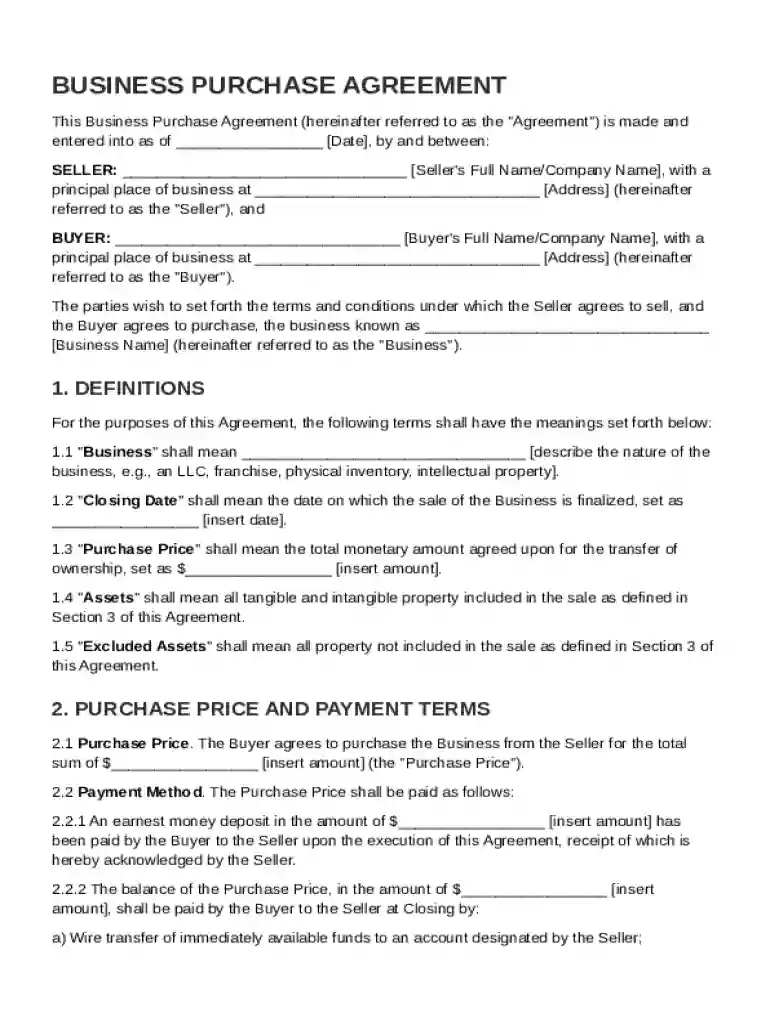
The Business Purchase Contract Template is designed to outline the critical components of a business transaction between a buyer and a seller. It typically includes several key elements that ensure both parties are clear on the terms and expectations.
Purchase Price and Payment Terms: This section specifies the total amount to be paid for the business and details the payment structure. It may include down payments, financing arrangements, and installment plans.
Asset Inclusion: A detailed list of assets included in the sale, such as equipment, inventory, and intellectual property, forms a crucial part of the agreement. This ensures both parties agree on what is sold.
Representations and Warranties: Both parties provide assurances about certain facts. For the seller, this might include verification that the business is in compliance with laws, while the buyer may need to prove financial capability.
Conditions for Closing: Enumerates the specific conditions that must be met before the deal can be finalized. This can include obtaining necessary permits, or the buyer securing financing.
Indemnification Clauses: These clauses protect both parties from future claims related to the business. For example, if undisclosed liabilities later emerge, the responsible party promises to cover associated costs.
Drafting a Business Purchase Contract involves several steps to ensure all required information is accurately captured.
Identify Parties: Begin by clearly identifying the buyer and seller, including their legal names and contact information.
Outline Business Details: Clearly describe the business being sold, including its name, nature, and location, to avoid any ambiguity.
Specify Terms: Include the purchase price, payment methods, and detailed timelines for payment completion.
List Assets and Liabilities: Catalogue all assets included in the sale and note any liabilities the buyer will assume.
Include Legal Provisions: Add necessary legal clauses such as arbitration procedures, confidentiality terms, and governing state law.
Sign and Date: Ensure both parties review the final document, sign, and date it to make the agreement binding.
Several terms within the Business Purchase Contract Template are crucial for understanding its contents.
Buyer/Seller: The parties involved in the transaction, where the buyer typically agrees to pay a predetermined sum to purchase the business.
Due Diligence: The buyer's investigation process to verify the business's financial health and legal compliance before agreeing to purchase.
Earnout: A conditional additional payment based on the business's future performance, often included in the contract to bridge valuation differences.
Non-Compete Clause: A provision preventing the seller from starting a similar business within a specific geographic area and time frame post-sale.
The Business Purchase Contract Template is legally binding and used in various circumstances to outline the sale terms.
Compliance with ESIGN Act: Electronic signatures collected via DocHub are federally recognized, ensuring legality in digital transactions.
Confidentiality Agreements: Legal provisions within the contract might include clauses that protect sensitive information shared during negotiations.
Applicable Laws: The contract should specify which state's laws govern the agreement, impacting how disputes are resolved.
Enforceability: Clauses must be drafted to ensure they are enforceable in court, particularly concerning breaches or disputes.
A diverse group of professionals often utilizes this contract template.
Small Business Owners: Looking to buy or sell established enterprises, they use the template to formalize transactions.
Attorneys: Legal professionals may employ the template as a starting point for customizing specific client agreements.
Real Estate Agents: When a business includes real estate, agents may be involved in drafting or advising on related portions of the contract.
Accountants: Frequently review the financial aspects of the agreement to ensure accuracy in reporting business valuations and liabilities.


Contracts must often be adapted to align with state regulations, which can vary significantly.
UCC Regulations: Most states follow the Uniform Commercial Code for sales of goods and can impact clauses concerning warranty and service contracts.
Licensing Requirements: Some states may require additional disclosures or licensing processes before a sale can be completed.
Real Estate Considerations: States may have varying requirements if the business sale includes real estate, necessitating additional documentation.
Practical examples highlight the contract's utility in different scenarios.
Franchise Sales: A franchise owner might use the template to sell their rights and obligations to another party.
Family-Owned Business Transition: When a family business is sold to an external buyer, the contract formalizes the transfer of ownership.
Mergers and Acquisitions: Corporations engage in complex transactions that require detailed contracts outlining terms, which can be guided by this template.
Understanding format options is essential for users who may be uncertain about the best method for their situation.
Digital Format: Provides flexibility and ease of distribution, allowing for quick edits, annotations, and e-signatures — all integrated within tools like DocHub.
Paper Version: Despite declining use, paper contracts are still favored in situations where formal in-person signings or traditional archiving practices are necessary.
At DocHub, your data security is our priority. We follow HIPAA, SOC2, GDPR, and other standards, so you can work on your documents with confidence.


The Agreement to furnish certain goods and services described herein and in the documents referenced herein (Goods and/or Services) is made by and between The
Terms Conditions of Purchase of Goods and Services. 1. General. This Purchase Order (Order) is placed by the entity issuing the Order.


