
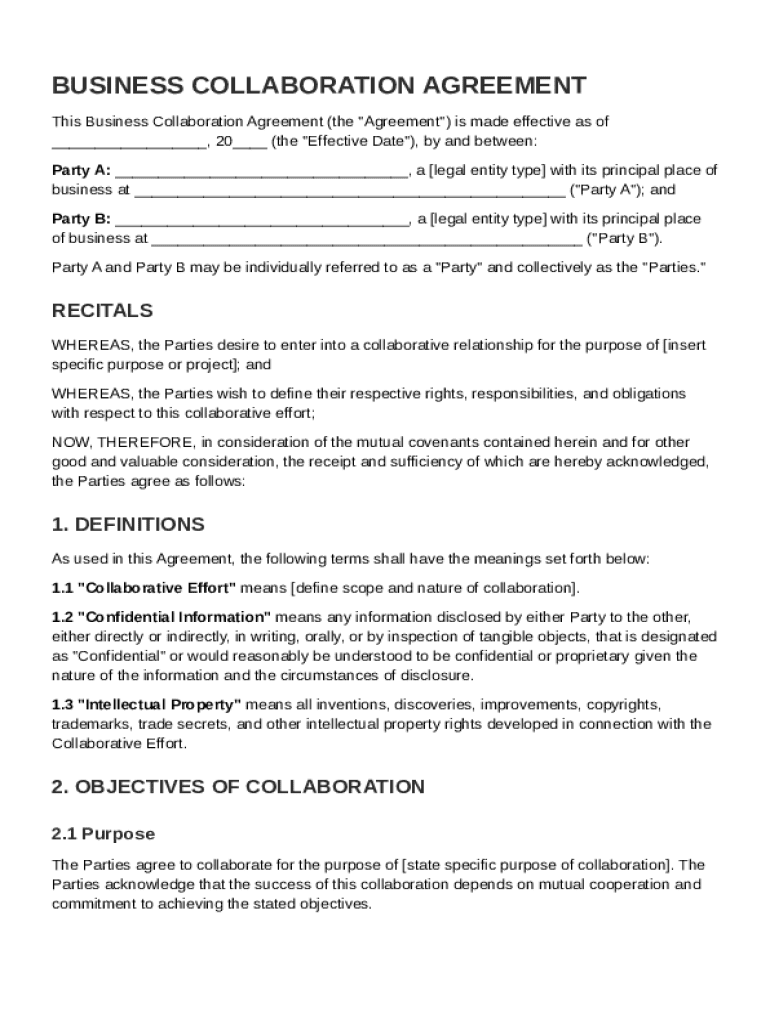







Definition & Meaning
A Business Collaboration Contract Template is a standardized legal document designed for use by two or more business entities that wish to collaborate on joint projects. This template outlines the terms and conditions under which the parties will work together, detailing their roles, responsibilities, and financial obligations. The primary goal of this document is to ensure a clear understanding among all parties involved, preventing misunderstandings and disputes. The agreement also safeguards each participant's intellectual property rights and clarifies confidentiality obligations, which are critical elements in any business relationship.
Key Elements of the Business Collaboration Contract Template
A comprehensive Business Collaboration Contract Template includes several essential components:
- Roles and Responsibilities: Clearly defines what each party is expected to contribute to the collaboration.
- Financial Terms: Outlines how revenue, expenses, and profits will be managed and shared among the parties.
- Intellectual Property Rights: States who owns any IP developed during the collaboration and how pre-existing IP will be protected.
- Confidentiality Clauses: Mandates the confidentiality of proprietary information exchanged during the project.
- Dispute Resolution: Provides mechanisms for resolving conflicts that may arise, such as mediation or arbitration.
- Termination Conditions: Specifies the conditions under which the agreement can be terminated by either party.
Steps to Complete the Business Collaboration Contract Template
Completing the Business Collaboration Contract Template requires several important steps:
- Identify Parties: Clearly list all participating entities by their legal names and addresses.
- Detail Project Goals: Define the specific objectives and expected outcomes of the collaboration.
- Assign Roles: Specify the roles and responsibilities of each participating party.
- Outline Financial Arrangements: Document how revenues and costs will be divided and consider including provisions for financial audits.
- Intellectual Property Clauses: Include clauses that define the ownership and use of any IP.
- Include Dispute and Termination Provisions: Specify how disputes will be managed and list scenarios that may result in contract termination.
- Review and Revise: Conduct a thorough review to ensure that all parties agree on the terms, followed by legal review if necessary.
- Sign and Execute: Obtain signatures from all parties and distribute finalized copies.
Legal Use of the Business Collaboration Contract Template
This contract template serves as a legally binding agreement, provided it meets certain criteria:
- Mutual Consent: All parties must voluntarily agree to the terms.
- Legal Purpose: The contract must be for a lawful objective.
- Capacity: Parties entering the contract must have the legal capacity to do so, such as being of legal age and mentally competent.
- Consideration: Each party must provide something of value to one another, which could be goods, services, or money.
In the U.S., the enforceability of these contracts is supported by state and federal laws, and discrepancies are typically resolved through the judicial system.
Who Typically Uses the Business Collaboration Contract Template
A range of entities and individuals benefit from using a Business Collaboration Contract Template:
- Small to Medium Enterprises (SMEs): Use these templates to formalize partnerships with other companies or freelancers.
- Corporations: Leverage these templates for joint ventures and strategic alliances.
- Non-Profits: Collaborate with other organizations to achieve shared missions and objectives without profit motives.
- Startups: Engage with investors or incubators who can provide funding or mentorship.
- Freelancers and Consultants: Partner with businesses to contribute expertise on specific projects.


Examples of Using the Business Collaboration Contract Template
Various scenarios exemplify the utility of a Business Collaboration Contract Template:
- Technology Co-Development: Two tech firms join forces to innovate a new software solution, using the contract to delineate development roles and IP ownership.
- Marketing Partnerships: Two companies collaborate on a joint marketing campaign, sharing leads and revenue.
- Research and Development: Universities and private companies collaborate on research projects, detailing funding sources and publication rights.
- Product Co-Creation: Two manufacturers combine resources to design and produce a new product line, sharing design and patent rights.
State-Specific Rules for the Business Collaboration Contract Template
While generally governed by federal contract law, some aspects of business collaboration agreements vary by state:
- Regulations and Enforcement: Different states have varying laws impacting the enforcement of collaboration agreements.
- Taxation: State-specific tax regulations can affect the financial components outlined in the contract.
- IP Laws: States may have differing rules on intellectual property rights, affecting how IP clauses are constructed.
- Dispute Resolution: Each state may have different requirements for mediation or arbitration procedures included in the contract.
Understanding these state-specific nuances is essential for ensuring the contract's enforceability within each jurisdiction.
Importance of the Business Collaboration Contract Template
Using a Business Collaboration Contract Template is crucial for several reasons:
- Prevents Misunderstandings: By clearly outlining expectations and responsibilities, the template reduces the chance for confusion or disputes.
- Risk Mitigation: Protects against legal disputes by pre-defining conflict resolution processes.
- IP Protection: Ensures all parties' intellectual property rights are clearly defined and respected.
- Enhanced Collaboration: Facilitates smoother cooperation by setting clear guidelines and objectives.
Ensuring all parties are on the same page from the start is vital for a successful and productive business relationship.




