Solar Lease Agreement Template 2026

Get Form
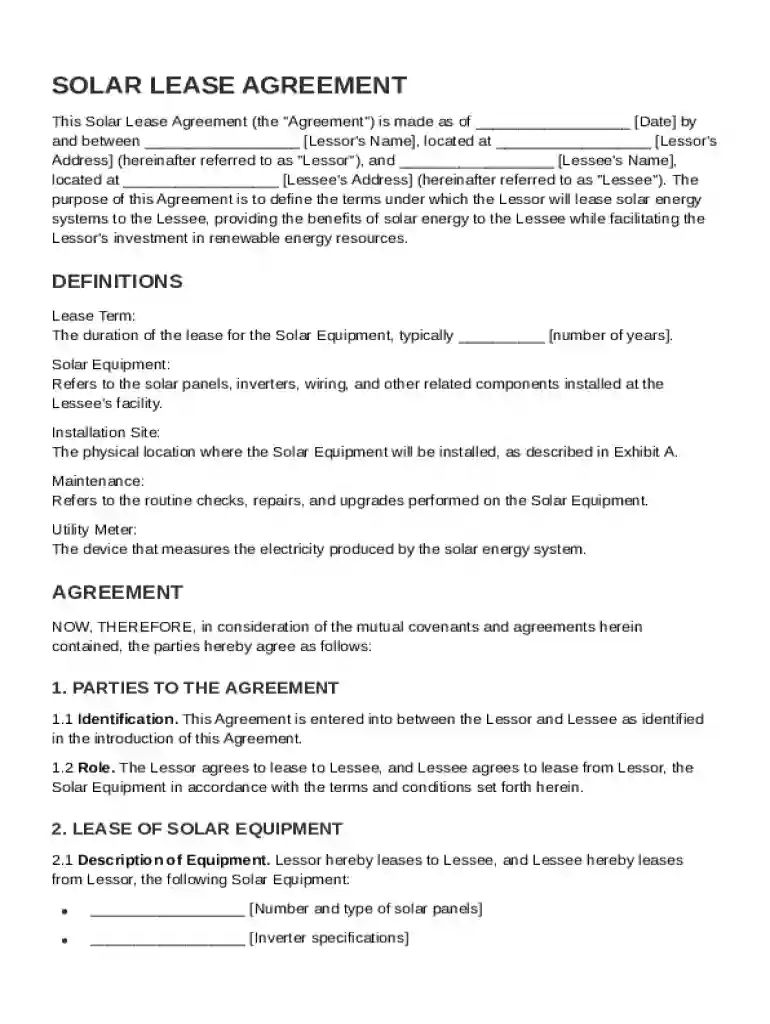
Solar Lease Agreement Template Preview on Page 1

Here's how it works

01. Edit your form online
Type text, add images, blackout confidential details, add comments, highlights and more.

02. Sign it in a few clicks
Draw your signature, type it, upload its image, or use your mobile device as a signature pad.

03. Share your form with others
Send it via email, link, or fax. You can also download it, export it or print it out.

Definition and Meaning

The Solar Lease Agreement Template is a legal document used to define the terms under which one party, known as the lessor, leases solar energy systems to another party, the lessee. It specifies the responsibilities involved in the installation, maintenance, and payment for the solar equipment. This template serves as a detailed guide for both parties, outlining essential components like the lease term, payment obligations, and the rights and duties of each participant in the agreement.

Key Components of the Solar Lease Agreement

  • Lease Term: Defines the period during which the lessee will utilize the solar energy system.
  • Solar Equipment Description: Specifies the types and specifications of the solar panels or systems being leased.
  • Payment Terms: Details the financial responsibilities, including the amount, frequency, and method of payments.
  • Responsibilities: Outlines obligations regarding maintenance, repair, and operational standards for the solar equipment.

Important Terms Related to the Solar Lease Agreement

Understanding the terminology is vital for the effective use of the Solar Lease Agreement Template. Legal and technical terms can significantly affect the interpretation and adherence to the agreement.

Common Terms and Definitions

  • Lessor: The owner of the solar equipment who grants the lease.
  • Lessee: The recipient of the solar equipment under the lease terms.
  • Installation: The process and responsibility for setting up the solar energy system.
  • Maintenance: The repair and upkeep obligations to ensure the solar system functions correctly.
  • Termination Conditions: Situations and processes through which the lease can be ended either by mutual agreement or due to breaches.

Steps to Complete the Solar Lease Agreement Template

Properly completing the Solar Lease Agreement Template ensures clarity and legal compliance. The process involves several detailed steps to guarantee the document's validity and effectiveness.

Step-by-Step Instructions

  1. Review Terms: Ensure both parties understand and agree on the core elements like lease term, payment specifics, and responsibilities.
  2. Fill In Details: Input specific data like the contact information of both lessor and lessee, and the precise location of the solar equipment installation.
  3. Finalize Financials: Specify the total cost, payment intervals, and any deposit or upfront fees required.
  4. Legal Consultation: It is advisable to have a legal professional review the agreement to ensure it meets all state and federal regulations.
  5. Signatures: Once finalized, both parties should sign the document to make it legally binding.

Key Elements of the Solar Lease Agreement Template

This template includes specific sections that are critical to its function. These elements are structured to provide comprehensive coverage of responsibilities and agreements between the parties.

Essential Sections

  • Insurance and Liability: Outlines insurance specifications and liability for potential damages or malfunctions.
  • Governing Law: Specifies which state laws will govern the agreement, allowing for any state-specific legal requirements.
  • Data Sharing and Privacy: Addresses how data related to energy consumption and system performance will be shared and protected.
  • Dispute Resolution: Provides mechanisms for resolving disagreements, such as mediation or arbitration.

Legal Use of the Solar Lease Agreement Template

Ensuring legal compliance is crucial to the effectiveness of the Solar Lease Agreement Template. The document must align with federal and state laws applicable to leasing solar energy systems.

Compliance and Legal Standards

  • Federal Regulations: Adhere to standards set by federal bodies concerning energy production and distribution.
  • State Laws: Each state may have unique requirements, such as incentives or regulations regarding renewable energy sources.
  • ESIGN Act Compliance: If electronic signatures are used, they must comply with the Electronic Signatures in Global and National Commerce Act to be legally recognized.

State-Specific Rules for the Solar Lease Agreement Template

While the Solar Lease Agreement Template provides a general framework, state-specific rules can significantly influence its content and enforcement.

Variations by State

  • California: Strong incentives for solar energy may impact the economic feasibility and terms of leasing agreements.
  • Texas: Different taxation and incentive structures could affect payment terms and maintenance responsibilities.
  • New York: Specific guidelines on installation and energy efficiency requirements may be more stringent than federal standards.

Examples of Using the Solar Lease Agreement Template

Practical examples show how the template can be applied in real-world scenarios, providing insights into potential challenges and best practices.

Case Studies

  • Residential Use: An example could be a homeowner in Arizona using the agreement to lease solar panels to reduce electricity costs, which includes specific clauses for maintenance services.
  • Commercial Application: A retail store in New Jersey leases a solar system to offset energy costs, utilizing the agreement to outline the responsibilities for system performance and reporting metrics.
  • Municipal Projects: Local governments might lease solar systems to power public buildings, employing the template to address installation schedules and public utility rebates.

Who Typically Uses the Solar Lease Agreement Template

Understanding the typical users can offer insights into how the document is tailored to meet specific needs.


decoration image ratings of Dochub

Primary Users

  • Homeowners: Individuals leasing solar panels to decrease energy expenses.
  • Business Owners: Companies of various sizes interested in sustainable energy solutions for cost-saving measures.
  • Property Managers: Managing multiple properties with a focus on sustainable and renewable energy integrations.

Through these sections, the Solar Lease Agreement Template is comprehensively covered, providing a robust resource for ensuring effective engagement in solar leasing contracts.

be ready to get more

Complete this form in 5 minutes or less

Get form

Got questions?

We have answers to the most popular questions from our customers. If you can't find an answer to your question, please contact us.
Contact us
The Lessee has paid to the Lessor / s a sum of Rs. only being month / s rent in respect of the said premises as deposit of rent to be adjusted towards the rent for the last month / s of the tenancy. also be borne and paid by lessor (landlord).
The 20% rule means your solar panels should give you 20% more energy than your home usually needs. It is a way to avoid power loss during cloudy days or high-use months. For example, if your home uses 1,000 kilowatt-hours (kWh) of energy each month, you should a system that gives you 1,200 kWh.
A solar lease is a solar financing option where a solar company installs and owns the solar panels on your roof, and you make monthly payments to the company to use the solar energy they generate. Under a solar lease, the solar company owns the solar panels and gets to take advantage of rebates and tax incentives.
With a solar lease, you pay a fixed monthly fee for the use of the solar panels. With a PPA, you pay for the electricity you consume from the solar panels at a predetermined rate per kWh.
When you lease a solar energy system, a company installs the system on your house and you sign a contract to use the system. Contracts often last 20 years or more. You dont buy the system or own anything installed on your property.

Security and compliance

At DocHub, your data security is our priority. We follow HIPAA, SOC2, GDPR, and other standards, so you can work on your documents with confidence.

Learn more
ccpa2
pci-dss
gdpr-compliance
hipaa
soc-compliance

People also ask

You dont qualify for solar tax credits or incentives under a lease, and you also miss out on the added home equity that comes with ownership. By buying out the system, you not only make the transfer process to a new owner far simpler, but you can also factor the systems added value directly into your selling price.
A big disadvantage of leasing solar panels is the decreased long-term savings opportunity. Since you pay the solar company every month for the length of your lease, you can save money on your energy bills, but typically not as much in the long term compared to owning.

Related links