






Definition and Purpose of the School University Collaboration Agreement
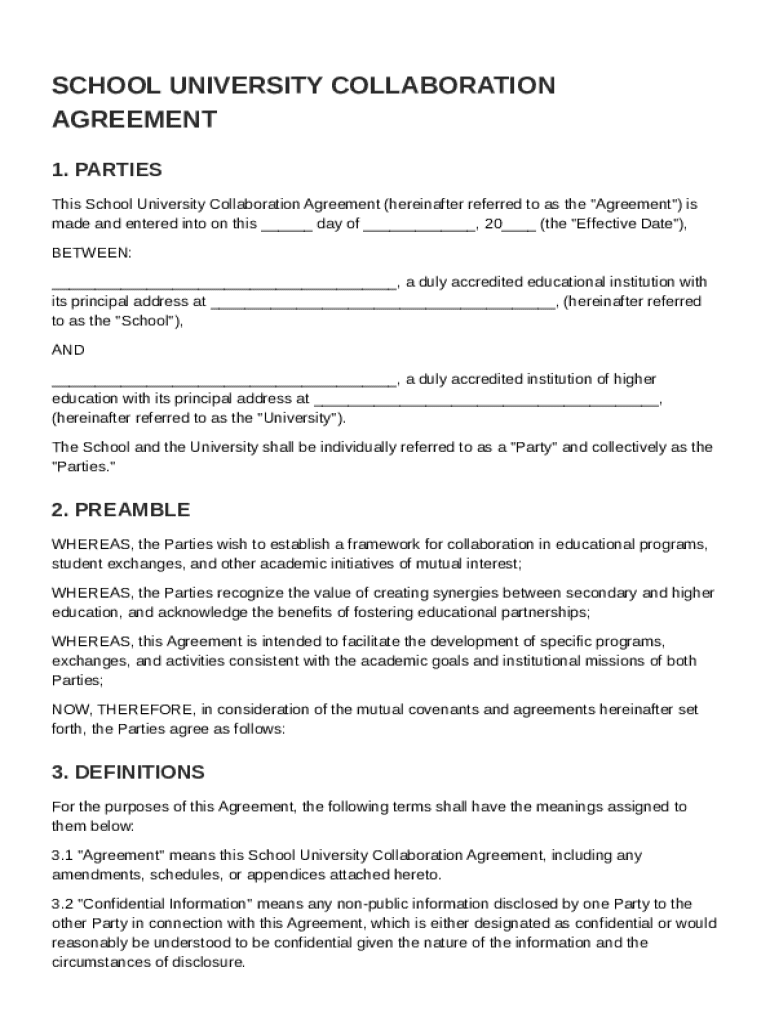
The School University Collaboration Agreement is a legally binding document that establishes a framework for partnership between a school and a university. It aims to enhance educational opportunities through joint programs, student exchanges, and shared resources. This agreement outlines the roles and responsibilities of both parties, financial arrangements, confidentiality, intellectual property rights, dispute resolution processes, and general provisions governing the collaboration.
Key Elements of the Agreement
- Roles and Responsibilities: Clearly defines the roles each institution will play in the partnership, including management, oversight, and execution of joint programs.
- Financial Arrangements: Details the financial obligations of each party, including funding sources, budgeting, and cost-sharing mechanisms.
- Intellectual Property Rights: Establishes ownership and usage rights for any intellectual property developed during the collaboration.
- Dispute Resolution: Outlines the processes for resolving any conflicts or disagreements that may arise during the partnership.
- Confidentiality Provisions: Ensures the protection of sensitive information shared between the institutions.
How to Use the School University Collaboration Agreement Template
When utilizing the School University Collaboration Agreement template, both parties should begin by reviewing the document to ensure it aligns with their objectives. The template should then be customized to reflect specific partnership details.
Steps to Customize the Template
- Initial Review: Both parties should review the generic template together to understand its scope and what needs personalizing.
- Details Insertion: Add specific information related to the roles, responsibilities, and financial arrangements.
- Legal Review: Consult legal advisors to ensure compliance with regional laws and institutional policies.
- Approvals: Obtain the necessary internal approvals from both the school and university administrators before finalizing the agreement.
- Signing: Both parties should sign the agreement to execute it, making it legally binding.
Important Terms in the School University Collaboration Agreement
Understanding the terminologies used in the agreement is crucial for clarity and effectiveness in execution.
Common Key Terms
- Joint Programs: Educational initiatives that involve cooperation between the school and university.
- Student Exchanges: Programs that allow students from one institution to attend courses at the partner institution.
- Resource Sharing: Mutual use of facilities, materials, or information technology resources.
- Financial Obligations: Commitments related to funding and budgeting within the partnership.
- Confidential Information: Any data or information disclosed from one entity to another, intended to be kept confidential.
Legal Use and Compliance
The School University Collaboration Agreement must comply with legal requirements to maintain its enforceability.
Legal Considerations
- Regional Laws: Ensure the agreement adheres to the specific educational, financial, and privacy laws of the United States.
- Institutional Policies: Both partners must verify that the agreement aligns with their respective institutional policies.
- Signing Authority: Confirm that the individuals signing have the authority to bind their respective institutions legally.
Who Typically Uses the School University Collaboration Agreement
The agreement is commonly used by educational institutions looking to formalize partnerships that bolster academic opportunities or resource efficiency.


Primary Users
- Higher Education Administrators: Involved in setting and managing inter-institutional collaborations.
- Legal Teams: Ensure compliance with legal and institutional requirements.
- Financial Officers: Oversee budgeting, funding, and financial arrangements within the partnership.
- Academic Program Directors: Facilitate and manage specific educational initiatives contained within the agreement.
State-Specific Rules and Variations
Each U.S. state may have specific regulations that affect how school-university partnerships are formed and governed.
State Considerations
- Education Policy: Some states have unique requirements for educational programs and partnerships.
- Financial Legislation: Variations in financial compliance laws may affect funding arrangements.
- Data Privacy: State-specific privacy laws may impact how student and institutional data is handled.
Examples and Case Studies
Utilizing real-world examples can provide insights into how institutions benefit from such agreements.
Notable Case Studies
- Case of University-School Network: A midwestern university partnered with local high schools to develop dual-enrollment programs, enhancing college readiness among students.
- Tech Equipment Sharing: A university and a local school drafted an agreement to share technological resources, significantly cutting costs and enhancing resource utilization.
Alternate Forms and Variations
There are alternative versions and templates for various types of school-university collaborations.
Common Variations
- Memorandums of Understanding (MOUs): Used for less formal partnerships that do not require the legal binding nature of a full agreement.
- Joint Venture Agreements: For partnerships involving significant shared investments or resource co-development.
Such collaborations can greatly enhance educational quality, resource management, and strategic initiatives. By following a thorough process of drafting, reviewing, and implementing the School University Collaboration Agreement, both parties can create mutually beneficial partnerships.