
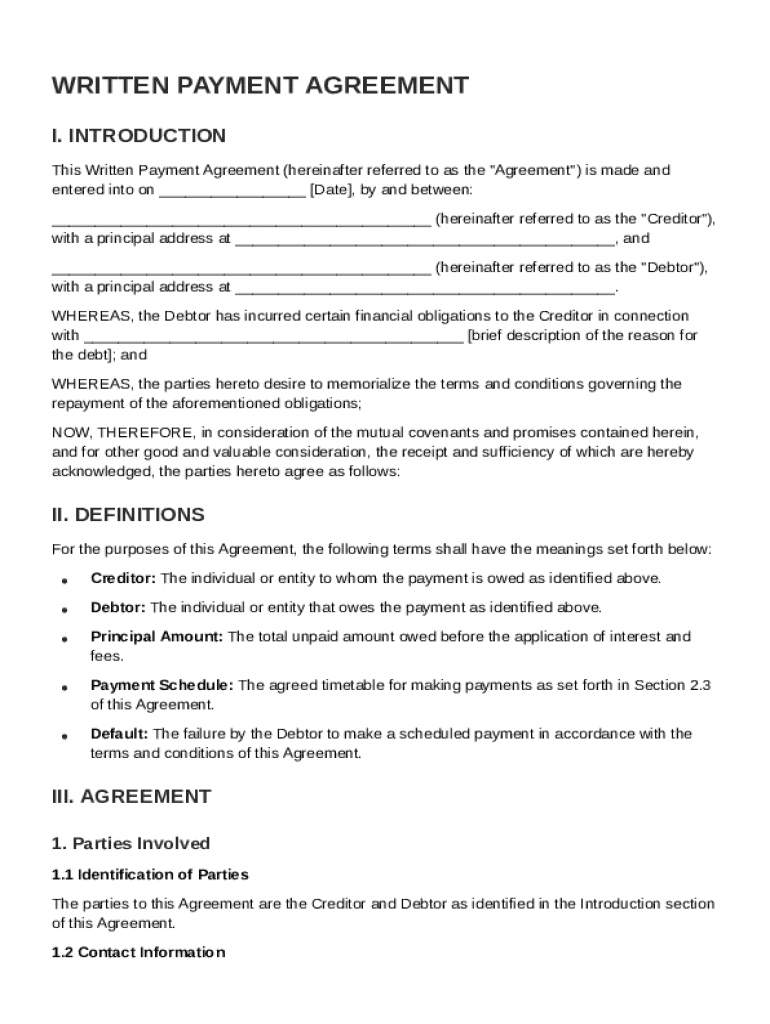







Definition and Meaning
A Written Payment Agreement Template is a formal document that clearly outlines the terms and conditions agreed upon by a creditor and a debtor for the repayment of a financial obligation. This template serves as a legally binding agreement, establishing the rights and responsibilities of both parties involved. Such agreements are crucial for ensuring that all parties have a clear understanding of repayment schedules, the amount owed, and the procedures to be followed in case of default. In essence, it helps protect all involved parties by creating a transparent and enforceable framework for financial transactions, thus minimizing misunderstandings and disputes.
Key Elements of the Written Payment Agreement Template
The Written Payment Agreement Template comprises several critical elements that ensure its effectiveness and enforceability. These include:
-
Definitions: Clear definitions of key terms like 'Creditor', 'Debtor', 'Default', and 'Payment' to avoid any ambiguity.
-
Payment Terms: Detailed payment schedule specifying amounts, due dates, and acceptable payment methods. This ensures mutual agreement on how and when payments should be made.
-
Penalties for Late Payments: Specific penalties or interest rates applied to late payments, which act as deterrents for delays and incentivize timely payments.
-
Rights to Prepay: Clauses that allow the debtor to repay the loan earlier than scheduled without incurring additional fees, offering flexibility in fulfilling financial obligations.
-
Conditions for Default: Circumstances under which the debtor would be considered in default and the remedies available to the creditor, such as acceleration of the debt or legal action.
-
Governing Law: Provisions that specify which jurisdiction's laws govern the agreement, offering clarity in legal contexts.
-
Amendment Provisions: Procedures for modifying the agreement terms, ensuring any changes are mutually agreed upon and documented.
Steps to Complete the Written Payment Agreement Template
Completing a Written Payment Agreement Template requires careful attention to detail to ensure that all relevant information is accurately captured. Here’s a step-by-step guide:
-
Identify the Parties: Clearly state the legal names of the creditor and debtor, along with any additional identifiers, such as address or contact information.
-
Detail the Obligation: Accurately describe the financial obligation, including the principal amount, interest rates, and purpose of the loan or debt.
-
Set Payment Terms: Define the repayment schedule, including specific amounts and deadlines. Include options for early repayment if applicable.
-
Specify Penalties and Default Conditions: Outline any penalties for late payments and describe the conditions under which the debtor will be considered in default.
-
Outline Legal Provisions: Include governing law and jurisdiction clauses, detailing how disputes will be resolved.
-
Get Agreement and Signatures: Ensure both parties review the terms, make any necessary revisions, and sign the document. Signatures make the agreement legally binding.
Who Typically Uses the Written Payment Agreement Template
A Written Payment Agreement Template is widely used by various individuals and entities, including:
-
Individuals: People borrowing or lending money informally, such as family loans or personal loans, benefit from having a clear and enforceable agreement.
-
Businesses: Small to medium-sized enterprises (SMEs) and large corporations engaging in trade agreements or supplier contracts to detail payment arrangements.
-
Financial Institutions: Banks and credit unions use such agreements to formalize loans and credit extensions to clients while ensuring compliance with regulatory standards.
-
Legal Professionals: Attorneys often draft or review these templates to ensure they meet legal requirements and are tailored to the client's specific needs.


Legal Use of the Written Payment Agreement Template
Using a Written Payment Agreement Template helps establish a legally enforceable contract between a creditor and a debtor. This document provides a clear reference point in case of disputes and can be used in court to enforce payment terms. When crafted correctly, it complies with legal standards such as those outlined in the Uniform Commercial Code (UCC) and relevant state or federal laws, providing a solid foundation for legal redress in case of non-compliance. It also helps prevent disputes by demonstrating clear expectations between the involved parties.
State-Specific Rules for the Written Payment Agreement Template
State laws can significantly influence the terms and enforcement of a Written Payment Agreement. For example, usury laws dictate the maximum interest rate that can be charged, which varies by state. Additionally, state-specific regulations may require additional disclosures or affect how default conditions are governed. Therefore, it’s important to tailor the agreement to reflect the relevant state regulations, ensuring that the template is compliant with local laws. Consulting with legal professionals familiar with state laws can provide important insights and prevent potential legal pitfalls.
Examples of Using the Written Payment Agreement Template
Written Payment Agreement Templates find application in various scenarios, such as:
-
Personal Loans: Individuals formalizing borrowings between friends or family can use the template to prevent disputes and ensure a clear record of the debt.
-
Business Transactions: Companies engaging in sales on credit can deploy this template to secure payment whilst defining terms clearly, averting risks associated with defaults.
-
Real Estate Agreements: Property transactions involving deferred payments or vendor financing, where outlining clear payment schedules and conditions are crucial.
By providing clarity and legal backing, the template aids different users in safeguarding their interests.
Important Terms Related to the Written Payment Agreement Template
Certain terms are essential to understanding and completing the Written Payment Agreement Template effectively:
-
Principal: The original sum of money borrowed or the outstanding balance before interest and penalties.
-
Interest Rate: Charges imposed as a percentage of the principal, influencing the total cost of borrowing.
-
Maturity Date: The date by which the entire debt must be paid off, after which penalties or legal actions may be pursued.
-
Collateral: Assets pledged by the debtor to secure the loan, potentially affecting recovery in case of default.
Understanding these key terms is vital for both creditors and debtors to ensure informed decision-making as they work through the agreement.




