
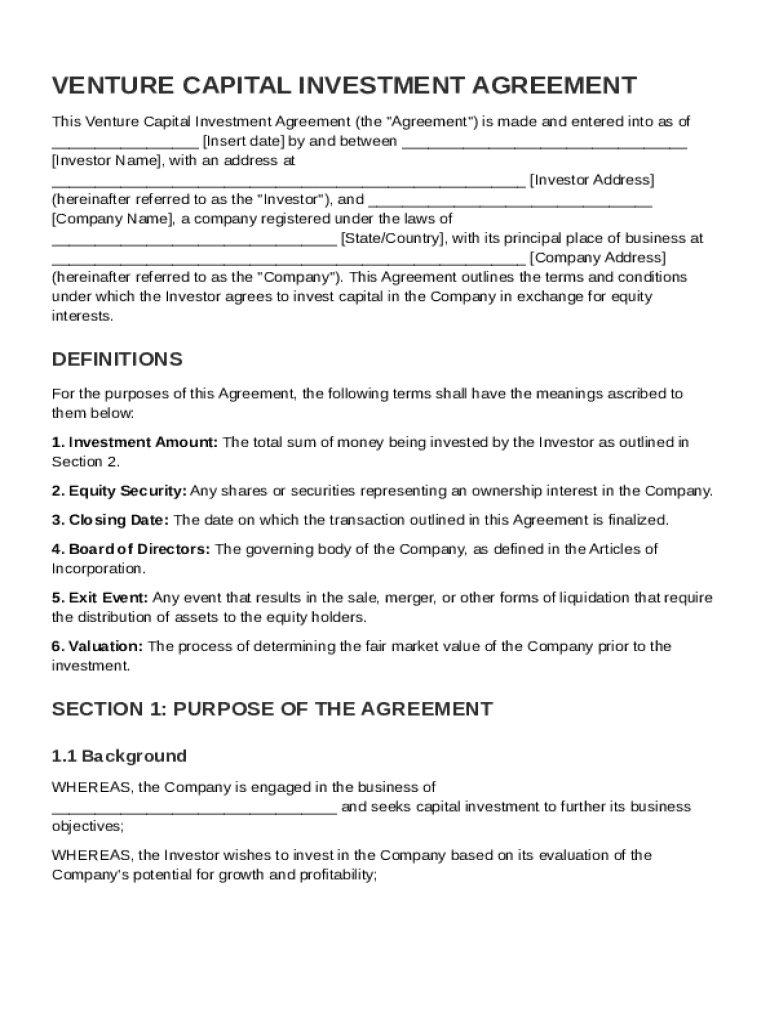







Definition & Meaning
The Venture Capital Contract Template serves as a foundational document for establishing the terms under which a venture capital investment is made. This legal instrument outlines the relationship between investors and a company, delineating roles, responsibilities, and expectations. Essential sections typically include equity details, investment timelines, and exit strategies. It safeguards the interests of both parties by specifying conditions under which the investment will take place. While simplifying complex legal jargon, this template maintains all crucial elements needed for compliance and clarity in the investment process, ensuring both parties are aligned on their goals and operations.
Key Elements of the Venture Capital Contract Template
Understanding the crucial components of a venture capital contract is essential for anyone involved in the process:
- Investment Terms: Details about the capital amount invested, valuation of the company, and share of equity.
- Representations and Warranties: Statements ensuring that both parties are legally and ethically bound to their promises.
- Governance Rights: Information about decision-making roles and responsibilities within the company structure.
- Exit Strategy Provisions: Clearly defines the plan for how investors might profit from their investment in the future.
- Miscellaneous Clauses: Additional provisions addressing various eventualities, like dispute resolution processes.
Each of these sections is vital in forming a comprehensive and legally sound agreement that benefits both the company and its investors.
Steps to Complete the Venture Capital Contract Template
Completing a venture capital contract requires attention to detail and a thorough understanding of each section. Here's a step-by-step guide:
- Review Legal Definitions: Start by understanding all legal definitions used in the contract.
- Fill Out Basic Information: Include names, addresses, and roles of the parties involved.
- Specify Investment Details: Outline the amount of investment and the type of securities being offered.
- Insert Representations and Warranties: Ensure both parties can fulfill their legal obligations.
- Detail Governance Rights: Define the roles and powers of investors within the company.
- Outline the Exit Strategy: Establish conditions under which the investor can exit the investment.
- Review and Sign: Verify all details before signing, ensuring both parties agree on every term.
By following these steps, both the investor and the company can safeguard their interests and promote a transparent, mutually beneficial relationship.
State-Specific Rules for Venture Capital Contracts
Venture capital agreements can differ significantly depending on the state. It is essential to take into account the jurisdiction-specific legal environments:
- California: Known for its robust tech industry, contracts often include provisions that are friendly to start-ups.
- Delaware: Many companies incorporate here due to favorable corporate laws which may influence the terms of venture capital agreements.
- New York: Financial laws may lead to stricter compliance necessities, demanding rigorous documentation and transparency.
Each state has unique legal frameworks, and it is advisable to consult legal experts familiar with local laws to ensure the contract complies with all relevant regulations.
Legal Use of the Venture Capital Contract Template
The legal standing of a venture capital contract is paramount for its enforceability:
- Contract Enforcement: Ensures that all agreed terms are legally binding.
- Compliance with Regulations: Adheres to federal and state-level securities and investments laws.
- Protection of Intellectual Property: Safeguards proprietary company technology or strategies against unauthorized use.
These legal considerations provide a framework that protects both parties’ interests, ensuring that any legal disputes can be resolved efficiently and fairly.
Examples of Using the Venture Capital Contract Template
Real-world examples illuminate how this template might be utilized:
- Tech Startups: Often seek venture capital to scale operations quickly while investors demand strong equity positions and clear governance structures.
- Biotech Firms: Require significant upfront investment in research and development, making exit strategies and investor rights crucial.
- Consumer Goods Companies: May use these contracts to expand market reach, necessitating a well-defined capital utilization plan.
Each sector might have different priorities and focus areas within the contract, depending on its specific needs and challenges.
Business Types That Benefit Most from Venture Capital
Not all businesses are suited for venture capital investments, but certain types thrive with these agreements:
- High-Growth Technology Startups: Benefit from venture capital to fund rapid scaling and technological advancements.
- Medical Device Companies: Often need investment for research, regulatory approval, and market entry.
- SaaS Providers: Use venture capital to fund development cycles and user acquisition strategies.
These business types often present high-risk opportunities with potentially high returns, aligning them well with venture capital investment objectives.
Software Compatibility and Integration
To leverage maximum efficiency in handling these contracts, it's beneficial to use software that supports the necessary file formats:
- Document Editing Tools: Platforms like DocHub easily accommodate formats such as PDF, DOC, PPT, and others for ease of editing.
- Integration with Cloud Storage: Direct uploads from Google Drive, Dropbox, and OneDrive simplify document management.
- Electronic Signature Software: Ensures compliance and eases the process of signing legally binding agreements.
By integrating these technological tools, users can streamline the process of drafting, negotiating, and finalizing venture capital contracts.




