Bare Trust Agreement Template 2026

Get Form
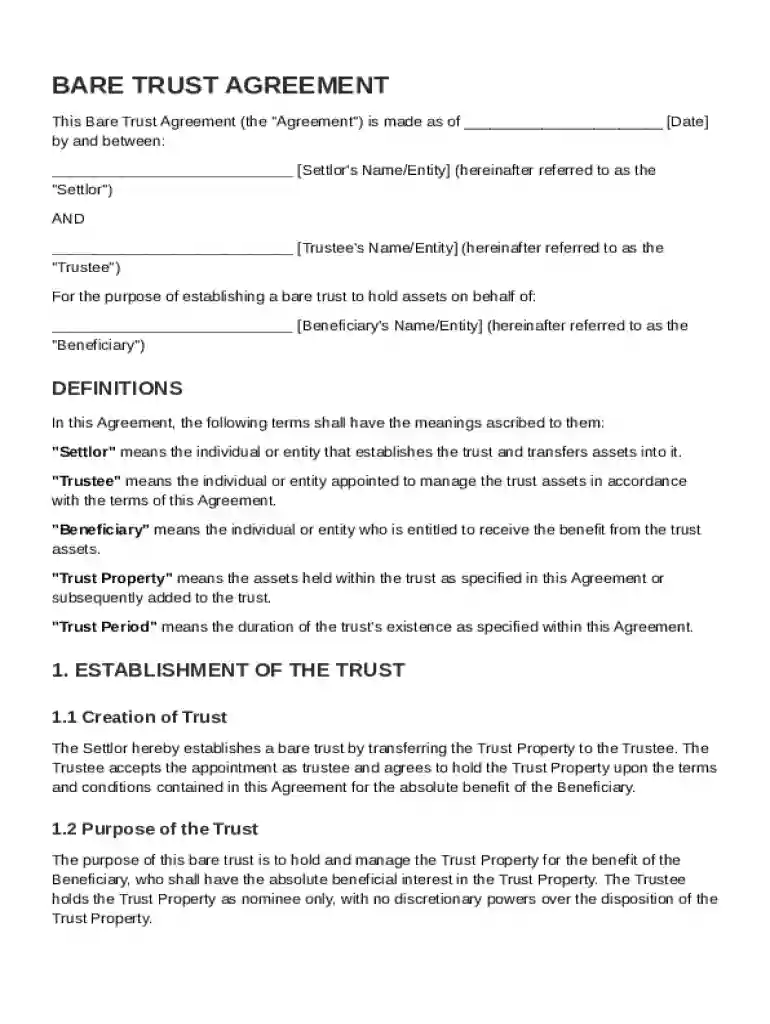
Bare Trust Agreement Template Preview on Page 1

Here's how it works

01. Edit your form online
Type text, add images, blackout confidential details, add comments, highlights and more.

02. Sign it in a few clicks
Draw your signature, type it, upload its image, or use your mobile device as a signature pad.

03. Share your form with others
Send it via email, link, or fax. You can also download it, export it or print it out.

Definition and Purpose of a Bare Trust Agreement Template

A Bare Trust Agreement is a legal document that defines the relationship between a Settlor, a Trustee, and a Beneficiary. In this arrangement, the Settlor transfers assets to the Trustee, who holds them for the sole benefit of the Beneficiary. One of the defining characteristics of a Bare Trust Agreement is that the Trustee has no discretionary powers over the assets, meaning they must act exclusively on the Beneficiary's instructions. This type of trust is often used when the Beneficiary is a minor or requires assistance in asset management.

The Bare Trust Agreement Template serves as a guide for setting up this specific type of trust agreement. It provides a structured outline of the necessary components, such as definitions, roles, responsibilities, and conditions governing the relationship between the parties involved. By using this template, the Settlor can ensure clarity and legal compliance while establishing a trust.

Key Elements in a Bare Trust Agreement Template

The Bare Trust Agreement Template incorporates several critical elements to structure the trust effectively. These elements include:

  • Definitions: Clear definitions of terms like Settlor, Trustee, and Beneficiary are crucial for understanding the parties' roles.
  • Trustee Powers and Duties: Outlines the responsibilities the Trustee must abide by, including maintaining assets and following instructions from the Beneficiary.
  • Beneficiary Rights: Specifies the Beneficiary's entitlements, including access to assets and the ability to direct the Trustee.
  • Administration Procedures: Details how the trust will be managed, including asset distribution and record-keeping.
  • Indemnification Clauses: Protects trustees from liability, except in cases of gross negligence or misconduct.
  • Termination Conditions: Establishes scenarios that can lead to the dissolution of the trust agreement.
  • Governing Law: Identifies the jurisdiction under which the trust will be governed, typically determined by the Settlor’s state of residence.

Important Terms Related to a Bare Trust Agreement

Understanding specific terms is vital when dealing with a Bare Trust Agreement:

  • Settlor: The individual or entity transferring assets to the trust.
  • Trustee: The person or institution holding legal title to the trust assets, responsible for administering the trust under the Beneficiary's instructions.
  • Beneficiary: The individual or group entitled to the assets and benefits of the trust.
  • Fiduciary Duty: A legal obligation for Trustees to act solely in the Beneficiary's interest.
  • Corpus: The principal amount or assets placed into the trust by the Settlor.

Steps to Complete the Bare Trust Agreement Template

Completing the Bare Trust Agreement Template requires careful attention to detail. Here are the steps involved:

  1. Identification of Parties: Accurately list the names and contact information of the Settlor, Trustee, and Beneficiary.
  2. Asset Description: Clearly describe the assets being transferred into the trust.
  3. Define Terms: Fill in precise definitions for key terms within the introductory sections of the agreement.
  4. Determine Trustee Duties: Specify the duties and limitations of the Trustee.
  5. Layout Rights of Beneficiary: Establish the Beneficiary’s rights to the assets and expectations for managing them.
  6. Include Indemnities: Draft clauses to protect the Trustee from undue liability.
  7. Define Termination Conditions: Set conditions under which the trust may be dissolved.
  8. Ensure Legal Compliance: Check that the agreement adheres to the relevant state laws and regulations.

Legal Use of the Bare Trust Agreement Template

The Bare Trust Agreement Template is used to convey specific instructions that are legally binding, ensuring compliance with applicable state laws and regulations. It must be detailed and precise to avoid misunderstandings or legal disputes. Moreover, this document can serve as evidence in court to demonstrate adherence to the legal obligations agreed upon by involved parties.

Using this template correctly is critical, as it provides a legal framework governing the trust's creation and administration. It should be reviewed by legal counsel or a trust professional to ensure all aspects of U.S. law are considered, especially in matters of tax implications and asset distribution.

State-specific Rules for Bare Trust Agreements

In the United States, state laws can significantly impact the formation and administration of a Bare Trust. Each state may have unique requirements related to trust registration, applicable taxes, and operational compliance. For example:

  • California: Requires specific registration formalities and may impose different tax treatments for trust income and disbursements.
  • New York: Enforces strict fiduciary duties on Trustees, ensuring they act with utmost good faith for the Beneficiary's interest.
  • Florida: Provides specific protections to Beneficiaries in cases of trustee mismanagement or insolvency.

Understanding these state-specific rules is essential to ensure that the Bare Trust Agreement Template is appropriately utilized within the governing state's jurisdiction.

Examples of Using the Bare Trust Agreement Template

Bare Trust Agreements are often used in scenarios where asset management needs to be straightforward and directed by the Beneficiary. Examples include:

  • Minor Beneficiaries: When assets are held for a child until they reach the age of majority.
  • Family Trusts: Simplifying asset transfers within a family, with clear directives given to Trustees.
  • Investment Portfolios: Managing investments with directed orders from the Beneficiary to address specific financial goals.

Such scenarios highlight the template's practical applications, ensuring assets are managed efficiently and transparently, ahead of personal or familial needs.

Tax Implications and IRS Guidelines for Bare Trust Agreements

While the Bare Trust Agreement serves primarily as a legal framework, understanding its tax implications is vital:

  • Income Attribution: Income generated by the trust assets typically attributes directly to the Beneficiary.
  • IRS Reporting: Beneficiaries must report income derived from the trust on their personal income tax returns.
  • Gifting Rules: Transfers into the trust may influence gift tax considerations and should be evaluated with IRS guidelines in mind.

Following IRS guidelines can mitigate tax-related issues, ensuring compliance and proper reporting of income and assets held in the trust.

be ready to get more

Complete this form in 5 minutes or less

Get form

Got questions?

We have answers to the most popular questions from our customers. If you can't find an answer to your question, please contact us.
Contact us
A bare trust is a trust with the following characteristics: (1) the beneficiary or beneficiaries can call for the trust property on demand; and (2) the bare trustee has no independent powers, directions, or responsibilities. Typically, the sole function of a bare trustee is to hold legal title to the trust property.
What are some examples of a bare trust arrangement? An adult child is added to a joint bank account or joint investment account with parent often for ease of estate administration on the parents passing.
Bare trusts are often created either by a transfer of cash to the Trustees or the transfer of existing assets, such as insurance bonds, share portfolio or other investment funds. There are no Capital Gains Tax liabilities for these lifetime gifts involving cash or existing bonds.
A bare trust is created when a person (the settlor) makes a gift to another person (the beneficiary) and a trustee oversees the trust. The gift would be recognised as a Potentially exempt transfer for inheritance tax purposes.
The potential drawbacks of a bare trust include: Once the trust is established, the beneficiaries and their entitlements cannot be changed, even if circumstances change. Beneficiaries gain full control over the trust assets at age 18, which might be too young for them to manage substantial wealth responsibly.

Security and compliance

At DocHub, your data security is our priority. We follow HIPAA, SOC2, GDPR, and other standards, so you can work on your documents with confidence.
Learn more
ccpa2
pci-dss
gdpr-compliance
hipaa
soc-compliance

People also ask

Based on these proposals, some common bare trusts that appear to be exempt include: Spouses that have a joint bank account for the use and benefit of both spouses. A parent that is on legal title of a principal residence to allow a child to obtain a mortgage.
Typically, a bare trust holding cash will be around 1,400 plus VAT to set up.
The most common example is an absolute gift to a minor. A gift by Brendas Will of 1,000 to David absolutely will create a bare trust if David is not 18 when Brenda dies. David is beneficially entitled to the 1,000 (and any income arising) but cannot hold legal title because he is not an adult.

Related links