
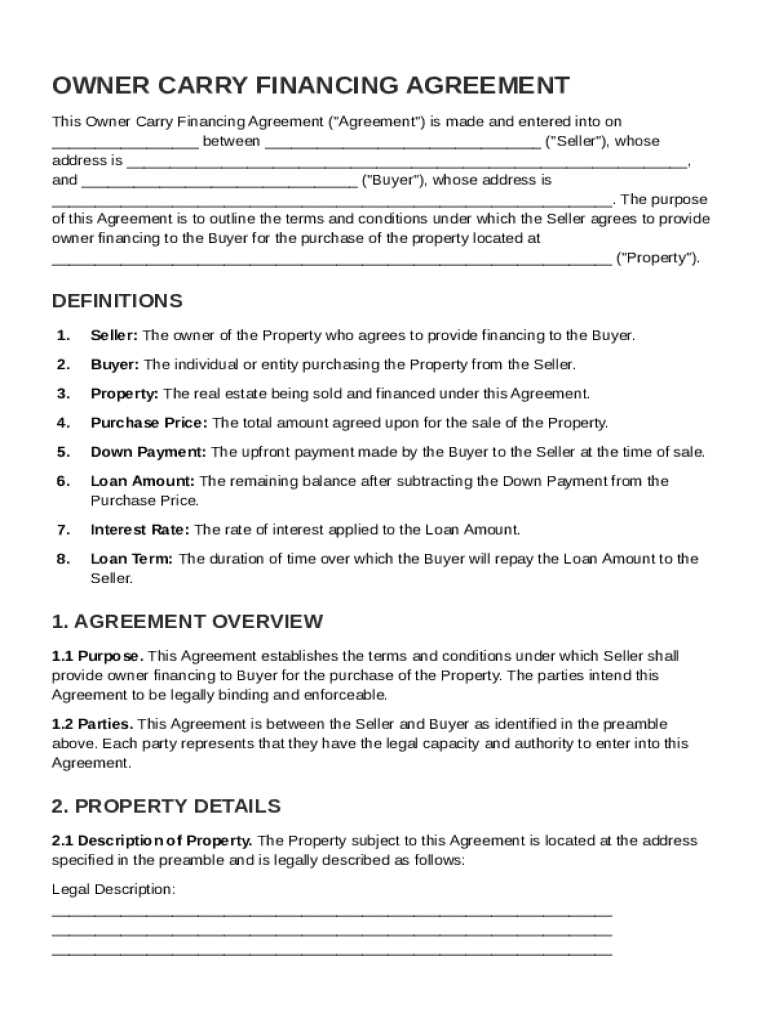







Definition & Meaning
An Owner Carry Contract Template is a structured agreement used in real estate transactions where the seller finances the buyer’s purchase of a property. Also known as a Seller Financing Agreement, this contract outlines specific terms related to the property sale, addressing both the buyer and seller responsibilities. It includes crucial details such as the purchase price, interest rates, installment amounts, payment schedule, and any conditions for default.
-
Seller Financing Explanation: In seller financing, the seller acts as the lender, offering a loan to the buyer to purchase the property. This is beneficial when traditional mortgage options are unavailable or insufficient for the buyer.
-
Importance of Documentation: Documentation of such agreements is vital to ensure both parties are legally protected and obligated to the terms defined in the contract.
Key Elements of the Owner Carry Contract Template
An effective Owner Carry Contract Template contains several critical components to ensure clarity and enforceability.
-
Property Details: Exact description of the property, including address and legal identifiers, to prevent any ambiguity regarding the transaction.
-
Purchase Price and Down Payment: Clearly outlines the total purchase price and initial down payment amount required from the buyer.
-
Interest Rate & Payment Terms: Specifies the interest rate applied to the outstanding balance and details the payment schedule, including the frequency and amounts of payments.
-
Default Clauses: Describes what constitutes default, such as missed payments, and the potential remedies available to the seller, including foreclosure rights.
-
Signatures: Both parties must sign the contract, along with any required witnesses or notary, to validate the agreement legally.
Steps to Complete the Owner Carry Contract Template
Completing the Owner Carry Contract Template requires careful attention to detail and a systematic approach.
-
Review Terms: Both parties should review all terms and seek legal advice if necessary to ensure understanding and mutual agreement.
-
Customize Contract: Input specific transaction details such as names, addresses, and financial terms. Each entry should be cross-checked for accuracy.
-
Include Additional Agreements: Any additional terms, such as property maintenance responsibilities or penalty clauses, should be added.
-
Final Review and Signing: Both parties conduct a final review before signing. The presence of a notary public might be required, depending on state regulations.
-
Distribute Copies: After signing, ensure that each party has a copy of the signed agreement for their records.
Legal Use of the Owner Carry Contract Template
Legal enforceability is a vital concern in owner carry contracts, requiring adherence to state and federal laws.
-
Compliance with State Laws: Each state may have specific laws regulating seller financing, affecting interest rates, disclosures, and foreclosure processes. Ensure your contract aligns with these regulations.
-
Federal Regulations: The Dodd-Frank Act impacts seller financing, requiring sellers to meet certain criteria unless exempted. Understanding these requirements is essential for compliance.
-
Legal Disputes and Resolutions: Clearly defined dispute resolution processes, such as mediation or arbitration, should be incorporated to efficiently handle any disagreements.
Who Typically Uses the Owner Carry Contract Template
The Owner Carry Contract Template is utilized by a variety of parties in the real estate sector.
-
Property Sellers: Especially those unable to sell through conventional means or looking to expedite the sale process.
-
Buyers Lacking Conventional Financing: Individuals without access to traditional bank loans due to credit issues or self-employment may benefit from owner financing.
-
Real Estate Investors: Investors may use these contracts to facilitate quicker deals and potentially gain favorable terms not typically available through standard lending institutions.


State-Specific Rules for the Owner Carry Contract Template
Seller financing laws differ by state, necessitating awareness of relevant local regulations.
-
Interest Rate Caps: Some states impose a maximum allowable interest rate on seller-financed deals to protect buyers from exorbitant charges.
-
Foreclosure Procedures: Vary across states, influencing how quickly a seller can take back the property upon buyer default.
-
Title Transfer Requirements: Procedures such as escrow and title insurance may differ, impacting the timing and method of legal title transfer.
Examples of Using the Owner Carry Contract Template
Real-life scenarios highlight practical applications of the Owner Carry Contract Template.
-
Rural Properties: In areas with limited banking facilities, sellers often use this template to offer financing options that expedite transactions.
-
Fixer-Uppers: Buyers interested in properties requiring extensive renovations might find traditional financing challenging and use seller financing as an alternative.
-
Family Transfers: Families often use these templates to transfer property between relatives, simplifying the transaction process while being legally secure.
-
Market Fluctuations: In fluctuating markets, sellers can quickly offload properties while maintaining income streams through financed payments.
Important Terms Related to Owner Carry Contract Template
Understanding related terminology enhances clarity when discussing or drafting the agreement.
-
Amortization: Process of gradually paying off the loan through scheduled payments, where early payments include more interest and less principal.
-
Balloon Payment: A significant final payment made at the end of the loan term after smaller installment payments throughout the contract duration.
-
Equity: The value of ownership a buyer has accumulated in the property, calculated by the difference between the property's value and any remaining loan balance.
-
Recourse vs. Non-Recourse: Indicates whether the seller can pursue the buyer’s other assets in case of default beyond repossessing the property.
By carefully considering these elements and guidelines, individuals engaging in owner finance transactions can navigate the complexities with greater assurance and effectiveness.




