
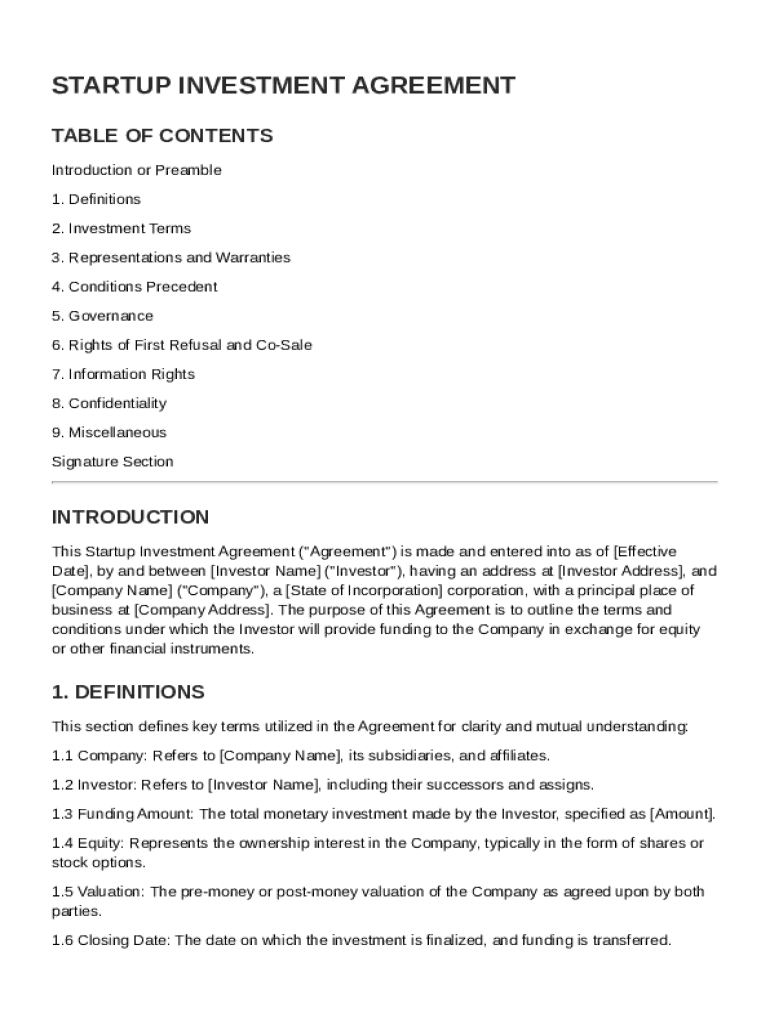







Definition & Meaning
The Startup Investment Agreement Template is a comprehensive document that outlines the terms and conditions under which an investor provides capital to a startup in exchange for equity. This agreement establishes a baseline for understanding the rights and responsibilities of each party involved in a startup venture. It covers critical components such as the investment amount, equity ownership, representations and warranties, and shareholder rights. By detailing these aspects, the template helps mitigate misunderstandings and legal disputes, offering a clear structure for the business relationship between founders and investors.
Key Components
- Investment Terms: Specifies the financial details, including the amount and structure of the investment.
- Equity Distribution: Outlines the percentage of equity the investor will receive.
- Governance Rights: Defines the investor’s role in business decisions and corporate governance.
How to Use the Startup Investment Agreement Template
Employing this template efficiently requires an understanding of the startup's specific needs and circumstances. Begin by gathering essential information about both the startup and the investor. Follow these steps:
- Customize the Template: Adapt sections such as financial terms, equity percentages, and governance rights to fit the unique context of the deal.
- Collaborate with Stakeholders: Engage legal advisors, financial experts, and other stakeholders to ensure all aspects are comprehensively covered.
- Review and Finalize: Ensure that all parties agree on the terms, then proceed with finalizing and signing the document.
Practical Tips
- Consult with Experts: Involve legal experts to verify that the agreement complies with relevant laws and regulations.
- Tailor to Specific Needs: Modify sections of the template to reflect the specific arrangement between parties.
Key Elements of the Startup Investment Agreement Template
This template includes several essential elements that form the backbone of the investment agreement:
- Financial Clauses: These outline the specifics of the financial arrangement, including payment schedules and conditions for additional funding rounds.
- Representations and Warranties: These are critical assurances provided by the startup to the investor regarding the company's legal standing and financial health.
- Confidentiality and Non-Disclosure: Ensures that sensitive information shared during the investment process is protected.
Important Terms Related to Startup Investment Agreement Template
Understanding certain critical terms is crucial for effectively using this agreement template. These terms often determine the relationship dynamics and operational parameters:
- Pre-Money Valuation: The valuation of the startup before the new investment is added.
- Liquidation Preference: The order in which investors will be paid out in the event of a liquidation.
- Convertible Notes: A short-term debt that converts into equity, typically in conjunction with a future financing round.
Examples
- First Refusal Right: Grants the investor the priority to purchase additional shares before they are made available to external parties.
- Drag-Along Rights: Allows majority shareholders to force minority shareholders to sell their shares in agreements aligned with particular conditions.
Legal Use of the Startup Investment Agreement Template
The template is designed to adhere to legal requirements, providing a structured approach to establishing equity investments without running afoul of regulatory constraints:
- Compliance with the ESIGN Act: Ensures that electronic signatures within the document are enforceable and legally binding.
- State-Specific Regulations: Addresses variations in laws across states and ensures that the agreement is valid in the intended jurisdiction.
Legal Considerations
- Jurisdiction Clauses: Define which state laws apply to the agreement, which is vital for resolving disputes.
- Dispute Resolution: Specifies the method for resolving conflicts, whether through arbitration, mediation, or court proceedings.
Who Typically Uses the Startup Investment Agreement Template
This template serves a diverse range of users, all acting within the startup ecosystem:
- Entrepreneurs and Founders: Use the template to formalize investment arrangements with potential backers.
- Venture Capitalists and Angel Investors: Utilize the agreement to protect their investment interests.
- Legal Professionals: Offer guidance and modifications to ensure that agreements adhere to best legal practices.

Key Differences Between State Regulations
Although this template provides a uniform framework, variations in state laws mean that adjustments may be necessary to remain compliant:
- Securities Regulations: Some states have distinct securities regulations that could influence investment terms.
- Disclosure Requirements: Different states might require varying levels of disclosure regarding financial data and business operations.
Adaptations
- Risk Mitigation: Tailor clauses to accommodate state-specific legal considerations and minimize litigation risks.
Real-World Examples of Using the Startup Investment Agreement Template
Practical applications of this template highlight its importance in real-world scenarios:
- Tech Startups: A tech startup raising capital for product development might use this template to formalize terms with a venture capitalist.
- Retail Ventures: A retail company planning an expansion could secure funding through a similar agreement, ensuring clarity in investor-founder relations.
- Biotech Firms: Allowing for tailored investment strategies that accommodate lengthy R&D cycles typical in the biotech industry.
By focusing on these eight content blocks, users gain comprehensive insights into the effective use of a Startup Investment Agreement Template, ensuring that agreements are thorough, compliant, and tailored to their specific needs within the U.S. legal and cultural context.




