
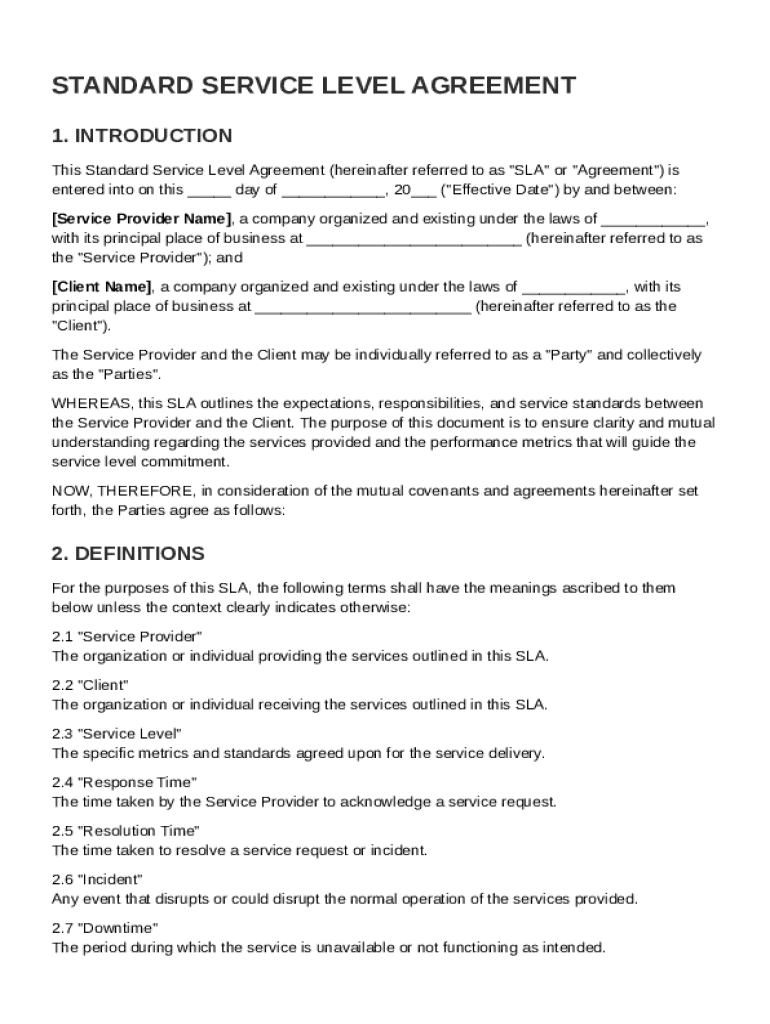







Definition and Meaning of the Standard Service Level Agreement Template
The Standard Service Level Agreement (SLA) Template serves as a crucial document between a Service Provider and a Client, outlining the terms and conditions regarding service expectations, responsibilities, performance metrics, and incident management. It commonly includes definitions of key terms such as service levels, response times, and resolution times, while also detailing the scope of services provided. This template is typically utilized to ensure both parties clearly understand their roles, obligations, and expectations in the service relationship.
Key Features of the Standard SLA Template
- Service Levels: Specifies the standards for minimum acceptable performance.
- Response and Resolution Times: Details how quickly issues should be addressed and resolved.
- Scope of Services: Defines the specific services to be delivered.
Practical Scenarios
Service Providers often use this template in customer service or technical support contexts to manage the client's expectations and ensure consistent service delivery. For example, an IT service provider might use an SLA to guarantee network uptime or response time for technical support requests.
Key Elements of the Standard Service Level Agreement Template
A comprehensive Standard Service Level Agreement Template includes several key sections designed to protect the interests of both parties and ensure clarity in the service relationship.
Primary Components
- Roles and Responsibilities: Clearly defines duties for both the Service Provider and Client.
- Performance Measurement: Outlines methods and metrics for assessing service delivery.
- Incident Reporting Procedures: Establishes standardized processes for reporting and addressing service disruptions.
Detailed Breakdown
- Penalties for Non-Compliance: Specifies consequences if service levels are not met, such as financial penalties.
- Termination Conditions: Details situations under which the agreement can be terminated by either party.
How to Use the Standard Service Level Agreement Template
Proper use of the Standard SLA Template involves several important steps to ensure it effectively addresses the needs of the parties involved.
Steps to Implement
- Customization: Tailor the template to the specific services and expectations of both parties.
- Review and Approve: Both parties should thoroughly review the document, making any necessary adjustments.
- Sign and Store: Once finalized, the document should be signed by authorized representatives and securely stored for reference.
Common Use Cases
- IT Services: To outline software support, hardware maintenance, or network management terms.
- Customer Support: Define response times and support availability for client inquiries or complaints.
Important Terms Related to the Standard Service Level Agreement Template
Understanding the terminology used in SLAs is essential for ensuring clear communication and setting accurate expectations between the Service Provider and Client.
Key Terms to Know
- Service Credit: A penalty or compensation offered when the provider fails to meet the agreed-upon service levels.
- Force Majeure: A clause that frees both parties from liability or obligation when an extraordinary event prevents one or both parties from fulfilling their contract obligations.
- Escalation Procedures: Processes for raising unresolved issues to higher authority levels within the organization.
Examples of Use
For instance, if a server outage occurs, the SLA might specify a service credit to the client for the downtime, and the escalation procedures would dictate how the issue is elevated within the service provider’s hierarchy.
Legal Use of the Standard Service Level Agreement Template
Legal considerations are an essential aspect of any SLA to protect the rights of both parties and provide remediation avenues in case of disputes.
Compliance and Obligations
- Confidentiality Obligations: Ensures that sensitive information shared between the parties is not disclosed to unauthorized entities.
- Limitations of Liability: Caps the liability of either party under specific circumstances, often excluding cases of gross negligence or fraud.
- General Provisions: Governs the overall interpretation of the agreement, including legal jurisdiction and choice of law.
Legal Scenarios
These considerations are crucial in sectors like healthcare and finance, where both federal regulations and consumer protection laws necessitate stringent confidentiality and data protection standards.
Examples of Using the Standard Service Level Agreement Template
Real-world examples provide clarity on how the Standard SLA Template can be effectively applied across different industries.
Industry-Specific Applications
- Telecommunications: SLAs might define network availability and technical support response times.
- Software as a Service (SaaS): Outlines the uptime guarantees, backup provisions, and support service levels for subscribers.
Case Studies
A telecommunications company used an SLA to meet customer demand for reliable services by defining uptime guarantees and establishing penalties for service interruptions, effectively improving customer satisfaction and retention.
State-Specific Rules and Differences for the Standard Service Level Agreement Template
State-specific legal and regulatory requirements can affect how SLAs are drafted and enforced across different jurisdictions in the United States.
Considerations by State
- Service Delivery: Some states may have distinct rules about the allowable time frames for service delivery.
- Consumer Protection: Certain states enforce stricter penalties for non-compliance or deceptive practices.
Variations in Implementation
For example, California may mandate more robust consumer protection clauses to cover tech-related services, compared to other states where telecommunications might face more scrutiny.
Software Compatibility and Integration with the Standard Service Level Agreement Template
Modern digital environments require SLAs to be accessible and editable using various software tools, supporting seamless integration into existing workflows.
Relevant Software
- Editing Platforms: Tools like DocHub support creating, editing, and sharing SLAs in document formats like PDF, DOC, and more.
- Cloud Storage Integration: Compatibility with services like Google Drive and Dropbox allows easy document management and collaboration.
Integration Benefits
The flexibility to use and modify SLAs through software platforms supports real-time collaboration and streamlines the negotiation process while ensuring secure document management features.




